Affiliate Program Incrementality Test: 7 Steps for Brands
An affiliate program incrementality test separates lift from attributed sales. Use seven steps for an affiliate placement test and choose what to scale.
On this page (8)

Who Should Promote This Affiliate Program?
An affiliate program incrementality test estimates whether a placement or partner caused additional business beyond the sales that would have happened anyway. Affiliate attribution can record a valid referral while still overstating how much new demand the activity created.
Start with one commercial question, a credible comparison group, and a decision rule written before launch. The seven steps below turn that into a test plan for paid placements, partner holdouts, or a change in offer terms.
Quick Answer
Measure the difference between a defined treatment and a credible control, then compare the incremental contribution with the full cost of the placement. Keep the partner, offer, landing page, tracking, and measurement window stable enough to interpret the result. A click or attributed order alone is not evidence of incremental lift.

The Seven Steps
1. Write the decision question
State the decision the test will inform. For example: “Should we renew this paid placement at the proposed price?” is easier to answer than “Does affiliate marketing work?” A single question keeps the test focused on a decision rather than collecting numbers without a next action. A well-scoped affiliate program incrementality test names one intervention and one decision.
Name the partner, placement, audience, dates, and alternatives. A placement test asks whether a particular promotion added value. An offer test asks whether a discount, commission, or message changed results. Awin's guide to testing for incrementality discusses these different test types and the role of partner holdouts.
2. Choose an outcome and a decision threshold
Select one primary outcome before looking at results. For a paid placement, incremental contribution profit is often more useful than attributed revenue because it accounts for margin, commission, discount, and the placement fee. If profit data is unavailable, document the proxy you will use and its limits.
Set the smallest lift that would change your decision. For example, decide in advance that a renewal needs to recover its placement fee and exceed a chosen contribution threshold. Also choose a guardrail, such as refund rate, discount cost, or new-customer share. A decision threshold prevents a small, noisy increase from being treated as a win after the fact.
3. Build a credible control group
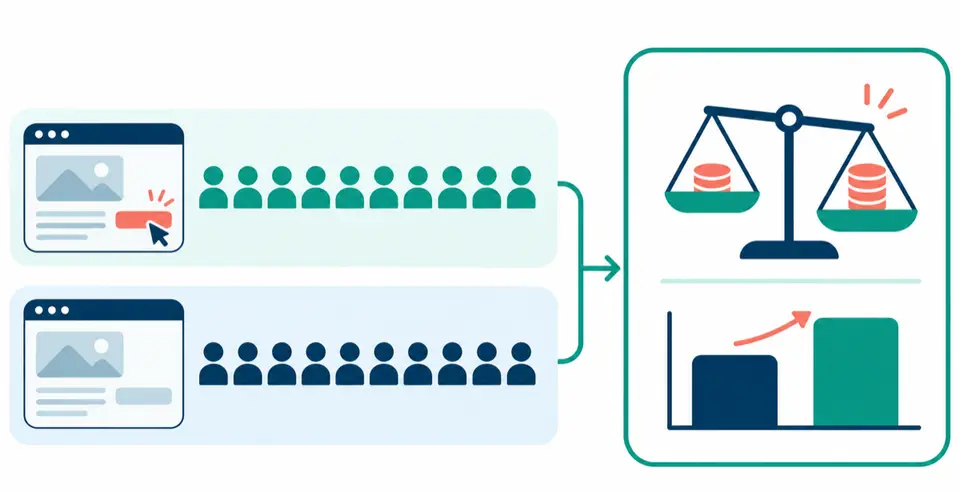
Choose the strongest comparison available for the partner and audience. A randomized holdout among eligible users can reduce selection bias. If that is not feasible, compare carefully matched audiences, geographies, or partners with similar prior performance, and label the design as observational rather than randomized.
The IAB guidance for incremental measurement in commerce media emphasizes credible counterfactuals and accounting for bias. A simple before-and-after comparison is weak when seasonality, brand campaigns, stock levels, or the partner's audience changed at the same time. Write down why the control should approximate what would have happened without the placement.
4. Change one main variable
Decide whether the treatment is a paid placement, a discount, a commission change, or another specific intervention. Keep other conditions as consistent as possible across treatment and control. If the placement and discount both change, a result may show that the package worked but cannot reveal which part caused the lift.
Write down the exposure rules, start and end dates, attribution settings, landing page, and any exclusions. Agree with the partner how they will implement the placement and what proof they can provide. These details reduce the risk that a tracking change or an unplanned promotion becomes the real treatment.
5. Gather the inputs before launch
Capture a baseline for both groups using the same definitions. At minimum, collect eligible audience size, impressions or exposure, clicks, conversions, order value, returns, commission, discount, placement fee, and contribution margin where available. Record new and returning customer mix if that distinction affects the decision.
Check attribution and analytics before the test starts. Confirm that links, campaign parameters, conversion events, and partner reporting refer to the same dates and sales. A tracking discrepancy can create a false difference between groups. If the program platform reports attributed orders but your finance system holds net sales or margin, define how you will reconcile them before reading results.
6. Set a duration that covers the buying cycle
Run the test long enough to include the normal delay between exposure and purchase, plus a suitable return or cancellation window if your outcome depends on settled orders. A few days can be too short for products with a long consideration cycle. At the same time, extending the test through a major sale or inventory disruption can make the groups less comparable.
Set the sample or calendar duration in advance and do not stop early because the first few days look favorable. Note holidays, price changes, email campaigns, stock outages, and other traffic that could affect results. If the available audience is small, report that the test is inconclusive when evidence is too weak instead of labeling a directional result as proof.
7. Calculate lift and decide what happens next
Compare the treatment outcome with the control using the method chosen before launch. Report the absolute difference, relative lift if useful, incremental contribution, total costs, and uncertainty. Keep the raw attributed result visible, but separate it from the estimated incremental result so stakeholders do not confuse the two.
Use the pre-agreed threshold to renew, renegotiate, change the placement, or stop. If the result is positive but uncertain, repeat the test with a stronger control or a longer window. If you change the placement or offer, treat the next version as a new test. A clear record of the decision makes future partner negotiations more evidence-based.
A Compact Test Plan to Save Before Launch
| Plan field | Write down before the test | Why it matters |
|---|---|---|
| Question | The placement or offer decision | Prevents a vague test objective |
| Treatment and control | Exact exposure and comparison rules | Defines the counterfactual |
| Primary outcome | Contribution, new customers, or another measure | Separates business value from attribution |
| Costs and guardrails | Placement fee, commission, discount, refunds | Captures the full economics |
| Duration | Exposure dates and conversion lag | Limits early stopping and timing bias |
| Decision threshold | Minimum lift and next action | Keeps the result tied to a decision |
Tools, Attribution, and Incrementality
Affiliate software can record referrals, commissions, and campaign activity, but tracking does not by itself show what would have happened without exposure. If you are comparing platforms, the FindAffiliates listings for Rewardful, FirstPromoter, and Tapfiliate can help you research their partner programs and product context. Evaluate the measurement features directly with each vendor.
For the financial side of a placement decision, use the paid placement cost allocation worksheet. After a test, the affiliate campaign postmortem template can capture what changed and what to do next. Keep the outcome definitions aligned with the affiliate program KPI guide for SaaS, especially when multiple teams use the same dashboard.
Common Design Mistakes
Calling attributed revenue “incremental” is the most common mistake. Attribution describes how a system assigned credit under its rules; incrementality estimates the difference caused by an intervention. Report both measures with separate labels.
Other risks include using different offers for the treatment and control, changing several conditions at once, choosing a comparison group after seeing the results, and ignoring refunds or placement costs. If you cannot build a credible control, describe the analysis as directional. A transparent limitation is more useful than a strong causal claim the design cannot support.
Key Takeaways for Affiliate Program Incrementality Test: 7 Steps for Brands
An affiliate program incrementality test starts with a decision, a control that approximates the counterfactual, and a business outcome that includes the costs of the activity. Agree on the design before a placement runs, then report attributed and incremental results separately.
Use the evidence to renew, renegotiate, redesign, or stop. If the control or sample is too weak, record the result as inconclusive and improve the next test instead of treating a tracking report as proof of lift. Find more program-owner resources on FindAffiliates.
FAQ
What is an affiliate program incrementality test?
It is a comparison designed to estimate whether an affiliate activity caused additional outcomes beyond what a credible control group would have produced without it. The result depends on the quality of the control and the outcome definition.
How do you measure affiliate placement incrementality?
Compare a defined treatment with a credible control, then calculate the difference in a preselected outcome such as incremental contribution profit. Include commission, discount, returns, and placement fees where possible.
Is affiliate attribution the same as incremental sales?
No. Attribution assigns credit under a platform's tracking rules. Incrementality estimates additional sales or profit caused by a placement or offer compared with a counterfactual.
How long should an affiliate incrementality test run?
Run it long enough to cover the normal exposure-to-purchase delay and any relevant return window. Choose the duration before launch, and account for seasonality, stock changes, and other campaigns that can affect the groups.