How to Choose Affiliate Products: 8-Point Scorecard
Use this affiliate product selection scorecard to assess audience fit, proof, availability, alternatives, and program terms before promoting an item.
On this page (12)
What Should You Compare Before Choosing?
How to choose affiliate products is a product decision first and a commission decision second. Start with a real question your audience has, then decide whether a specific item solves it well enough to recommend. A high payout cannot make a confusing, unreliable, or unsuitable product useful to your reader.
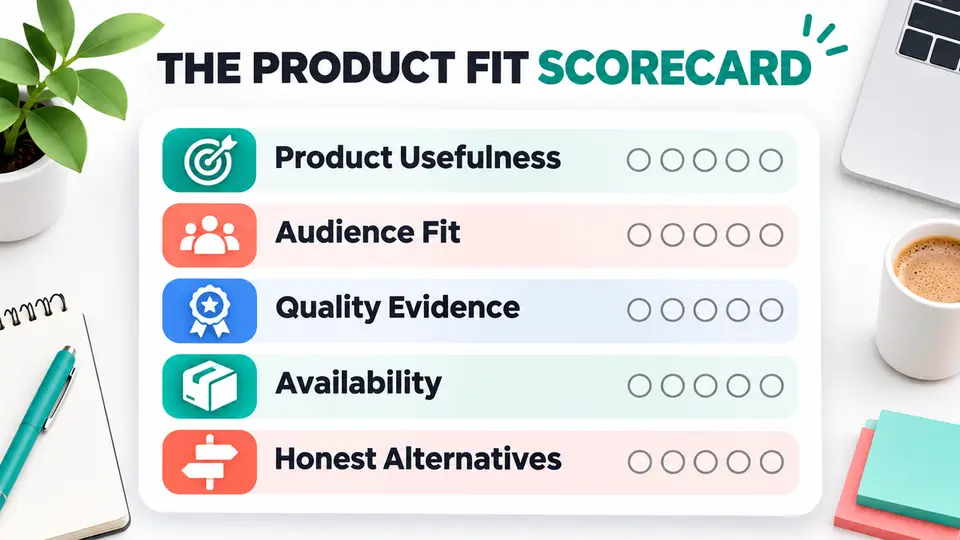
Quick answer: Score each candidate on audience need, evidence, product quality, availability, price, alternatives, content usefulness, and promotion fit. Give each check zero, one, or two points. This score is an editorial filter, not an earnings forecast or industry benchmark. Any safety, accuracy, or audience-fit concern can stop a recommendation regardless of its total.
| Check | 0 points | 1 point | 2 points |
|---|---|---|---|
| Reader need | No clear use case | Occasional fit | Direct, repeated reader need |
| Evidence | No reliable basis | Limited or indirect | Useful product evidence available |
| Quality | Serious unresolved concern | Mixed or unclear | Benefits and limits can be explained |
| Availability | Hard to buy or maintain | Market limits need checking | Access and stock are clear |
| Price | Poor value is evident | Value depends on reader | Cost fits a specific use case |
| Alternatives | No fair comparison | Some options differ | Readers can compare meaningful choices |
| Content value | Link-only recommendation | A narrow mention | Useful demonstration or decision guide |
| Promotion fit | Terms block the use | Important terms are unknown | Current terms allow your channel |
The scorecard helps answer whether a product deserves a place in your content. The separate guide to choosing affiliate programs and affiliate program research checklist cover offer discovery and terms review in more depth.
---
1. Start with a reader's specific job
Write the reader's task as a sentence before opening a catalog. “Choose a laptop for travel editing” is a usable job. “Find a good product” is not. A specific task gives you a way to judge fit, describe tradeoffs, and decide which product details matter. This turns the broad question of how to choose affiliate products into a task you can assess.
Look for evidence in questions readers already ask, support requests, search queries, comments, product reviews, or your own audience research. Do not treat one search trend as proof that a recommendation will sell. Google's Trends documentation explains that its interest values are normalized for comparison, not absolute search volume. Use trends as one signal alongside audience evidence and the actual problem the product solves.
Give the candidate zero points if you cannot name a reader and a task without using the product's marketing copy. Give one point if the need is plausible but based on limited evidence. Give two points when the task appears repeatedly and you can describe the decision a reader needs to make.
---
2. Check what evidence you can gather
Decide what you can honestly verify: hands-on use, a demonstration, product specifications, independent tests, customer support, or a clear set of public limitations. The evidence should match the claim. A feature list may support a feature description, but it does not prove that the product is easy to use or worth its price for every audience.
If you have used the product, describe what you tested, how long you used it, and what you did not test. If you have not, say that the article is based on public documentation or a comparison of published terms. Keep vendor claims attributed to the vendor. Never turn a product page into a personal endorsement.
Program review standards vary. Check the current criteria for your own account and market, and do not assume that a commission listing proves acceptance. The editorial principle is broader: publish evidence that helps readers decide, not a collection of claims that could be copied from a product page.
---
3. Look for quality problems and important limits
Check whether the product works as described and whether any limit changes who should buy it. Depending on the category, that may include compatibility, durability, accessibility, privacy, customer support, cancellation, ingredient information, or a requirement to buy another device or service.
Do not make safety, health, income, or performance claims beyond the evidence you have. A product may be appropriate for one reader and a poor choice for another. State the conditions that matter, such as a supported device, a location, a skill level, or a recurring fee.
Give zero points if a serious question remains that could make your recommendation misleading or harmful. One point means the product may be suitable but needs more verification. Two points means you can explain both its useful qualities and the limits a reader should weigh.
---
4. Confirm access, availability, and upkeep
A product is not a good recommendation if your audience cannot get it. Check the countries served, supported devices, current stock, delivery limits, language or format options, and whether the product is still being maintained. For software, look at platform support and product changes. For physical goods, note shipping regions and return conditions.
Some offers change faster than evergreen content can. If a product's price, availability, or compatibility changes often, estimate the work required to keep the page accurate. A product that fits today may need a review before every major shopping season or release.
Score the product based on the reader's real access. If availability is uncertain, write the uncertainty plainly and do not imply that every reader can buy the item. If you cannot find a viable market for your audience, pause the recommendation.
---
5. Compare price with the outcome the reader needs
Price should be judged against the job, not against a commission percentage. Compare the full cost, including subscription renewals, accessories, shipping, taxes, fees, and required upgrades. A low starting price can become a more expensive commitment if the feature the reader needs is on a higher tier.
Explain who may find the price worthwhile and who may prefer a lower-cost option. Avoid claims such as “best value” unless you define the use case and show what you compared. A useful recommendation can include a product that is not the most expensive, especially when it meets the reader's task with fewer tradeoffs.
Give two points when you can explain the cost and the practical outcome with current evidence. Give one point when the value depends on reader preferences or a changing price. Give zero if the cost is unclear or the recommendation depends on a saving claim you cannot verify.
---
6. Identify alternatives that solve the same problem
A fair comparison tells readers what else could meet the same need. Alternatives might be a lower-cost model, a different product type, a free tool, or no purchase. They do not need to be affiliate offers. Include the differences that affect the decision, such as learning curve, portability, supported region, service fees, or the time required to use the product.
Do not add alternatives just to create a longer list. If another product serves a different task, explain that distinction. Your article should help the reader choose among realistic options, even when the best answer is to wait or use what they already own.
For example, a creator comparing an online course platform can browse the Teachable affiliate program listing as one route to discover software, then assess the actual course product and learner need separately. The Kit affiliate program and Shopify affiliate program are other examples of directory listings, not automatic product endorsements.
---
7. Decide whether you can make useful content about it
A product should give you something helpful to explain: an original demonstration, a comparison, a setup guide, a limitation, or an answer to a recurring question. If the only content angle is “buy this,” the recommendation may not help the reader make a decision.
Think about the format that fits the evidence. A video can show a setup process. A written guide can compare terms or compatibility. A newsletter can explain a tested use case to readers who asked for it. If you cannot add useful context, do not create a thin page just to place an affiliate link.
Program acceptance rules differ. Before investing in a product, confirm the current criteria for your account and market. A stronger editorial page gives the reader a reason to trust the recommendation even if the affiliate link is removed.
---
8. Check the affiliate terms after the product passes
Only after the product earns an editorial place should you decide whether its affiliate program fits your channel. When deciding how to choose affiliate products, use these checks before you look at payout. Confirm the approved product, qualifying event, commission basis, attribution window, eligible countries, traffic rules, return treatment, and payment conditions. A product can be worth recommending even when no affiliate program is available. The existence of a program does not make a weak product a good choice.
Keep the content and commercial relationship separate. The Federal Trade Commission says creators should disclose a material connection clearly and conspicuously. Put the disclosure where a reader will see it near the recommendation, and follow the current law and platform rules that apply to your audience.
For a worked example of what a product review should include, use the affiliate product review template. If the product passes your editorial checks, compare the offer terms with the FindAffiliates directory and confirm them with the program before publishing.
Use the score as a decision aid, not a forecast
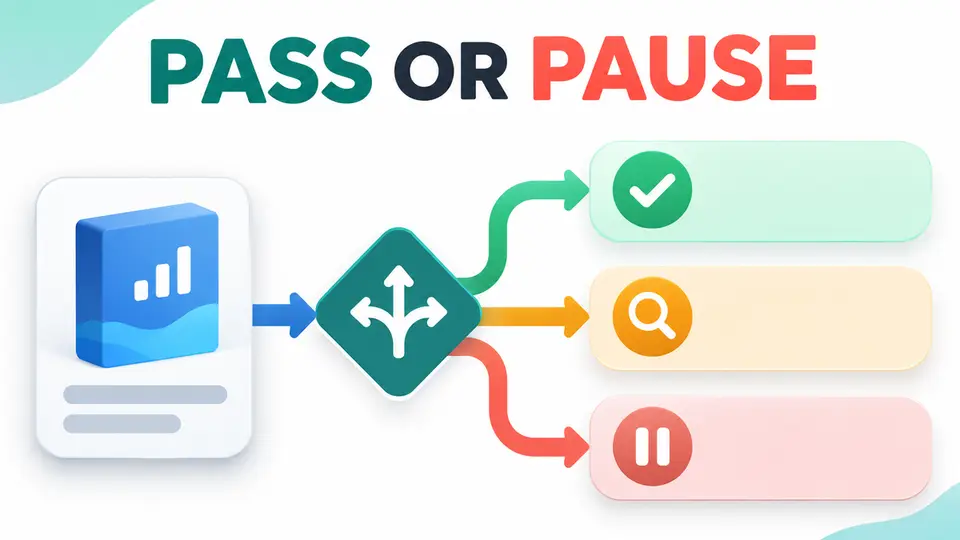
Add the eight scores for a maximum of 16 points. As an editorial rule of thumb, a strong score can justify more research, a middle score calls for evidence or comparison, and a low score suggests pausing. These cutoffs are a workflow aid created for this guide, not a validated conversion formula.
Any serious product concern overrides the total. Do not recommend an item with an unresolved safety issue, a misleading claim, an audience mismatch, or no realistic way for your readers to access it. If a missing fact can be checked, keep the item in research. If it cannot be verified, choose a better-supported alternative.
---
| Result | Editorial next step |
|---|---|
| Strong evidence and clear fit | Prepare a useful review, comparison, or demonstration |
| Some promise with missing facts | Ask the seller or gather more evidence |
| Unclear value or weak access | Compare a realistic alternative |
| Material safety, accuracy, or fit concern | Do not recommend until resolved |
---
Key Takeaways for How to Choose Affiliate Products: 8-Point Scorecard
How to choose affiliate products comes down to whether an item fits a real audience need, whether you can support the claims, and whether readers can make an informed decision from your content. Use the scorecard to keep product quality ahead of payout, then review the affiliate terms as a separate final gate. Browse the FindAffiliates directory after you have a product category and reader in mind.
---
FAQ
Should I choose an affiliate product because it has a high commission?
No. Evaluate the product's usefulness, quality, fit, and evidence first. Commission is a later commercial consideration, and it does not prove that a product will convert or serve the reader.
How many points should a product score before I promote it?
This guide's eight checks are an editorial aid, not a universal benchmark. A strong score can justify more research, but a serious concern about safety, accuracy, audience fit, or access should stop a recommendation regardless of the total.
Do I need to buy every product I recommend?
Not every content format requires a purchase, but you must be clear about what you personally tested and what comes from public sources. Never imply hands-on experience you do not have.
What should I compare before adding an affiliate link?
Check that the product solves the reader's task, that your claims have evidence, that the audience can access it, that alternatives are described fairly, and that the affiliate terms permit your channel and region.