Affiliate Program Research Checklist for Beginners
Use this affiliate program research checklist to vet payouts, cookie windows, source confidence, audience fit, and promotion risk before applying.
Who Should Promote This Affiliate Program?
An affiliate program research checklist helps beginners avoid the most common mistake in affiliate marketing: joining a program because the commission looks attractive before checking whether the offer fits the audience, the source is current, and the terms are safe to promote.
The short version is simple. Research the program source, payout model, cookie window, allowed traffic sources, audience fit, conversion path, and proof you can show in content before you apply or publish a recommendation.
Use this guide as a repeatable checklist before adding any program to a review, comparison, newsletter, YouTube description, resource page, or affiliate roundup.
Quick Answer
The best affiliate program research checklist starts with proof, not payout. Confirm the program is live, verify the commission and cookie window from an official or current listing, check whether your traffic source is allowed, then decide whether the product solves a real problem for your audience.
| Research step | What to check | Why it matters |
|---|---|---|
| Source confidence | Official affiliate page, current listing, or partner dashboard note | Prevents outdated commission claims |
| Audience fit | Reader problem, budget, intent, and trust level | Improves conversion quality |
| Terms | Commission, cookie, payout timing, approval rules | Sets realistic earnings expectations |
| Promotion risk | Disclosure, traffic rules, brand bidding, coupon rules | Avoids rejected commissions |
| Content angle | Review, comparison, tutorial, template, or roundup | Helps the link earn clicks naturally |
This is different from simply searching for the highest commission. A program with a smaller payout can outperform a large payout when the buyer intent is stronger and the product is easier to explain.
Start With Source Confidence
The first item in any affiliate program research checklist is source confidence. Before you write a claim, ask where the claim came from and whether a reader could verify it.
Good sources include the official affiliate page, current partner documentation, a live FindAffiliates program listing, or a dashboard note from the program owner. For example, if you are reviewing the Shopify affiliate program, compare the FindAffiliates listing with the official Shopify affiliates page before using payout or eligibility language.
Do the same for software programs with changing terms. If a program like the Semrush affiliate program has a public official page, use that page near factual claims and avoid repeating old numbers from screenshots or forum comments.
Source confidence checklist
- Is the affiliate program still accepting partners?
- Is there a current official page or trusted listing?
- Are commission, cookie, and payout details visible?
- Does the program mention traffic source limits?
- Are there recent signs that the product still serves the audience you plan to reach?
If any answer is unclear, mark it as unavailable in the draft. Do not fill gaps with guesses.
Check Audience Fit Before Payout
Audience fit is the second checkpoint because affiliate income comes from trust and intent, not from a commission table alone.
Start with the reader job. A blogger comparing SEO tools might care about keyword research, content planning, and monthly software costs. A creator choosing ecommerce software might care about store setup, payments, themes, and whether the audience is ready to sell products. Those are different buying moments.
The Fiverr affiliate program can fit creators writing about freelance services, startup hiring, logo design, or task outsourcing. The Kit affiliate program fits creators who teach email list building, newsletter growth, and creator business workflows. The better program is the one your audience can understand and act on.
Audience fit questions
- What problem does the reader have right now?
- Is the product a direct solution or only a loose adjacent tool?
- Would the reader need this product before or after another step?
- Can you show a real workflow, example, or comparison?
- Would you still recommend the product if the commission changed?
That last question is useful. If the answer is no, the article may be built around payout instead of reader value.
Verify The Money Details
Once the source and audience fit are clear, review the money details. For beginners, this means four fields: commission model, cookie window, payout timing, and approval risk.
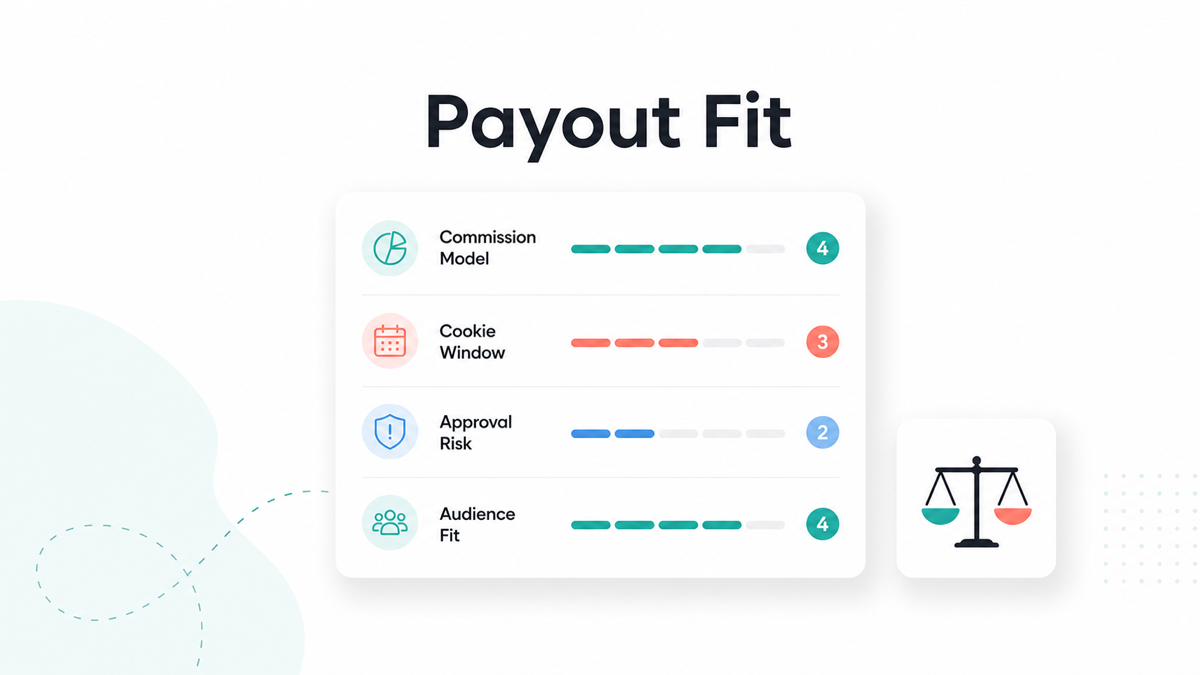
| Field | What to record | How to use it in content |
|---|---|---|
| Commission model | Flat fee, recurring percentage, first-month payout, or tiered reward | Explain how the affiliate gets paid |
| Cookie window | Attribution period if public | Show how long referral tracking may last |
| Payout timing | Monthly, threshold-based, manual, or unavailable | Set expectations for cash flow |
| Approval risk | Manual review, invite-only, product fit, traffic rules | Help readers decide whether to apply now |
The Kinsta affiliate program is a good example of why this matters. Kinsta's official affiliate page explains its payout structure and cookie window, so it gives affiliates more confidence than a program page with no visible terms. That does not make it right for every audience, but it makes the recommendation easier to support.
If a program does not show a cookie window or payout timing publicly, say that the data is unavailable. This is better for SEO and trust than inventing a number.
Review Traffic Rules And Disclosure Fit
A beginner can find a strong program, write useful content, and still lose commissions if the traffic source or disclosure approach breaks the rules.
Check whether the program allows SEO content, coupon content, email promotion, paid search, paid social, YouTube, TikTok, Pinterest, or direct linking. Some programs welcome broad content affiliates. Others restrict brand bidding, coupon sites, trademark use, or certain ad placements.
Disclosure is part of the research process too. If your content includes affiliate links, the disclosure should be close enough to the link that a reader sees it before acting. That affects blog posts, resource pages, newsletter recommendations, video descriptions, and social captions.
For more selection context, read how to find affiliate programs and how to choose affiliate programs. Those guides cover discovery paths and quality filters before this checklist turns the research into a repeatable review process.
Build A Content Angle Before Applying
The best time to decide your content angle is before you apply. Programs often want to know where traffic will come from and why your audience is a fit.
Choose one primary angle:
- Review: best when you can explain product fit and limitations.
- Comparison: best when readers are deciding between two tools.
- Tutorial: best when the product is part of a workflow.
- Listicle: best when you can compare several verified programs in one category.
- Template or checklist: best when readers need a repeatable decision process.
For example, the best affiliate programs for beginners works because it compares programs by beginner fit, not just payout. A narrower post like software affiliate programs for bloggers works because it matches the programs to a specific publishing workflow.
Use the checklist to decide whether your angle has enough proof. If you cannot explain who should promote the product, what terms are verified, and how the reader should use it, keep researching.
Common Research Mistakes
The biggest mistake is copying another site's commission table without checking the source. Affiliate programs change terms, move networks, pause applications, and remove public details.
The second mistake is ignoring approval requirements. A program can be excellent, but if it needs a business email, existing audience, quality content library, or manual review, a beginner should know that before applying.
The third mistake is treating all programs in a niche as equal. A recurring SaaS program, a marketplace program, and a one-time ecommerce program can all fit the same site, but they need different content and expectations.
The fourth mistake is using weak internal links. Strong affiliate content should point readers to related guides, such as best recurring affiliate programs, and to the exact program pages being discussed.
Final Checklist
Before you publish or apply, run this final pass:
| Question | Pass condition |
|---|---|
| Is the program live? | The program page or official source is available now |
| Are the terms verified? | Commission and cookie are sourced or marked unavailable |
| Is the audience fit clear? | You can name the reader problem and buying stage |
| Are traffic rules acceptable? | Your planned channel is allowed or not restricted publicly |
| Is disclosure easy? | You can place clear disclosure before the affiliate link |
| Is the content angle useful? | The post helps readers decide, compare, or act |
If a program passes the checklist, it is ready for a draft, review, or comparison. If it fails, either choose a different program or explain the uncertainty in the article.
Key Takeaways for Affiliate Program Research Checklist for Beginners
An affiliate program research checklist protects both sides of the recommendation. It helps beginners avoid outdated payout claims, mismatched offers, weak traffic-source assumptions, and content that only exists because a commission looked high.
Start with source confidence, match the program to reader intent, verify the money details, check traffic rules, and pick a content angle that makes the product easier to evaluate. When you need more programs to test against the checklist, browse the FindAffiliates directory and compare live program pages before writing.
FAQ
What should beginners check before joining an affiliate program?
Beginners should check whether the program is live, what commission model is public, whether a cookie window is listed, how payouts work, what traffic sources are allowed, and whether the product solves a real problem for their audience.
How do I know if an affiliate program is trustworthy?
A trustworthy affiliate program has current source information, clear terms, a real product page, reasonable application expectations, and a promotion path that matches your audience. If key terms are missing, mark them as unavailable instead of guessing.
Should I choose the affiliate program with the highest commission?
Not always. A lower commission program can earn more if it fits your audience better, converts more easily, has clearer terms, and supports content you can explain with confidence.
What is the easiest way to research affiliate programs?
Use a directory, official affiliate pages, and related comparison posts together. Start with discovery, shortlist programs by audience fit, verify the terms, then build a simple table before applying or publishing.