How to Calculate Affiliate Program ROI for SaaS Teams
Calculate affiliate program ROI for SaaS with a gross-profit formula, cost checklist, worked example, break-even test, and attribution caveats.
Who Should Promote This Affiliate Program?
Affiliate program ROI is the gross profit from referred customers, after the program's full cost, divided by that program cost. For SaaS teams, the calculation should use a consistent customer cohort and a fixed measurement window. Counting attributed subscription revenue as if it were profit can make an unprofitable program look successful.
Use this formula:
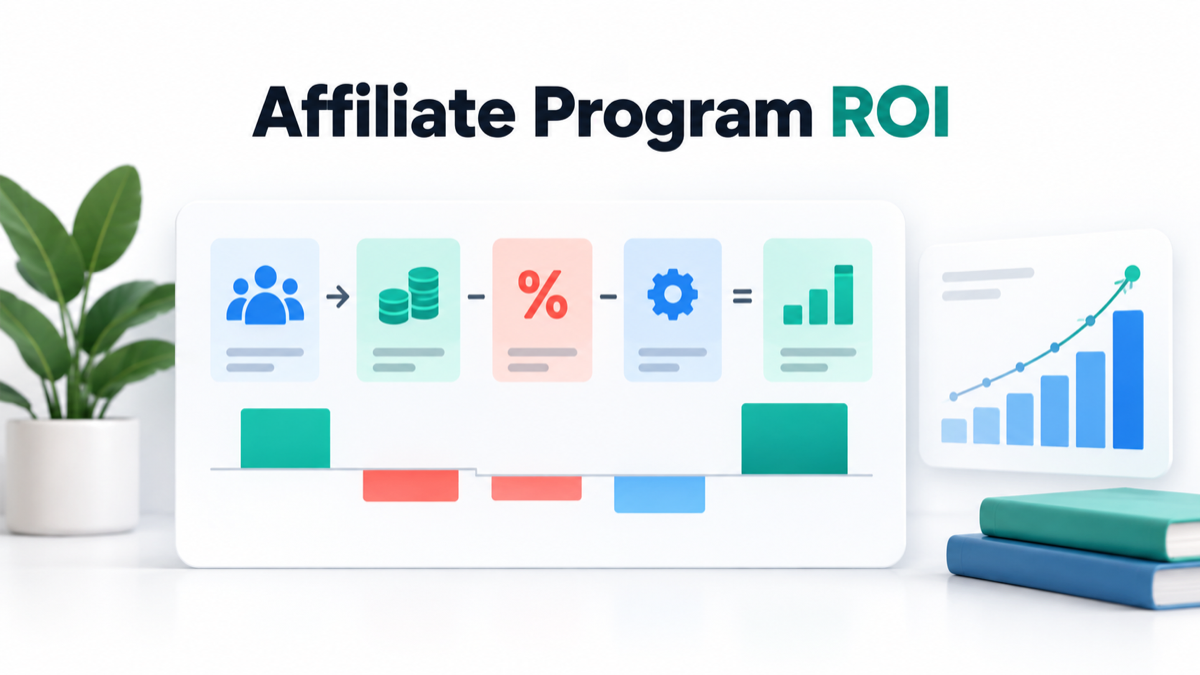
Affiliate program ROI = (referred-customer gross profit − total affiliate program cost) ÷ total affiliate program cost
For example, if a defined cohort produces $16,000 in gross profit and the affiliate program costs $8,000, ROI is 100%. That means the program returned $1 in profit for each $1 spent after recovering its cost. It does not prove affiliates caused every attributed sale; attribution and incrementality are separate questions.
Quick formula and inputs
| Input | Include | Keep separate |
|---|---|---|
| Referred-customer gross profit | Revenue in the cohort minus direct cost to serve those customers | Do not call revenue profit |
| Commission cost | Approved commissions, less valid reversals and refunds | Match the earning period to the cohort |
| Platform and payment cost | Affiliate software, tracking, and payout fees | Avoid counting fees twice |
| Operating cost | Allocated partner management, recruiting, and creative support | Use a documented allocation method |
| ROI | (Gross profit minus all program cost) divided by all program cost | Report the cohort window and attribution method |

Step 1: Define the cohort and time window
Before exporting numbers, decide which referrals belong in the calculation and how long each customer is observed. A useful cohort could include customers whose first paid subscription began in July through September and whose original qualifying touchpoint was an approved affiliate referral. Use the same inclusion rules for revenue, cost of service, commissions, and program expense.
Choose a window long enough to capture the revenue you expect to evaluate, such as the first 12 months after each customer's start date. Do not compare a three-month revenue window with a full-year commission total, or a mature customer cohort with a still-growing expense period. SaaS contracts renew at different times, so show both the customer start period and the observation cutoff.
For a new program, many subscriptions will be immature. Label the result as provisional, report months observed, and avoid treating expected renewals as realized profit. If you model future renewals, present a separate forecast with its retention assumptions. Do not silently blend forecast revenue with observed results.
Step 2: Calculate gross profit, not subscription revenue
Start with revenue recognized from the referred customer cohort during the chosen window. Then subtract the direct costs that rise when you serve those customers. Depending on the SaaS business, these can include hosting, payment processing, support usage, onboarding services, or third-party usage charges. Finance should determine which costs belong in gross profit under the company's reporting method. Stripe's SaaS gross margin guide explains why gross margin matters when judging subscription economics.
Use one method across channels. If payment processing is already included in direct cost to serve, do not add it a second time as an affiliate program expense. If a cost is fixed and would exist without any affiliate customers, decide whether to exclude it from cohort contribution or allocate it consistently. Record that choice so the next review is comparable.
Discounts, refunds, chargebacks, free months, and mid-cycle cancellations can change revenue. Use net recognized revenue for the period rather than list price or the initial contract value. If annual prepayment creates cash before service delivery, do not mistake cash collection for the same period's gross profit.
A compact gross-profit calculation
Suppose 20 new customers each generate $1,000 of recognized revenue in their first 12 months. If direct costs to serve those customers total $200 per customer, the cohort produces:
- Revenue: 20 × $1,000 = $20,000
- Direct costs: 20 × $200 = $4,000
- Gross profit: $20,000 − $4,000 = $16,000
These are illustrative assumptions, not a SaaS benchmark. Substitute your own cohort data and finance-approved direct cost definition.
Step 3: Add the full cost of the program
Program cost includes more than the commission rate. Add commissions earned on qualifying referrals, tracking or affiliate platform fees, payout fees, and a reasonable share of the team's operating time. If the company funded partner content, samples, bonuses, or recruitment campaigns for the cohort, include those costs when they would not otherwise have been incurred.
Use the cost period that matches your cohort. For commissions, account for approved earnings and later reversals according to your finance policy. Do not count rejected or pending transactions as final expense. For a monthly platform fee, define whether you use the full amount, an affiliate-specific share, or an allocation based on active channels. Apply the same method when comparing paid search, sponsorships, or other acquisition programs.
| Cost item | Example treatment |
|---|---|
| Affiliate commissions | Include earned amounts attributable to the cohort, net of approved reversals |
| Software subscription | Include the affiliate-specific fee or a consistent allocation |
| Payout fees | Include transaction costs not already counted elsewhere |
| Partner management | Allocate documented hours and loaded labor cost |
| Recruiting and creative | Include incremental spending tied to the program |
| Product delivery costs | Subtract once when calculating gross profit, not again as program cost |

The important control is to avoid double counting. Product cost to serve belongs in the gross profit step. Affiliate tracking fees and partner operations belong in the program cost step. A spreadsheet should show each category and its source, not hide the calculation in a single blended percentage.
Step 4: Calculate ROI and explain what it means
In the example, assume the program generated $16,000 of referred-customer gross profit. Commissions cost $4,000, software cost $1,000, and allocated partner operations cost $3,000. Total affiliate program cost is $8,000.
ROI = ($16,000 − $8,000) ÷ $8,000 = 1.0, or 100%
The cohort produced $8,000 more gross profit than the measured program cost. A 100% ROI is not a 100% margin, commission rate, or revenue share. State the measurement window, the costs included, and whether the calculation uses platform attribution or an incrementality estimate. A plain result without those notes can invite false comparisons.
It is also useful to report gross profit-to-cost as a separate multiple: $16,000 ÷ $8,000 = 2.0. That says $2 of gross profit was observed for each $1 of program cost. This is not the same as ROI, which subtracts cost in the numerator. SaaS teams should use gross profit when revenue alone ignores delivery costs, and state which costs and cohort window the calculation includes.
What if the program has a negative result?
Negative ROI does not identify the cause. The result could reflect a poor-fit offer, low-quality referrals, a short observation window, a generous commission, high operating cost, or missing conversion data. Break the report out by partner, acquisition date, plan, and maturity, while protecting small-sample privacy and keeping cohort definitions consistent.
If a small number of high-cost partners dominate the result, do not assume the whole channel should close. First check tracking, reversals, customer fit, and partner-level concentration. Then compare program costs with a realistic alternative channel on the same gross-profit and time-window basis.
Step 5: Find the break-even customer count
A break-even estimate turns the ROI result into a planning tool. Separate fixed costs from per-customer variable costs, then compare the gross profit contribution from one customer with that customer's commission.
In the example, software and allocated partner operations are fixed at $4,000. Each referred customer produces $800 in gross profit and incurs an assumed $200 in commission. Contribution after that variable commission is $600 per customer.
Break-even customers = fixed program cost ÷ (gross profit per customer − variable commission per customer)
So $4,000 ÷ ($800 − $200) = 6.67. Because a SaaS customer is not divisible, the program needs 7 customers to exceed break-even under these assumptions. At 7 customers, gross profit is $5,600, commissions are $1,400, and fixed costs are $4,000, leaving $200.
This is a simplified planning model. If commissions recur on renewal, plans have different margins, partners earn bonuses, or customers cancel at different rates, model those cases separately. The formula also fails if variable cost per customer equals or exceeds gross profit per customer, because extra customers would not cover fixed costs.
Step 6: Check attribution and incrementality
An affiliate platform can show which eligible link received credit under the program's attribution rules. That is an attribution-based result. It does not establish that the purchase would not have happened without the affiliate. A brand-search coupon, an existing customer referral, and a new audience discovery can all appear as attributed conversions while representing different incremental value. Impact.com's incrementality guidance explains why the last click alone can misstate partner contribution.
Start by checking tracking coverage, deduplication with other channels, referral timing, coupon use, self-referrals, and reversals. Where volume and data access allow, use a holdout, geographic comparison, or another credible experimental design to estimate incrementality. Keep this estimate separate from platform-attributed ROI and document the method. Affiliate attribution QA can help teams review the measurement setup before interpreting the result.
Do not increase commissions or recruit more partners based on a single top-line ROI figure. Use partner-level quality, contribution margin, retention, and incremental evidence together. For a broader view of platform fit, compare tools such as Rewardful, FirstPromoter, and PartnerStack, then confirm current product capabilities and pricing directly with each provider. The affiliate program research checklist can help teams record their offer comparison criteria.
Common mistakes to avoid
Using revenue in place of profit
Revenue ignores the cost of serving a customer. A subscription with heavy support or third-party usage can produce much less contribution than its contract value suggests. Calculate gross profit with finance's definition, then compare it against program cost.
Mixing time periods
A new cohort's first months are not comparable to a mature cohort's full year. Match customer age and cost periods, or label the comparison as provisional. Present retention forecasts separately from realized results.
Leaving out operating expenses
Recruiting, content support, platform fees, and partner management take resources. If those are omitted, the number measures a narrower commission-only return. Call it that if you need the partial view, and show all-in ROI alongside it.
Treating attribution as proof of lift
Platform credit is useful for settlement and reporting, but it does not by itself measure incremental customers. Keep attributed performance and causal lift separate until a valid experiment supports an incrementality claim.
Key Takeaways for How to Calculate Affiliate Program ROI for SaaS Teams
Calculate affiliate program ROI from cohort gross profit and full program cost over a defined time window. Add the break-even customer count, show attribution limits, and keep forecasts separate from observed results. This gives finance and partner teams a result they can reproduce and improve. Explore the FindAffiliates directory when comparing programs and tools for your next review.
FAQ
What is a good affiliate program ROI for SaaS?
There is no universal target that fits every SaaS company. Required return depends on gross margin, retention, payback expectations, acquisition alternatives, and the cost of managing partners. Set an internal target against the company's own unit economics and compare channels using the same profit definition and observation window.
Should affiliate ROI use revenue or gross profit?
Use gross profit when the goal is to understand value after the direct costs of serving referred customers. Revenue-only return can overstate economics, especially when support, hosting, or usage costs vary. If you show revenue-to-cost too, label it separately so no one mistakes it for profit ROI.
Which costs belong in affiliate program ROI?
Include earned commissions, relevant tracking and payout fees, platform cost, and a documented share of partner operations or incremental campaign spending. Subtract direct product delivery costs in the gross-profit calculation. Keep categories separate and avoid counting any expense twice.
How do I calculate break-even affiliate customers?
Divide fixed program cost by gross profit contribution per customer after variable commission. For example, if fixed cost is $4,000 and each customer contributes $600 after commission, break-even is 6.67, so 7 whole customers are needed to exceed it. Model different plans and recurring commissions separately.
Does affiliate attribution prove a partner caused the sale?
No. Attribution assigns credit under a set of tracking rules. Incrementality asks whether the sale would have happened without the affiliate. Use a credible holdout or comparison design when volume permits, and report an incrementality estimate separately from platform-attributed ROI.