Affiliate Paid-Placement Cost Allocation Worksheet: 8 Fields
Separate paid placement fees, commissions, platform costs, and outcomes with this affiliate cost allocation worksheet for a clearer campaign decision.
On this page (8)
What Should You Compare Before Choosing?
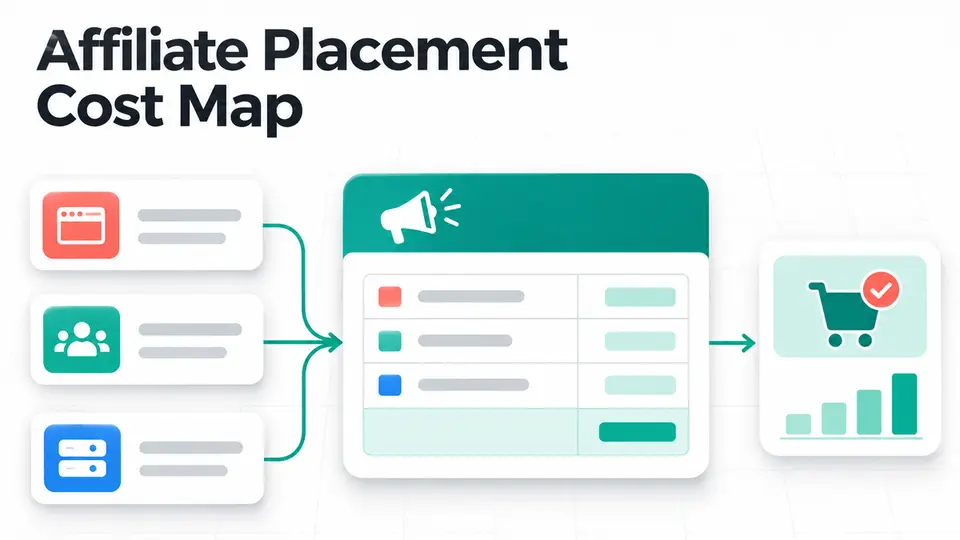
An affiliate paid placement cost allocation worksheet helps a program team compare a contracted placement with what it delivered. It separates fixed fees, sales commissions, platform costs, and approved outcomes.
Use the eight fields below before approving a newsletter feature, homepage slot, seasonal package, or other paid exposure. Then reconcile the commitment against delivery and qualified transactions. The worksheet is a decision aid, not a promise that attribution proves incremental sales.
Quick Answer
Record the placement, commitment, fixed fee, variable commissions, tracking rules, approved outcomes, allocation formula, and reconciliation owner. This affiliate paid placement cost allocation worksheet calculates cost per approved new customer as allocated campaign cost divided by approved new customers in the same reporting window. Keep pending, reversed, and untracked transactions separate until resolved.
| Cost type | Typical treatment | Keep separate from |
|---|---|---|
| Fixed placement fee | Amount paid for a named format and period | Per-sale commission |
| Affiliate commission | Amount on eligible, approved transactions | Clicks or provisional orders |
| Platform or network charge | Contracted subscription, usage, or transaction cost | Publisher compensation |
| Creative and discount costs | Incremental campaign expenses and customer offer | Net sales value |
The Eight Worksheet Fields
1. Placement identity and objective
Give each commitment a unique row ID. Record the partner, placement name, campaign, market, channel, and business objective. An objective might be qualified new customers, new trials, or a specific product launch. Avoid a vague goal such as more awareness unless you also define what evidence will be reviewed.
Use a separate row for each materially different placement. A newsletter mention, homepage feature, and dedicated email have different delivery evidence and may have different dates or prices. Combining them makes it harder to see which unit was delivered.
2. Contracted format and delivery window
Write down what the partner agreed to publish: format, position, duration, audience or geography, creative version, link destination, and expected date. Add the signed order, email approval, or campaign brief as the source record. If the booking includes a make-good or replacement slot, record the trigger and due date.
A paid placement should be traceable to a deliverable. A dated record helps the team distinguish a purchased opportunity from a feature that actually ran. Do not mark a commitment delivered based only on an invoice or a booking confirmation.
3. Fixed fee and direct expenses
Record the placement fee in its original currency, payment status, invoice reference, tax treatment, and the period it covers. Add incremental creative production, agency charges, or approved setup costs when they belong to this placement. Keep routine program overhead in a separate budget line unless your finance policy allocates it consistently.
Do not infer a fee from a rate card if the final agreement differs. Save the approved amount and the source used to verify it. If a package covers several slots, define the allocation basis before the campaign begins, such as equal per-slot cost or the contracted value assigned to each slot.
4. Variable commission and incentives
Separate the placement price from the commission earned on eligible transactions. Record the commission rule, qualifying event, calculation base, transaction status, reversals, bonus, and incentive. A higher commission for a fixed period is still variable compensation, even if it was negotiated as part of a placement package.
This separation matters for an apples-to-apples comparison. A partner may receive a flat fee plus standard commission, or a fixed bonus instead of a higher rate. Awin's advertiser budgeting guidance lists paid placements and exposure packages alongside commissions and other costs.
5. Tracking and attribution definition
Write the source of truth for clicks, orders, approved customers, and commission. Include the tracking link or campaign identifier, attribution window, eligible markets, order cutoff, report date, and any known reporting delay. Identify whether the count includes new customers, renewals, cancellations, refunds, or only approved transactions.
Do not combine data with different windows. If placement delivery occurred in one week but commission is still pending validation, keep the spend confirmed and the outcome provisional. State the data source and export date so a second reviewer can reproduce the calculation.

6. Delivery proof and approved outcomes
Store a screenshot, archive, partner report, or other acceptable proof that the placement appeared in the contracted format and window. Capture clicks, referred leads, orders, qualified customers, and approved transactions as distinct measures when your system reports them. Also record reversals, refunds, duplicate events, and untracked transactions separately.
Do not use raw clicks as the denominator for customer acquisition cost or count an order as approved just because it appears in a click report. Review partner performance, commissions, and placements together before planning another campaign.
7. Allocation rule and decision formulas
State how each shared expense is allocated. If a $3,000 package covers three placements and no better breakdown exists, an equal $1,000 allocation is only a planning assumption. Label it as such and replace it if the contract assigns different values. Do not invent a precise placement value after the result is known.
Use consistent formulas in the affiliate paid placement cost allocation worksheet:
- Allocated placement cost = fixed fee share + placement-specific production and approved expenses.
- All-in campaign cost = allocated placement cost + eligible commissions + platform or transaction charges + approved incentives.
- Cost per approved new customer = all-in campaign cost divided by approved new customers in the same window.
- Placement return ratio = attributed contribution margin divided by placement cost, when margin and attribution evidence are available.
If the denominator is zero, delayed, or uncertain, report the cost and mark the ratio unavailable. A return ratio is descriptive. It does not prove that the placement caused the outcome, because the customer may have arrived through another channel or would have converted anyway.
8. Reconciliation, owner, and next decision
At close, compare the agreement, invoice, proof of delivery, and transaction report. Record the person responsible for each unresolved difference, the evidence needed, and a due date. Mark the row as confirmed, pending, disputed, or closed. Keep the original values and record corrections rather than silently overwriting them.
End with a decision: repeat, renegotiate, test a smaller booking, pause, or gather more evidence. A repeat decision should point to the same measure and data window used in the original objective. If the result is uncertain, keep the next commitment small enough to answer the remaining question.
Worked Example With Hypothetical Values
Suppose a brand pays a hypothetical $2,000 for a newsletter placement. The same campaign records $1,200 in approved commissions, $300 in attributable creative expenses, and 35 approved new customers. If all costs belong to that placement, the illustrative all-in total is $3,500 and the illustrative cost per approved new customer is $100. These amounts are examples for arithmetic only, not market benchmarks.
The result still needs context. Was the email delivered on the contracted date? Were all 35 customers eligible and approved? Did the measurement window include late orders or refunds? Would some customers have converted through another channel? Without those answers, report the observed cost and the source limits, not a confident causal claim.

Controls That Make the Worksheet Useful
Approve the placement before it runs
Save the owner, cap, delivery terms, and measurement plan before the commitment starts. Any change to format, price, dates, or expected exposure should have a dated approval. This prevents a delivered placement from being retroactively treated as the plan.
Protect editorial clarity
When a placement appears beside independent recommendations or rankings, record how it is labeled and separated from editorial decisions. The FTC's endorsement guidance warns that paid ranking boosts can mislead when presented as independent. Ask the appropriate reviewer to check the page and audience context.
Compare tools by operating needs
Compare Rewardful, FirstPromoter, and Tapfiliate as tracking-tool options. Confirm fees, transaction statuses, and reporting scope with each vendor.
For campaign operations, pair this worksheet with the affiliate campaign postmortem template, the Black Friday affiliate program checklist, and the affiliate test-order reconciliation checklist. They cover planning, closeout, and transaction evidence around the same spending decision.
Copyable Worksheet Row
| Placement ID | Partner and format | Window and market | Fixed fee | Commission and incentives | Tracking source and rule | Delivery proof | Approved new customers | Allocated cost | Cost per approved customer | Status and owner |
|---|---|---|---|---|---|---|---|---|---|---|
| [ID] | [Partner, slot] | [Dates, region] | [Currency and amount] | [Rule and amount] | [Link, event, cutoff] | [Proof URL or file] | [Count or pending] | [Formula] | [Amount or unavailable] | [Status, owner, due date] |
Keep one row per distinct placement and link source records instead of copying private partner information into a public report.
Key Takeaways for Affiliate Paid-Placement Cost Allocation Worksheet: 8 Fields
An affiliate paid-placement cost allocation worksheet turns a booking into a reviewable record. It separates the amount paid for exposure from commissions and other costs, ties each expense to a delivery and measurement window, and makes pending outcomes visible.
Use the same allocation rule before and after the campaign. Reconcile the placement proof and approved transactions, then decide whether the next commitment should repeat, change, or wait for better evidence. Program owners can browse FindAffiliates when comparing affiliate tools and program options.
FAQ
What should an affiliate paid placement cost worksheet include?
Include the placement identity, contracted deliverable, fee, commissions and incentives, tracking rules, delivery proof, approved outcomes, allocation formula, and reconciliation owner.
Are paid placement fees the same as affiliate commissions?
No. A placement fee buys a defined exposure or deliverable. A commission is variable compensation on transactions that meet the program's qualifying rules. Keep the amounts separate even when one partner receives both.
How do I calculate affiliate placement cost per customer?
Divide the allocated placement cost and other consistently included campaign costs by approved new customers from the same measurement window. If the customer count is pending or cannot be isolated, mark the result unavailable.
Can attributed sales prove that a placement caused conversions?
No. Attribution reports show how a system assigned a conversion under its rules. They do not by themselves establish that the customer would not have converted without the placement.
Should a paid placement be included in a program budget?
Yes. Track it alongside commissions and other program expenses, with its own approval, delivery evidence, and outcome measure. Follow your finance policy for shared costs and allocation.