Affiliate Holdout Contamination Checklist: 7 Checks
Use this affiliate holdout contamination checklist to catch crossover, eligibility drift, and missing assignment evidence before trusting a partner test.
On this page (7)

What Should You Compare Before Choosing?
An affiliate holdout can look clean in a spreadsheet and still be exposed to the promotion it was meant to avoid. A code may appear on a coupon site, a partner may send the offer to both groups, or an eligibility rule may change after assignment. This affiliate holdout contamination checklist helps program owners find those failures before they interpret a lift estimate.
Start by recording who was assigned, what exposure was allowed, and which events count as an outcome. Then check whether partner activity crossed the boundary, whether assignment stayed stable, and whether the analysis treats assigned and actually exposed users as different facts. A holdout is useful only when the operating rules and evidence support the comparison.
This is a practical audit framework, not a claim that every affiliate platform provides randomized experiments. Agree on the design with the partner, analytics, finance, and legal teams before changing placements, commissions, or participant treatment.
Use the affiliate holdout contamination checklist before the first placement runs, then repeat the exposure and exception checks while the test is live.
Quick audit table
| Check | Failure signal | Evidence to retain |
|---|---|---|
| 1. Freeze assignment | Eligibility or group rules change mid-test | Dated cohort definition and assignment export |
| 2. Map exposure | A partner asset reaches both groups | Placement, audience, and send records |
| 3. Find crossover | Holdout members receive treatment elsewhere | Click, code, impression, and referral paths |
| 4. Separate assignment from exposure | Analysts report exposed users as the randomized sample | Original assignment plus exposure records |
| 5. Reconcile identity and events | Orders cannot be joined to the assigned unit | Stable IDs, event definitions, and match rates |
| 6. Track interference | A concurrent campaign changes one group more | Campaign calendar and market-level context |
| 7. Lock analysis rules | Exclusions change after results appear | Predefined window, exclusions, and calculation |
What contamination means in an affiliate test
Contamination happens when the intended treatment differs from what participants actually experience. Someone assigned to a holdout may see a partner's email, social post, coupon, or public link. Someone assigned to treatment may never see the promotion. These cases can blur the contrast between groups and make a result harder to interpret.
Google describes control-group exposure across geographies as a source of contamination in its Conversion Lift guidance. The IAB and Media Rating Council measurement guidelines also emphasize sound assignment, comparable groups, and aligned targeting logic. Those documents address advertising experiments, so use them as methodological references rather than as affiliate-specific platform rules.
---
The 7 checks
1. Freeze eligibility and assignment rules
Write down the eligible partner, customer, geography, and time-window rules before the test begins. Include exclusions such as existing customers, markets where the offer cannot be used, partner types that are out of scope, or transactions that are not valid outcomes. Save the dated version used to create treatment and holdout groups.
Then compare the assigned population with the live program configuration. If a partner is added, removed, or moved between groups, record who made the change and when. A later eligibility adjustment can change the sample itself. Do not silently rewrite the original assignment file to make it match the latest view.
2. Map every route a partner can use to reach people
List the planned placements and the channels that might carry the same message: partner websites, email, video descriptions, creator bios, public coupon pages, retargeting, paid placements, and direct messages. Ask the partner which audience controls they can apply and what proof they can provide. A link that is public may reach beyond the intended treatment group even if the original brief was narrow.
Review screenshots, send records, placement dates, and campaign links during the test. Mark each exposure path as restricted, public, unknown, or not used. If a placement cannot be restricted to the intended group, treat that as a design limitation and document it before reading outcomes.
3. Search for crossovers and leakage
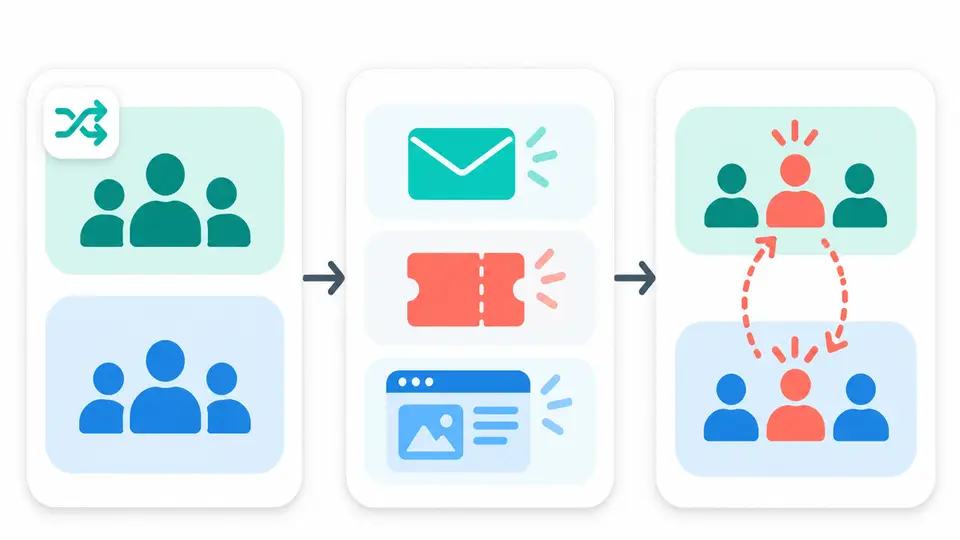
Look for holdout members who used the treatment code, clicked a treatment-only link, or arrived through a partner placement that was supposed to be withheld. Also check the reverse direction: treatment members who never received the promotion. Use the smallest unit the design assigned, such as a customer, household, partner, or geography, and do not assume that one click captures every exposure.
Make a dated exception list with the unit, observed path, timestamp, source, and whether the event can be verified. A public code can appear on a third-party page without the partner intentionally targeting the holdout. The cause matters for remediation, but the observed leakage still matters for interpretation.
4. Keep assigned groups separate from observed exposure
Preserve the original randomized group as the assignment record. Store exposure and click events in separate fields. If the analysis only compares people who actually saw a promotion with people who did not, it may select for people who were already more likely to engage. That is a different question from the effect of assigning the offer.
The IAB and MRC guidance recommends that the rules used to determine treatment also guide control selection in an experiment. For an affiliate test, document how partner audience selection, placement availability, and any holdback logic fit together. If the partner cannot apply the same eligibility logic to both groups, state that limitation rather than describing the result as a clean randomized estimate.
5. Audit identity, links, codes, and outcome events
Confirm that each unit can be connected from assignment to exposure and then to the agreed outcome, where that data is permitted and available. Check link redirects, sub-IDs, voucher codes, order records, refunds, cancellations, and duplicate conversion handling. Record unmatched events instead of dropping them without a trace.
Compare match rates by group and by partner. If one group loses more clicks or orders because of a missing parameter, browser restriction, or a different checkout path, the reporting gap can resemble a performance difference. The affiliate attribution QA checklist covers event and commission checks that can support this part of the audit.

6. Record interference and concurrent campaigns
Look for other activity that could affect one group differently: seasonal promotions, paid media, price changes, inventory shortages, partner newsletters, product launches, or a second creator campaign. Note when each activity started, which markets or audiences it reached, and whether the team can estimate its overlap with the test.
Do not claim that every concurrent event invalidates the test. Instead, document what changed and assess whether the impact was balanced across groups. If a campaign reached only one group, flag it as a possible confounder and include it in the interpretation. Retain the campaign calendar so someone can reconstruct the conditions later.
7. Lock exclusions and analysis decisions before results
Set the observation window, outcome definition, refund treatment, outlier handling, and exclusion rules before reviewing the final lift estimate. Document the method for handling users whose exposure cannot be verified and how you will report crossovers. If you use an intention-to-treat analysis, retain assignment as the basis for grouping.
Keep a decision log for every change. It should include the previous rule, new rule, reason, approver, timestamp, and whether the analysis was rerun. Tools such as FirstPromoter, Rewardful, and Tapfiliate may be part of a program's tracking setup, but confirm the product's current capabilities and data exports before assuming they store experimental assignment or exposure evidence.
---
Turn the checklist into a repeatable review
Assign one owner to maintain the cohort definition, one to collect partner exposure evidence, and one to approve the analysis rules. Schedule short checks while a test is live instead of waiting until the readout. Early checks can identify a public code or a misrouted placement while the team still has a chance to correct the exposure and record what changed.
Use a simple status for each check: verified, exception, unknown, or not applicable. Keep the source artifact beside each status, such as an assignment export, dated screenshot, click log, partner confirmation, or order reconciliation. Redact personal information where it is not needed and follow the data access and retention rules agreed for the test.
For design and execution details, pair this audit with the affiliate program incrementality test plan, then record daily decisions in the affiliate partner holdout log template. Both are different from this contamination review: one establishes the test, another preserves events, and this checklist inspects whether the comparison stayed credible.
Keep the affiliate holdout contamination checklist as the review layer between the plan and final analysis.
Key Takeaways for Affiliate Holdout Contamination Checklist: 7 Checks
The most useful affiliate holdout contamination checklist preserves assignment, maps exposure paths, checks crossovers, and keeps analysis choices visible. When evidence is incomplete, describe the limit and narrow the conclusion. Browse FindAffiliates for program discovery, and align any test changes with the partner agreement and your organization's measurement and privacy owners.
---
FAQ
What is contamination in an affiliate holdout test?
Contamination occurs when holdout units receive some treatment exposure or when treatment units do not receive the intended exposure. Record both cases separately from the original assignment.
Can a coupon code contaminate a holdout group?
Yes. A code intended for one group can be copied to public coupon pages or shared through another partner channel. Check code use, click paths, and exposure dates, then document confirmed and uncertain cases.
Does an affiliate platform provide a randomized holdout?
Do not assume it does. Confirm whether the provider supports your assignment unit, holdback rules, exposure evidence, and data export. A tracking platform can record referrals without proving a randomized experiment.
Should contaminated users be removed from the analysis?
That depends on the predefined design and analysis plan. Preserve the original assignment, report exposure separately, and document any exclusion rule before examining results. Removing crossovers after seeing performance can bias the comparison.