Affiliate Software API and Webhook Checklist for SaaS
Use this affiliate software API and webhook checklist to test events, security, retries, refunds, IDs, exports, sandboxes, monitoring, and recovery.
What Should You Compare Before Choosing?
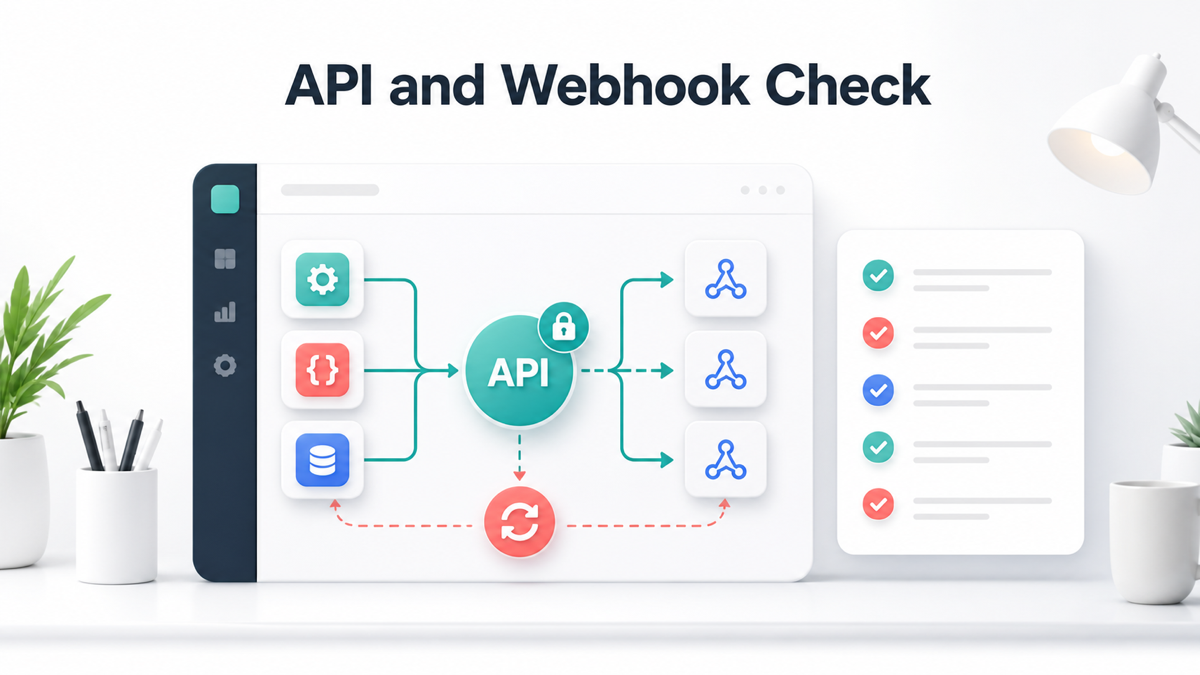
An affiliate software API and webhook checklist helps a SaaS team evaluate what happens after a vendor demo. A polished dashboard can still leave engineering without stable identifiers, finance without reproducible commission evidence, and operations without a safe way to recover failed events.
The goal is not to reward the platform with the most endpoints. It is to prove that required partner, customer, transaction, commission, refund, and payout workflows can move through the system accurately and recoverably. That requires documentation review, a small proof of concept, failure testing, and written acceptance criteria.
This checklist covers the data contract, security, event coverage, retries, idempotency, billing changes, exports, testing, observability, and exit plan. Feature access can vary by plan, edition, role, and implementation, so confirm every critical field in current documentation and the signed order form.
Quick Answer: What Should SaaS Teams Test?
Test whether the platform exposes stable IDs, documents its API version and authentication, sends the required webhook events, authenticates or protects deliveries, supplies a unique event identifier, retries failures, supports replay, maps refunds and subscription changes, offers a test path, records delivery history, exports complete records, and provides a backfill or reconciliation method.
| Control area | Minimum evidence | Failure if missing |
|---|---|---|
| Identity | Stable partner, customer, transaction, commission, and payout IDs | Records cannot be reconciled safely |
| Security | Server-side credentials, scoped access, delivery authentication | Events can be exposed or forged |
| Coverage | Documented create, update, cancel, refund, and payout events | Manual gaps appear in finance workflow |
| Reliability | Unique event ID, retries, history, and replay | Duplicate or lost automation |
| Testing | Sandbox or controlled test event and sample payload | Production becomes the test environment |
| Recovery | API query, export, or backfill after outage | Webhook loss becomes permanent |
| Change control | Versioning and changelog | Integration breaks without warning |

Before the Checklist: Define the Required Data Flow
Draw one event from start to finish. For a recurring SaaS commission, that path may include a referral click, signup, billing customer, paid invoice, transaction, commission, approval, payout, refund, and adjustment. Record which system owns each fact.
The affiliate platform should not silently become the source of truth for a field owned by billing. Likewise, the CRM should not overwrite the stable partner ID with a display name. Define the canonical keys, time zone, currency units, and expected state transitions before comparing vendors.
Rewardful, FirstPromoter, PartnerStack, and Tapfiliate all publish API or webhook documentation, but their event names, payloads, access paths, and operational controls differ. Compare your required flow, not the existence of a developer portal.
11-Point Affiliate Software API and Webhook Checklist
1. Inventory API Resources and Operations
List the resources required by engineering and operations: partners, applications, groups, campaigns, links, coupons, customers, leads, deals, transactions, commissions, adjustments, balances, payouts, and webhooks. For each resource, mark whether the API can create, read, update, list, filter, and delete it.
Record pagination, date filters, rate limits, ordering, expansion fields, and maximum lookback. A list endpoint without reliable filtering may be inadequate for daily reconciliation. A write endpoint may be unnecessary if the dashboard remains the approved control surface.
Tapfiliate's official REST documentation identifies API version 1.6, resource-oriented URLs, HTTP status codes, JSON responses, and header authentication. That is useful baseline evidence, but the team still must map required resources and plan access.
2. Require Stable Identifiers
Store platform IDs for every object that can change. Email addresses, names, referral codes, campaign labels, and payout descriptions are mutable business fields, not durable database keys.
The integration map should include the SaaS user ID, billing customer ID, subscription ID, invoice or charge ID, affiliate partner ID, referral ID, transaction ID, commission ID, payout ID, and webhook event ID. Document uniqueness and whether IDs differ across test and production environments.
If the platform accepts an external customer key, test duplicates, updates, deletion, and reuse. Never assume a missing ID can be reconstructed safely from an email address later.
3. Review Authentication and Secret Handling
Determine whether the API uses bearer tokens, basic authentication, OAuth, or a vendor-specific header. Check whether keys can be scoped, rotated, revoked, named, and restricted by environment or role.
Keep credentials on the server. Tapfiliate explicitly warns not to expose its secret API key in a public client. Apply that principle to every vendor. Store secrets in the approved secret manager, restrict access, log rotations, and prevent keys from appearing in browser code, support screenshots, or partner-facing documentation.
For outgoing webhooks, ask how the receiver verifies authenticity. Look for signed payloads, a shared secret, custom authentication headers, source restrictions, or another documented control. TLS protects transport but does not by itself prove who sent the request.
4. Match Webhook Events to Business States
Create an event coverage matrix. Required events may include partner application, partner approval, referral signup, customer creation, transaction creation, commission approval, commission reversal, payout status, refund, cancellation, and subscription change.
PartnerStack's webhook documentation describes JSON POST deliveries for supported events and registration through webhook API endpoints. FirstPromoter documents groups of promoter, referral, commission, payout, payment batch, and contract events. Rewardful publishes an event-type catalog and states that webhook object structures match corresponding REST resources.
Do not infer an event from a resource endpoint. An API may let the team query refunds without sending a refund webhook. Mark each required state as push, poll, export, manual, or unsupported.
5. Verify Payload Schema and Versioning
Save real sample payloads from the proof of concept. Confirm data types, null behavior, timestamps, currencies, minor units, nested objects, status values, and the presence of both platform and external IDs.
Ask how schema changes are announced. Look for versioned URLs, changelogs, deprecation windows, additive-field policy, and test payloads. Build the receiver to ignore unknown additive fields while rejecting invalid required values into a review queue.
Document whether an update event contains the full current object, only changed fields, or old and new values. FirstPromoter's current guide describes unique event IDs and change details for updates, which supports deduplication and auditing.
6. Make Processing Idempotent
Assume a valid event can arrive more than once. Use the unique webhook event ID as a deduplication key when available. If it is not available, define a carefully tested composite key and ask the vendor for a safer option.
Record receipt before running downstream work. Then process the event through an idempotent state transition so a repeated commission event does not create a second credit, email, or accounting entry. Return the success status only after the durable receipt is stored.
Test duplicates intentionally. Send the same payload twice, replay a delivery, and confirm that business state changes once while both delivery attempts remain observable.
7. Test Timeouts, Retries, and Replay
Ask what response codes count as success, how long the sender waits, how often it retries, when it stops, and whether staff can replay a failed delivery. Confirm whether ordering is guaranteed and what happens if an earlier event fails while later events arrive.
FirstPromoter's current general webhook guide says failed deliveries retry three times by default with increasing waits, and it documents delivery history, manual retry, and a Run Test action. An older event-specific fulfillment page describes seven retries in a day. Treat retry behavior as event-specific until the vendor confirms the exact event and account behavior.
During testing, return a timeout, 500, 429, and malformed response. Record the sender behavior. Do not create a production dependency on a retry schedule that appears only in an old help article.
8. Map the Full Billing Lifecycle
Test a trial, paid signup, recurring invoice, upgrade, downgrade, cancellation, failed payment, full refund, partial refund, chargeback, coupon, and currency conversion when each applies. Record the billing event, affiliate result, time delay, status, amount, and commission adjustment.
The most important question is not whether the platform tracks a sale. It is whether finance can explain why an approved commission changed after a refund or plan change. Use the billing-native vs pixel affiliate tracking guide to identify the separate click and billing layers.
Do not assume every billing integration handles every event. FirstPromoter's Braintree guidance, for example, notes a refund limitation that can require manual commission denial. Platform and billing-provider combinations need individual evidence.
9. Demand a Safe Test Path
Prefer a sandbox or isolated test account with representative API and webhook behavior. If the vendor has no sandbox, use a controlled campaign, internal partner, test product, low-value transaction, and documented cleanup steps.
The test plan should include valid and invalid authentication, missing fields, duplicate IDs, rate limits, pagination, delayed events, retries, refunds, and replay. Capture request IDs and timestamps without logging secrets or unnecessary personal data.
Tapfiliate documents a Test action for webhook triggers. FirstPromoter documents Run Test. These controls help validate connectivity, but a sample event does not replace a real billing lifecycle test.
10. Build Monitoring and Reconciliation
Monitor delivery failures, processing latency, duplicate rate, schema errors, missing IDs, API errors, rate-limit responses, and reconciliation differences. Alerts need an owner, severity, runbook, and escalation path.
Run a scheduled comparison between the platform and the internal ledger. For example, query all transactions updated since a safe lookback time and compare them with stored webhook outcomes. The polling or export path protects against a silent webhook outage.
Use the affiliate payout audit checklist when the integration feeds commission approval, and structure unresolved differences with the payout reconciliation exception log.
11. Confirm Export, Backfill, and Exit Rights
Before signing, export sample partners, customers, transactions, commissions, adjustments, balances, and payouts. Check stable IDs, timestamps, status history, currencies, and pagination. Ask whether the API supports records updated during an outage and whether vendor support can backfill missed events.
Record data-retention limits, account-closure access, export format, deletion process, and any professional-services fee. The affiliate software migration checklist explains why historical evidence and operational migration are separate workstreams.
An exit plan is part of reliability. A platform that works only while its dashboard remains available creates avoidable finance and compliance risk.
Acceptance Criteria for the Proof of Concept
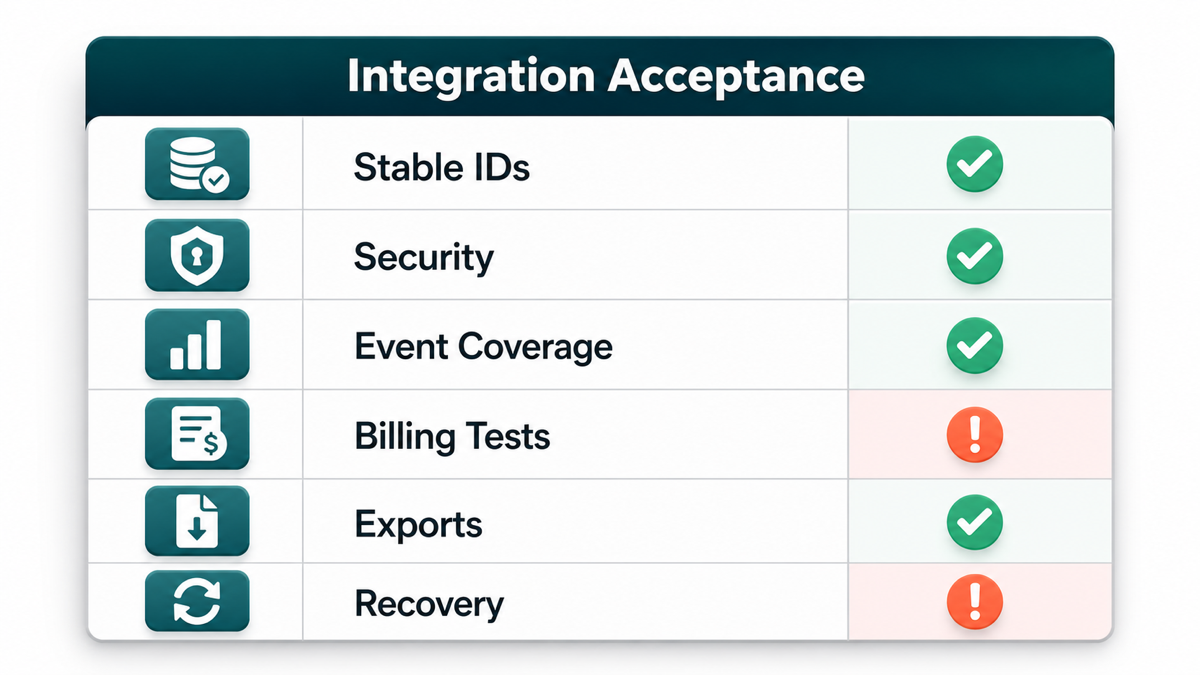
Approve the integration only when the required API operations work, identifiers remain stable, secrets stay server-side, webhook authenticity is addressed, duplicates are safe, retry behavior is documented, billing lifecycle tests pass, failure history is visible, reconciliation finds expected records, and a complete export is retained.
Use the affiliate software API and webhook checklist as the signed review record so engineering, partner operations, and finance approve the same evidence.
List every exception with severity, affected workflow, owner, workaround, due date, and retest result. A missing noncritical convenience endpoint may be acceptable. A missing refund adjustment or payout identifier may not be.
Key Takeaways for Affiliate Software API and Webhook Checklist for SaaS
An affiliate software API and webhook checklist turns developer documentation into operational evidence. Map the required data flow, prove stable identity, test failure recovery, reconcile against the source system, and retain an exit path.
The safest platform is not the one with the largest API. It is the one whose required workflows can be tested, monitored, explained, and recovered by your team. Browse FindAffiliates to compare affiliate software before starting the proof of concept.
FAQ
What is the difference between an affiliate API and a webhook?
An API lets your system request or change data. A webhook lets the platform push an event to your endpoint when something happens. Reliable integrations often use webhooks for speed and API queries or exports for reconciliation.
Should webhook receivers process the same event twice?
They should accept repeat delivery safely without repeating the business action. Store a unique event ID, make processing idempotent, and preserve delivery history for investigation.
Are webhook retries guaranteed across affiliate platforms?
No. Retry count, timing, response-code handling, history, ordering, and replay differ by platform and sometimes by event. Confirm the current documentation and test failure behavior on the exact account.
Does an affiliate platform need a sandbox?
A sandbox is preferable, but a controlled test program can work when no sandbox exists. Use isolated partners and transactions, document cleanup, and test both successful and failed paths before production traffic.
Why are exports part of an API review?
Exports provide reconciliation, audit, outage recovery, and exit evidence. An API can be useful for automation while still omitting historical fields that finance needs, so test both access paths.