9 Partner Payout FAQ Page Examples for SaaS in 2026
Use these partner payout FAQ page examples to explain timing, thresholds, statuses, refunds, tax checks, currencies, disputes, and rule changes.
On this page (8)
What Should You Compare Before Choosing?
Partner payout FAQ page examples are useful only when they answer the questions affiliates ask before a balance becomes overdue. A strong page explains eligibility, payment timing, statuses, thresholds, reversals, methods, verification, currency, disputes, and future rule changes in plain language.
The quick answer is to publish one partner-facing source of truth with nine concise questions, exact program rules, an effective date, and a named escalation route. Link to the full legal policy where needed, but do not make partners decode internal finance procedures.
This guide provides reusable answer structures. Replace every bracketed instruction with your actual rule before publishing. The examples are editorial templates, not legal or tax advice.
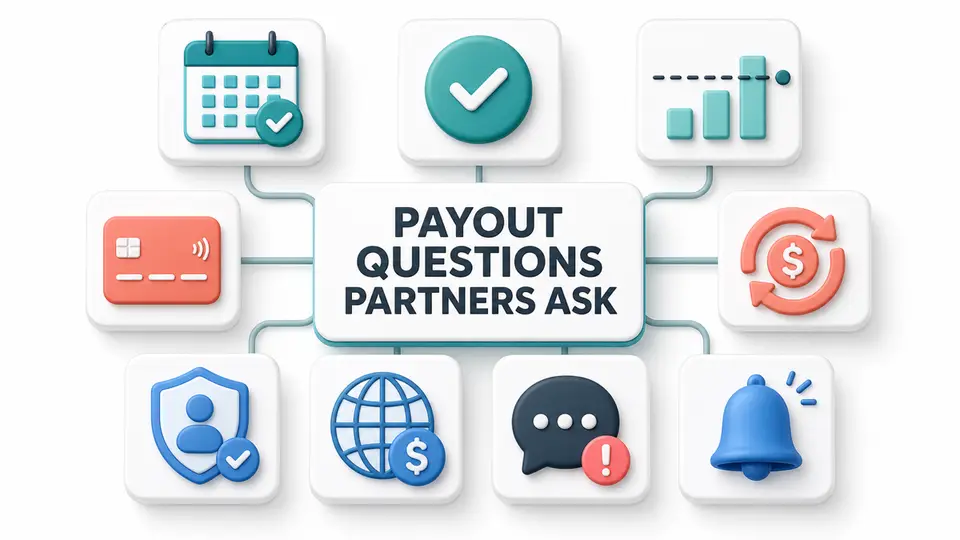
The nine questions a payout FAQ should answer
| FAQ section | Minimum answer |
|---|---|
| 1. Eligibility and timing | Hold period, approval event, payout cadence |
| 2. Status definitions | Meaning of each visible status |
| 3. Threshold | Minimum balance and rollover behavior |
| 4. Refunds and reversals | What can reduce or void commission |
| 5. Payment methods and fees | Available rails, countries, and fee owner |
| 6. Tax and identity checks | Required data and blocked-payment handling |
| 7. Currency | Reporting currency, payment currency, conversion rule |
| 8. Missing or incorrect payouts | Evidence, contact route, response target |
| 9. Rule changes | Notice method, effective date, treatment of prior referrals |
Platforms such as Rewardful, FirstPromoter, Tapfiliate, and PartnerStack expose different controls. Your FAQ must describe your configured program, not copy a platform default without checking it.
How to use these examples
Write the short answer first. A partner should understand the rule from the first two sentences. Put definitions, examples, and edge cases after that.
Use calendar dates instead of vague phrases when possible. "Paid monthly" is incomplete if the program does not say which month's commissions qualify, whether a hold applies, and what happens when the payout date falls on a weekend.
9 partner payout FAQ page examples
1. When is my commission eligible, and when do you pay?
This answer needs two clocks: the commission review or hold period, and the payout cadence. Rewardful documents a default pending period that merchants can align with their refund window, then a process for paying due commissions. The Rewardful payout documentation is a useful platform example, but your page must state your own dates.
Example answer: "New commissions remain pending for [number] days while we confirm payment and refund eligibility. Approved balances are paid on [date or rule] each [week or month]. A commission approved after the cutoff moves to the next payout cycle."
2. What do Pending, Due, Processing, Paid, and Reversed mean?
Status labels are not self-explanatory. Define every label partners can see and identify which statuses count toward the payable balance.
Example answer: "Pending means the commission is still inside its review period. Due means it passed review and meets the current payout rules. Processing means a payment file or managed payout is in progress. Paid means settlement was recorded. Reversed means the commission no longer qualifies because of [listed reasons]."
Match the wording to the partner portal. Do not publish "Approved" if the dashboard says "Due," or use "Paid" when finance has only exported a file.
3. Is there a minimum payout threshold?
State the exact threshold, currency, scope, and rollover rule. The related guide to affiliate payout threshold examples explains how thresholds affect partner cash flow.
Example answer: "The minimum payout is [amount and currency] per partner account. Eligible balances below that amount roll forward automatically and do not expire while the account remains in good standing. We do not charge a fee for carrying the balance."
4. What happens after a refund, cancellation, chargeback, or disapproval?
Partners need to know which events can reduce a commission and when the adjustment appears. Keep the explanation consistent with the customer refund policy and the signed partner agreement.
Example answer: "A commission may be reversed when the related order is refunded, charged back, canceled, fraudulent, duplicated, or outside program terms. We record the reason in the partner portal. If a reversal occurs after a payout, [state whether it creates a negative balance or another documented adjustment]."
Avoid a blanket right to remove earnings without evidence. List the common reasons and provide a review route for disputed reversals.
5. Which payout methods are available, and who pays fees?
Name only methods your program currently supports. Rewardful can support merchant-managed exports or managed payout options, while Tapfiliate lets advertisers configure offered methods. That platform flexibility is why a SaaS program must publish its own choices.
Example answer: "We currently offer [bank transfer, PayPal, Wise, or other method] in [supported locations]. The partner is responsible for [listed withdrawal, intermediary, or conversion fees], while the program covers [listed fees]. Payment details must be complete by [cutoff] to join the next run."
Include what happens when a payment is rejected. A practical answer says whether the balance returns to Due, whether the partner must update details, and whether another fee applies.
6. Do I need tax or identity verification before payment?
Do not give tax advice. Explain the operational requirement, where the partner completes it, and what status appears when information is missing.
Example answer: "Before the first payout, partners must complete the identity, address, banking, and tax information requested in [secure provider or portal]. We cannot release payment while required information is incomplete or unverified. Contact [team] if the verification provider requests information you cannot supply."
Never ask partners to email passports, tax forms, or banking credentials to a general support inbox. Use a secure provider and give the partner a safe escalation path.
7. Which currency applies to commissions and payouts?
Separate reporting currency, commission calculation currency, payout currency, and conversion fees. A dashboard displaying dollars does not prove the bank will receive dollars.
Example answer: "Commissions are calculated in [currency or source transaction currency] and displayed in [dashboard currency]. Payouts are sent in [currency choices]. When conversion is required, [provider or program] applies the rate and fees described at [source]."
If the program serves several markets, include a simple example showing the source sale, commission record, conversion, and final payout amount. Mark the example as illustrative when exchange rates vary.
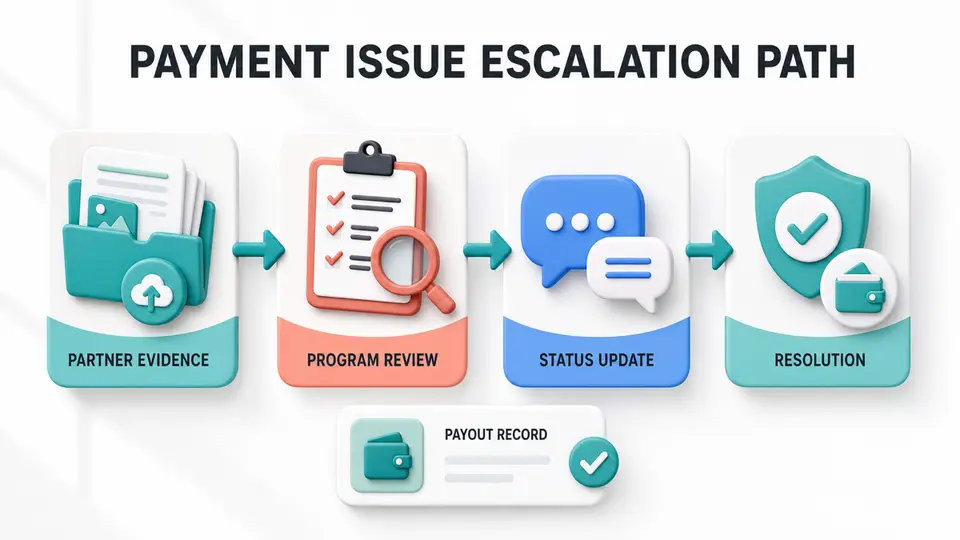
8. What should I send if a payout is missing or incorrect?
Make the evidence request specific and privacy-safe. Ask for partner email or ID, commission or conversion ID, click or conversion date, invoice or order reference, visible status, and a short description. Do not ask for customer passwords or full payment-card data.
Example answer: "Send [support route] your partner ID, affected commission ID, order reference, relevant dates, current status, and a screenshot with private customer data hidden. We acknowledge payout cases within [time] and provide a resolution or next update within [time]."
The Tapfiliate payout process shows why settlement records and balance updates must stay aligned. Your own escalation answer should identify the program manager or finance owner who can review that evidence.
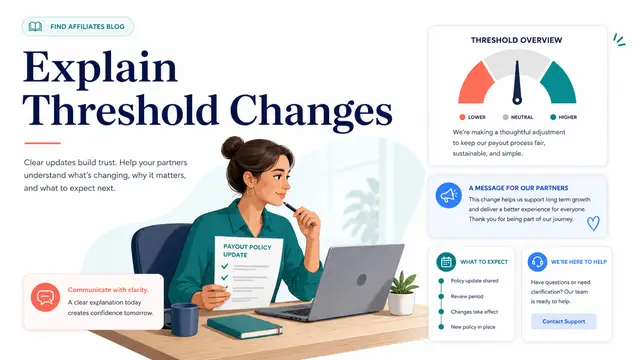
9. How will payout-rule changes be communicated?
Partners should not discover a new threshold, hold, fee, or schedule only after a missed payment. Publish the notice channel, effective date, scope, and treatment of earlier referrals.
Example answer: "We announce material payout changes through [email and portal notice] at least [number] days before they take effect. Each notice states the effective date and whether the change applies to existing referrals, new referrals, or both. The FAQ keeps a dated change log."
Keep older versions or a short change history. This is especially important when a platform setting can affect existing referrals as well as new ones.
Recommended page architecture
Start with a five-line payout summary containing the hold period, payment cadence, threshold, methods, and support route. Follow it with the nine expandable questions, then show the effective date and change log.
Link to the full affiliate payout policy examples instead of copying every legal clause into the FAQ. Link to payout status email templates when the operations team needs consistent notices.
Assign one owner to review the page after any platform, policy, provider, currency, fee, or calendar change. A partner FAQ becomes risky when it looks authoritative but no longer matches the configured system.
Mistakes to avoid
Do not use "usually," "soon," or "standard processing time" without a defined range. Do not call an exported payout file a completed payment. Do not hide a threshold in legal terms while a marketing page promises fast payouts.
Do not copy a software provider's status definitions if your portal uses different labels. Do not make the FAQ an internal audit checklist. The affiliate payout audit checklist is for finance controls, while this page is for partner questions and usable answers.
Do not expose private financial or identity data in support instructions. Tell partners which evidence helps, which fields to hide, and where secure documents belong.
Key Takeaways for 9 Partner Payout FAQ Page Examples for SaaS in 2026
The best partner payout FAQ page examples turn payout operations into nine direct promises partners can verify. They explain when commission becomes eligible, what every status means, how thresholds and reversals work, which payment requirements apply, and how a dispute reaches resolution.
Publish the page before recruiting at scale. Then compare it with the live portal, signed agreement, payout provider, and finance calendar after every material change.
Explore FindAffiliates for affiliate software and program examples that can inform a clearer partner experience.
FAQ
What should an affiliate payout FAQ include?
It should include eligibility timing, payout cadence, status definitions, threshold and rollover rules, reversals, methods and fees, tax or identity checks, currency handling, dispute steps, and change notices.
Should the payout FAQ replace the affiliate agreement?
No. The FAQ should explain the operational rules in plain language and link to the controlling agreement or policy. It should not weaken, expand, or contradict the signed terms.
Where should a SaaS program publish its payout FAQ?
Publish a public version near the program application and keep the same answers inside the partner portal. Put sensitive tax, identity, and banking steps behind authentication.
How often should the payout FAQ be reviewed?
Review it whenever a payout setting, provider, threshold, fee, currency, policy, or calendar changes. A quarterly check is useful even when no planned change occurred.