7 Affiliate Link Audit Frequency Rules for Creators 2026
Use these affiliate link audit frequency rules to schedule weekly, monthly, quarterly, and event-triggered checks by traffic, revenue, and risk.
On this page (7)

What Should You Compare Before Choosing?
Quick answer
Affiliate link audit frequency should match the cost of a failure. Check links tied to launches, major revenue, or changing offers weekly; review stable high-value links monthly; inspect lower-risk evergreen links quarterly; and run an immediate audit after a merchant, platform, policy, or site change.
The sources checked do not prescribe one universal audit interval for every creator, although individual program agreements may add requirements. A sensible schedule comes from traffic, revenue exposure, claim volatility, program rules, and detection speed.
This guide focuses on cadence, risk tiers, triggers, and ownership. For the actual inspection procedure, including redirect hops, destinations, tracking parameters, disclosure, and sponsored markup, use the 12-point affiliate link redirect audit checklist.
| Link tier | Typical examples | Starting cadence | Immediate trigger |
|---|---|---|---|
| Critical | Top revenue pages, launches, expiring offers | Weekly | Offer, policy, or tracking change |
| High | Stable links with meaningful traffic or revenue | Monthly | Click or conversion anomaly |
| Standard | Evergreen reviews and tutorials | Quarterly | Merchant migration or page update |
| Low | Low-traffic archive content | Twice yearly | Broken-link alert or reader report |

Why One Audit Schedule Does Not Fit Every Link
A creator with 20 links can review the whole portfolio more often than a publisher managing 20,000 placements. Even inside one site, a launch article for the Semrush affiliate program may deserve more attention than an old tutorial with one low-traffic link.
Cadence should reflect what can change. Pricing claims, promotions, commission terms, landing pages, and partner rules are volatile. A link beside a price or discount needs a tighter schedule than an evergreen explanation.
Separate monitoring from auditing. Automated monitoring can flag an error response, but a human audit asks whether the program is active, the recommendation still fits, and the public claim remains supportable. A page can load and still be wrong for the reader.
Use the seven rules below as a starting policy, then adjust with evidence from traffic, revenue, alerts, and program communications.
The 7 Affiliate Link Audit Frequency Rules
1. Audit Critical Revenue Links Every Week
Put links in the critical tier when they contribute a large share of affiliate revenue, sit on a top landing page, support a current launch, or promote an offer with a deadline. Review these links weekly while the exposure remains high.
A weekly audit does not need to become a full-site project. Open the placement, confirm the destination and nearby claim, check the partner dashboard, and record the result. Apply the complete redirect procedure when something changed or the last deep inspection is stale.
Critical status should be earned by impact, not brand size. A niche tutorial linking to the Kinsta affiliate program may be critical when revenue per qualified visit, reader reliance, or claim sensitivity is high.
2. Review Stable High-Value Links Monthly
Monthly reviews fit links that receive dependable traffic or commissions but are not tied to a short launch. This interval is frequent enough to catch merchant changes without forcing the team to inspect every important link each week.
Group the work into one recurring monthly session. Sort the register by revenue, clicks, and time since last review. Confirm the highest-impact pages first. If results changed, compare click records with the partner dashboard before assuming the destination is broken.
The affiliate link tracking and commission guide explains why publisher clicks, merchant conversions, approved commissions, and payouts should remain separate records. Monthly audits are easier when those records can be compared without rebuilding the history.
3. Check Stable Evergreen Links Each Quarter
Quarterly checks are a practical default for stable evergreen pages with moderate or low impact. Reviews, tutorials, resource pages, and older comparisons fit when their claims are not time-sensitive.
Do not treat quarterly as permanent. Move a link to monthly or weekly when traffic grows, a post starts ranking, a merchant changes its site, or a specific claim becomes important to the recommendation. Move a consistently quiet link to twice yearly only after confirming that lower frequency will not create a reader or compliance risk.
Also ask whether the recommendation still serves the search intent, whether a better official destination exists, and whether the article needs an update.
4. Audit Volatile Claims More Often Than Stable Pages
The statement beside a link can change faster than the URL. Prices, discounts, trials, commission rates, cookie windows, plan names, and availability need a shorter interval when they influence the click.
Set a claim review date separately from the link test date. A stable destination might need a quarterly check while a temporary discount needs review before and after its end date. Record the official source for each material claim.
Google's outbound link qualification guidance explains how paid placements should be identified for search systems. It does not prescribe an affiliate link audit frequency. Publishers still need their own evidence-based schedule for disclosures, claims, destinations, and program requirements.
5. Run an Immediate Audit After a Change Event
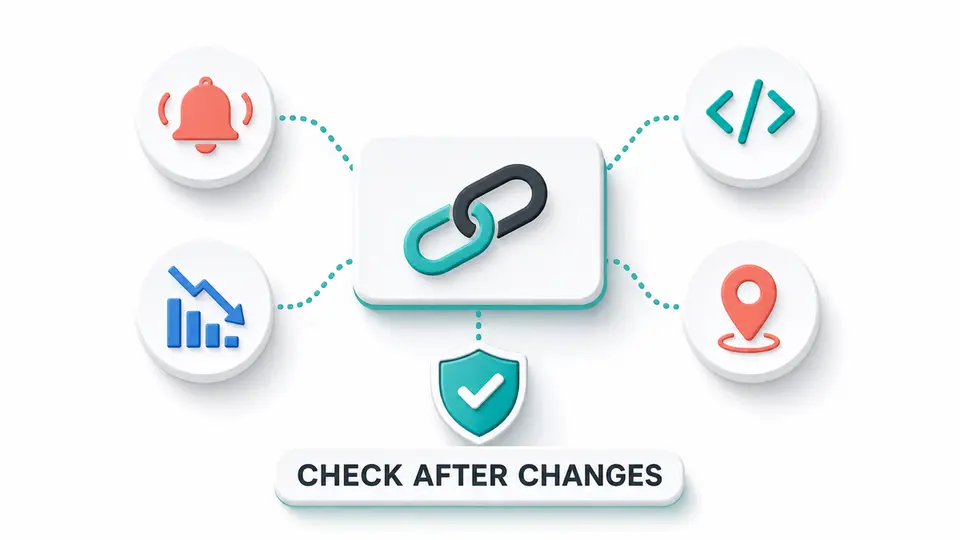
Calendar intervals are only the baseline. Audit affected links immediately after a merchant rebrand, website migration, affiliate-platform move, program closure, policy notice, commission change, product rename, CMS deployment, redirect update, or unusual performance drop.
Limit the first response to the affected scope. A merchant migration may affect every placement for that merchant, while a CMS template change may affect every affiliate button. A reader report should trigger that placement first, then other links using the same pattern.
Creators promoting the Kit affiliate program or Shopify affiliate program should treat current program messages and dashboard notices as operational evidence. Do not wait for the next quarterly date when the program itself signals a change.
6. Increase Frequency When Performance Signals Break Pattern
Use alerts and trend reviews to decide when a scheduled audit should happen early. Useful signals include a sudden click decline, a normal click count with no recorded merchant activity, an unusual conversion drop, repeated reader complaints, or a spike in error responses.
Do not diagnose the cause from one metric. A conversion decline can come from audience mismatch, seasonality, offer changes, attribution, or tracking. Check the placement and destination, then compare publisher records with the partner dashboard. The guide to investigating missing affiliate commissions provides a deeper evidence trail for a disputed referral.
Define alert thresholds before a problem occurs. Review a critical link when clicks fall below its normal range or the merchant records no activity during a period that usually produces results. Use your own baseline, not a universal percentage.
7. Assign Every Audit Tier to an Owner and Review It Twice Yearly
An audit calendar fails when no one owns the next action. Every link group should have an owner, tier, last review date, next review date, trigger source, and evidence location.
Review the tiering policy twice yearly. Promote links that gained traffic or revenue, lower the cadence for stable links with limited exposure, and retire placements that no longer help readers. Confirm alerts still reach an owner.
This rule keeps affiliate link audit frequency proportional over time. The schedule should change as the portfolio changes, while every adjustment remains explainable from traffic, revenue, volatility, and reader risk.
Build a Simple Affiliate Link Audit Calendar
Start with a spreadsheet or task system that supports recurring dates. Create one row for each placement, or one row for a link pattern when every placement shares the same destination, claim, owner, and risk.
Track the source page, program, destination, risk tier, claim type, last audit, next audit, triggers, owner, and evidence. Keep passwords, credentials, customer information, and payout details out of the register.
Schedule weekly and monthly work as recurring tasks. Group quarterly checks by month to spread the workload. Keep an event-trigger queue for policy emails, migrations, reader reports, and alerts.
Record one of four outcomes: keep, fix, pause, or retire. Note what changed and when the next review is due.
Common Scheduling Mistakes
The first mistake is giving every link the same interval. That wastes time on low-risk pages while critical placements wait in the same queue.
The second is relying only on broken-link software. Automated checks cannot decide whether a claim is current, a program rule changed, or a destination still matches intent.
The third is scheduling audits without event triggers. A quarterly plan is not a reason to ignore a migration notice for another two months.
The fourth is assigning a date without an owner. If responsibility is unclear, the task will usually move forward untouched. Keep the owner and evidence beside the next review date.
Key Takeaways for 7 Affiliate Link Audit Frequency Rules for Creators 2026
The right affiliate link audit frequency is risk-based. Review critical revenue and launch links weekly, stable high-value links monthly, evergreen links quarterly, and quiet archive placements twice yearly. Audit sooner whenever a merchant, platform, policy, claim, site system, or performance pattern changes.
Use these seven rules to build the calendar, then apply the full redirect checklist when a placement needs a deep inspection. Browse FindAffiliates to research relevant programs, and confirm current operating terms in each official agreement or partner dashboard.
FAQ
How often should creators audit affiliate links?
Use weekly reviews for critical revenue or launch links, monthly reviews for stable high-value links, quarterly reviews for evergreen placements, and twice-yearly reviews for low-traffic archives. Run an immediate audit after a material change or warning signal.
Is there an official required affiliate link audit frequency?
The sources checked do not prescribe one universal interval for every creator or link. Search guidance, disclosure rules, and individual program agreements can add requirements, while publishers still need a risk-based maintenance schedule for their own placements.
Are automated broken-link checks enough?
No. They can detect some response failures, but they do not prove that a program is active, a claim is current, tracking is recorded, disclosure is clear, or the destination matches the recommendation.
When should a quarterly link move to monthly reviews?
Increase the frequency when traffic or revenue grows, claims become more volatile, the merchant changes systems, readers report problems, or performance moves outside its normal range.
What should an affiliate link audit calendar record?
Record the source page, program, destination, risk tier, last and next review dates, immediate triggers, owner, evidence, and outcome. Keep secrets, customer data, and private payout details out of the register.