Multi Touch Affiliate Attribution Models for SaaS Teams
Compare multi touch affiliate attribution models for SaaS, including linear, time-decay, position-based, and data-driven analysis without changing payouts.
On this page (9)

What Should You Compare Before Choosing?
Multi touch affiliate attribution models help a SaaS team understand how several marketing interactions contributed to a signup or paid account. They are useful for analysis, budgeting, and partner development, but they should not silently replace the single attribution rule used to calculate an affiliate commission.
The practical answer is to keep two ledgers. Use one operational ledger to decide which partner earns the contractual payout, and use a separate analytics layer to study assisting touchpoints across affiliate, search, email, direct, and sales interactions. This separation prevents a reporting model from changing money owed to partners.
This guide focuses on that boundary. It compares common models, shows the minimum data path, and gives SaaS teams a decision framework that does not confuse marketing influence with commission ownership.
Quick Answer and Model Comparison
The safest multi touch affiliate attribution models are analytical views built on consistent event data. Start with linear or position-based reporting when the team needs an explainable baseline. Use time-decay when recent interactions deserve more analytical weight. Consider data-driven attribution only when the dataset, identity controls, and model documentation are strong enough to support it.
| Model | How analytical credit is assigned | Best use | Main caution |
|---|---|---|---|
| Linear | Equal credit across recorded touchpoints | Simple journey review and partner-assist reporting | Treats weak and strong interactions alike |
| Position-based | More credit to selected early and late touches | Discovery-to-conversion storytelling | Chosen weights are policy assumptions |
| Time-decay | More credit to interactions nearer conversion | Long journeys with recent activation signals | Can undervalue the partner that created initial demand |
| Data-driven | Model estimates contribution from observed paths | Mature teams with enough clean data | Output depends on model scope, data quality, and platform rules |
| Last-click control | All commission credit goes to the final eligible partner | Contractual payout and reconciliation | Does not describe every marketing influence |
Google Analytics attribution documentation defines attribution as assigning credit to touchpoints and currently describes data-driven and last-click reporting options. Its model availability can change, so confirm the live product rather than copying an old analytics diagram.
Separate Commission Credit From Marketing Influence
An affiliate agreement needs a deterministic answer to one question: who owns the qualifying referral? The rule might use first eligible click, last eligible click, a coupon, a registered lead, or a manager-approved deal. Whatever the rule, it should be published and reproducible.
An analytics report asks a different question: which recorded interactions appear to have helped the customer move toward conversion? That report may give fractional credit to several channels, but those fractions do not automatically create several payable commissions.
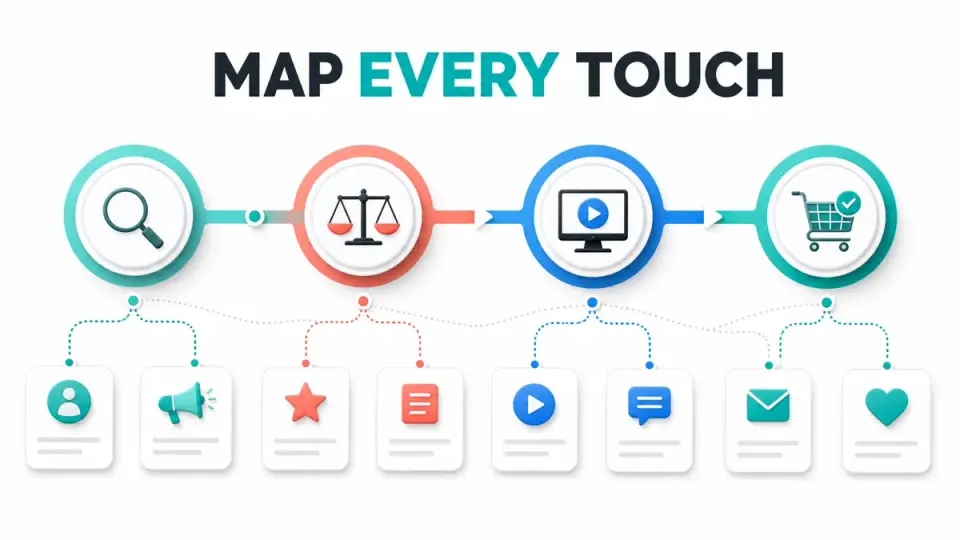
For example, a customer might discover a SaaS product in an affiliate comparison, return through organic search, attend a webinar, and later click a lifecycle email before subscribing. A linear report can assign 25 percent of analytical credit to each touch. The affiliate payout can still follow the program's written first-click or last-click rule.
This distinction extends the first click versus last click attribution guide without repeating it. That guide covers partner credit rules. Multi-touch analysis explains the wider journey after the payout owner is already governed.
Build the Minimum SaaS Event Path
A model is only as useful as the events it receives. Record a stable path from the first eligible interaction through the revenue event:
- Touchpoint ID, source, campaign, partner ID, landing page, and timestamp.
- Anonymous visitor or click ID with the applicable consent state.
- Lead or account ID created at signup.
- Billing customer, subscription, invoice, and transaction IDs.
- Commission ID, status, calculation basis, and payout owner.
- Refund, cancellation, dispute, or adjustment tied to the original transaction.
Do not use an email address as the only join key. Addresses change, may be mistyped, and can create unnecessary exposure of personal data. Keep vendor IDs and internal IDs in a controlled map, then define when identities can be merged.
The billing-native versus pixel tracking guide explains why click capture and recurring revenue are separate layers. The affiliate software API and webhook checklist adds event IDs, retries, exports, and recovery tests.
When comparing the FirstPromoter affiliate program, Tapfiliate affiliate program, Rewardful affiliate program, and PartnerStack affiliate program, treat their public directory pages as discovery aids. Your merchant configuration, contract, billing integration, and actual event payloads determine what can be measured.
Understand What Each Model Can and Cannot Prove
Linear attribution
Linear attribution is easy to explain because every recorded touch receives equal analytical credit. It works as an initial assist report when the team does not yet have a defensible weighting method.
Its weakness is intentional simplicity. A passing social view and an in-depth affiliate tutorial can receive the same weight. Use it to see path participation, not to claim equal causal impact.
Position-based attribution
Position-based attribution gives chosen weights to key locations, often the first and last touch, with the balance spread across middle interactions. It can help a team recognize both discovery and conversion support.
The weights are governance choices, not facts found in the data. Document the formula, keep it stable across comparisons, and never present a selected split as proof that one channel caused the outcome.
Time-decay attribution
Time-decay increases analytical credit as interactions approach the conversion. It can fit a long SaaS journey where recent demos, comparison pages, or lifecycle messages signal active evaluation.
It can understate durable education. An affiliate article may introduce the product weeks before the buyer is ready. Review the model beside first-touch and path reports so recent activity does not erase meaningful discovery.
Data-driven attribution
Data-driven systems estimate contribution from observed converting and non-converting paths. They can reveal patterns that fixed rules miss, but they require enough data, stable event definitions, and clarity about which channels and identities the platform can see.
Do not reverse-engineer a payout from a rounded model output. A model can be useful for budget allocation while remaining unsuitable for partner compensation or a dispute decision.
Choose a Model With a Practical Framework
Use multi touch affiliate attribution models only after naming the decision they will support.
| Decision | Recommended starting view | Required control |
|---|---|---|
| Explain complete customer paths | Linear plus raw path report | Consistent event order and identity rules |
| Recognize discovery and closing interactions | Position-based plus first and last touch | Published analytical weights |
| Study late-stage activation | Time-decay plus first-touch comparison | Fixed lookback and decay settings |
| Allocate marketing budget at scale | Data-driven plus controlled tests | Model documentation and sufficient data |
| Pay affiliate commissions | Contractual attribution rule | Reproducible transaction-level ledger |
Before adoption, answer five questions: What conversion is being modeled? Which touchpoints are observable? What lookback window applies? How are direct and unknown traffic handled? Can finance reproduce the payable affiliate result without the analytics model?
If the last answer is no, the architecture is mixing reporting with liability. Fix the separation before showing multi-touch metrics to partners.

Validate the Model Before Using It
Create controlled journeys that include an affiliate click, another marketing touch, signup, paid invoice, renewal, refund, and an attribution overwrite. Confirm the raw events first, the commission ledger second, and the analytical report third.
FirstPromoter's official architecture overview separates click tracking, referral tracking, and sales tracking. That separation is a useful test pattern even when another platform is selected. Verify the current documentation and your own account because available integrations and settings can differ.
Compare model outputs over the same date range and conversion definition. Investigate large changes before treating them as insight. A model switch can make a channel appear stronger even when no customer behavior changed.
Keep a version record with the model name, weights or settings, lookback window, included channels, identity policy, effective date, and owner. Re-run a fixed sample after any analytics, consent, billing, or affiliate-platform change.
Key Takeaways for Multi Touch Affiliate Attribution Models for SaaS Teams
Multi touch affiliate attribution models are most useful when they illuminate a SaaS journey without changing the contractual commission owner. Keep raw events, payable commissions, and analytical influence in distinct layers.
Start with an explainable model, publish its limits, and validate it against controlled paths. Use FindAffiliates to compare partner software, then require event-level proof from the platform and billing stack before relying on any attribution report.
FAQ
What is multi-touch affiliate attribution?
It is an analytical method that distributes conversion credit across several recorded interactions, which may include affiliate, search, email, social, direct, and sales touches. It does not automatically determine which affiliate earns a contractual commission.
Should SaaS companies pay several affiliates from one conversion?
Only if the written program terms and commission system explicitly support that arrangement. Most teams should keep one reproducible payout rule and use fractional attribution only for analysis and partner-development decisions.
Which attribution model should a small SaaS company start with?
Start with raw path reporting and a simple linear or position-based comparison. Those views are easier to audit than a complex model and can expose missing events before the company uses attribution for budget decisions.
How often should an attribution model be reviewed?
Review it after material tracking, consent, channel, billing, or product changes and on a regular governance schedule. Record every model version so a reporting shift is not mistaken for a performance shift.