Affiliate Software Field Portability Audit Checklist
Run an affiliate software field portability audit before migration to protect IDs, mappings, commissions, payouts, refunds, audit history, and rollback.
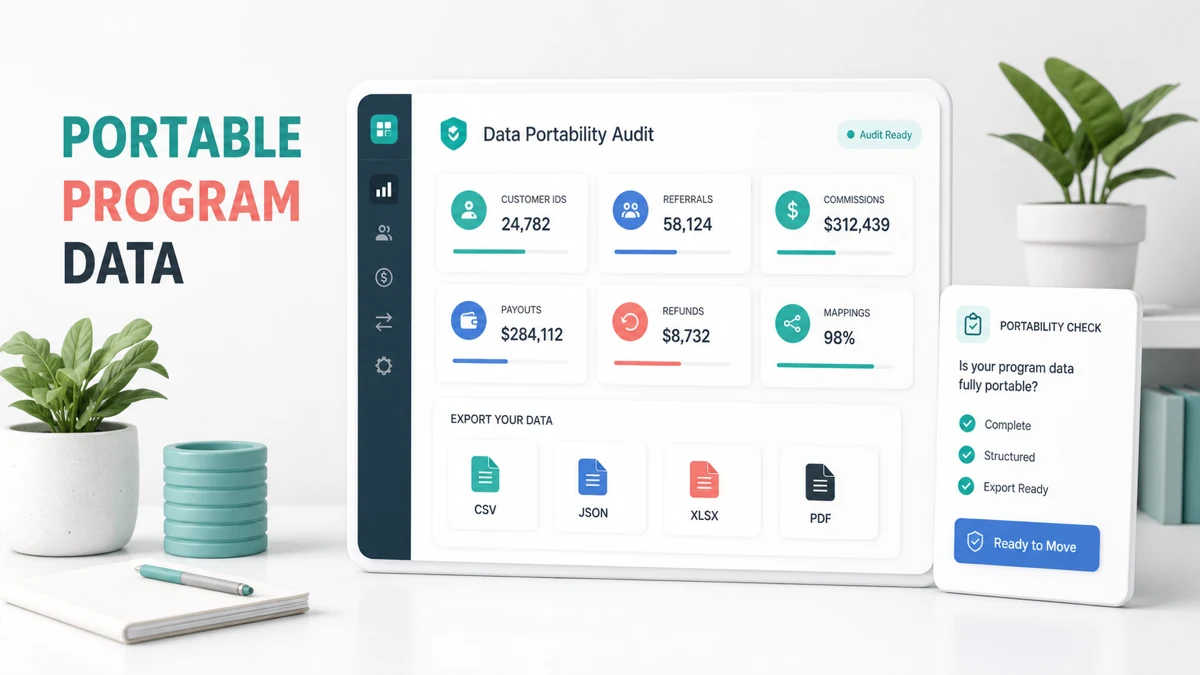
What Should You Compare Before Choosing?
An affiliate software field portability audit answers a harder question than whether a platform has an Export button. It tests whether the data you can retrieve is complete, stable, understandable, and usable for migration, reconciliation, or rollback.
The practical goal is to know which system owns every identifier, status, timestamp, commission, payout, refund, and audit event before a contract ends. By the end of this guide, you can grade each field as portable, reconstructable, archive-only, or unknown.
Quick answer: A sound affiliate software field portability audit maps each business record to a stable ID, preserves its state changes and financial evidence, and names the owner of any history that cannot move. A CSV of partner emails is not enough.
Use the same evidence standard for every export: a field counts as portable only when another system can identify it, interpret it, and reconcile it without relying on an undocumented manual step.
That distinction gives finance, operations, engineering, and legal teams a shared test, so migration decisions rest on evidence instead of assumptions about what an export probably contains.
What the Audit Must Prove
The audit should prove identity, completeness, meaning, chronology, and reversibility. A field is not truly portable just because it appears in an export. Your team must know what it identifies, whether it is unique, how it relates to other records, which time zone applies, and whether the destination can store it without changing its meaning.
Use four outcomes for every field:
| Outcome | Meaning | Required action |
|---|---|---|
| Portable | Exported and accepted by the destination | Map, test, and reconcile |
| Reconstructable | Not imported directly but reproducible from retained evidence | Document the method and owner |
| Archive-only | Must remain in a read-only source or controlled archive | Set retention and access rules |
| Unknown | Vendor documentation or account access does not confirm availability | Ask the vendor and delay irreversible cutover |
Do not convert unknown into assumed. If payout approvals, historical status changes, or refund links are not public in vendor documentation, record them as unknown until a sample export or written vendor response proves otherwise.

Audit Exportable IDs and Relationships
Start with IDs because names and email addresses can change. The minimum identity map usually includes affiliate ID, external customer ID, referral code, campaign ID, customer ID, subscription ID, invoice ID, commission ID, payout line ID, and payment reference.
For each ID, capture the source field name, format, uniqueness rule, parent record, destination field, and collision behavior. Preserve both the old and new platform IDs in a crosswalk. Never overwrite the source ID after import.
FirstPromoter is a useful example of why field-level review matters. Its official promoter API documentation exposes an internal promoter ID, a customer ID supplied by your system, status, creation time, referral identifiers, and a parent promoter relationship. Its webhook model also uses event IDs and timestamps. Those fields can connect an account to downstream events, but you still need to test which are included in your account's actual exports.
Compare that evidence with the export and import scope offered by Rewardful, Tapfiliate, and PartnerStack. Public product descriptions do not guarantee that historical records, custom fields, or audit events are portable. Ask for a sample export before choosing a destination.
The related affiliate software migration checklist covers cutover sequencing. This audit goes one level deeper by deciding whether each field can move or must stay under another owner's control.
Map Statuses and Timestamps Without Losing Meaning
Status labels often look compatible while representing different workflows. One system may call a commission pending until a refund window closes. Another may use pending until a manager approves it. Map definitions, not just words.
Create a state map for affiliates, referrals, customers, commissions, payouts, and webhook deliveries. Include allowed transitions. For example, a commission might move from pending to approved, held, paid, declined, or reversed. If the destination lacks a matching state, decide whether to transform it, retain it as metadata, or preserve it only in the archive.
Timestamps need the same care. Record created time, qualifying event time, approval time, payable time, payout batch time, settlement time, refund time, and last update time when available. Store the source time zone and precision. An export date is not a substitute for the original event time.
Stripe's subscription invoice documentation explains that subscriptions generate invoices across the billing lifecycle and that invoice behavior can vary by collection method and state. That is why a migration map should retain Stripe customer, subscription, invoice, and event references rather than reducing recurring revenue to a single commission total.
Preserve Commissions, Payouts, and Refund Links
Financial portability requires line-level evidence. Export the commission amount, currency, rate or fixed rule, eligible revenue basis, source invoice or order, affiliate, campaign, status, hold reason, approval record, and any later adjustment.
For payouts, retain the payout batch ID, line ID, affiliate ID, included commissions, gross amount, adjustments, fees when relevant, payment method reference, status, created time, sent time, settlement time, and failure reason. Keep sensitive bank or wallet credentials outside the migration workbook.
Refunds and chargebacks must link back to the original sale and commission. Preserve the original amount, refunded amount, refund ID, effective time, commission adjustment, and reviewer decision. A negative total with no source link is not sufficient audit evidence.
Run two reconciliations. First, trace commissions forward to payout and settlement. Second, trace eligible paid invoices backward to the expected commission. The affiliate payout audit checklist provides a fuller control framework for that two-way test.
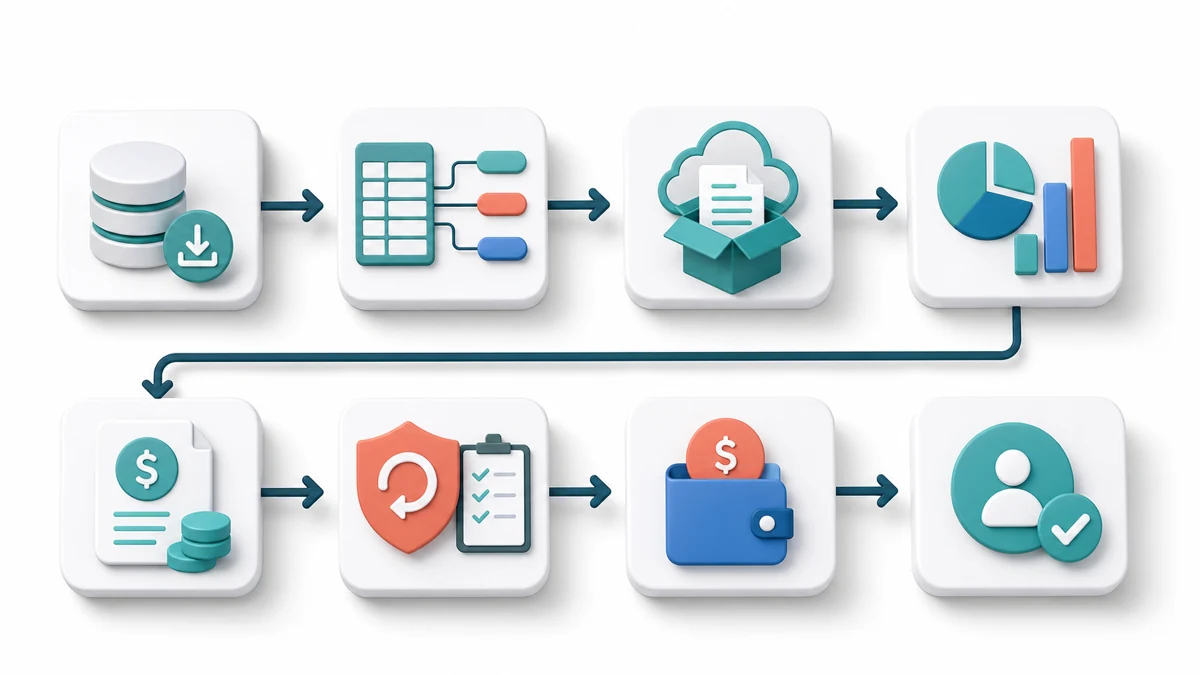
Retain Audit History and Webhook Evidence
An affiliate software field portability audit should include the history behind the current value. Export or archive application decisions, commission approvals, manual adjustments, payout status changes, campaign changes, rate overrides, and user actions when the platform makes them available.
Webhook evidence can fill part of that history. FirstPromoter's official API documentation shows stable promoter fields and explains that a supplied customer ID can be included in webhook events. Preserve event ID, event type, creation time, delivery time, payload version, response status, retry count, and the raw payload under an appropriate retention policy.
Webhooks are not automatically a complete ledger. An endpoint may have been added late, deliveries may have failed, and event schemas may change. Reconcile webhook history to platform exports and billing records before treating it as authoritative.
Assign Rollback Ownership Before Cutover
Rollback is an ownership plan, not a backup folder. Name who can restore old tracking, reactivate integrations, reverse redirects, pause duplicate commission creation, communicate with affiliates, and approve the financial reconciliation.
Use a simple responsibility table:
| Rollback area | Primary owner | Proof required |
|---|---|---|
| Referral links and redirects | Engineering | Tested restoration steps |
| Billing event delivery | Engineering or billing operations | Event replay and deduplication test |
| Commission ledger | Partner operations | Old and new totals reconciled by ID |
| Payout release | Finance | Locked batch and approval evidence |
| Partner communication | Program owner | Prepared notice and support route |
| Historical archive | Security or data owner | Access, retention, and recovery test |
Set a rollback decision deadline and objective triggers. Examples include missing priority links, duplicate commissions, unmatched active customers, failed renewal or refund tests, and an unexplained payout variance. The exact tolerance is a business control, so document it rather than borrowing a generic percentage.
Run the affiliate software field portability audit again after the pilot import. A mapping that looked complete on paper may fail when null values, custom rates, multiple currencies, or legacy statuses appear.
Key Takeaways for Affiliate Software Field Portability Audit Checklist
The safest affiliate software field portability audit treats partner data as a connected financial record. Preserve stable IDs, map states and timestamps, keep invoice-to-commission-to-payout links, retain audit events, and assign rollback authority before the old system becomes unavailable.
If a field cannot be exported, say whether it is reconstructable, archive-only, or unknown. That honest classification gives finance and partner operations a workable control plan. Use FindAffiliates to compare platform options, then request field-level proof from the vendors on your shortlist.
FAQ
What is an affiliate software field portability audit?
An affiliate software field portability audit checks whether partner, customer, attribution, commission, payout, refund, and audit data can be exported with enough context to migrate or reproduce it. It also assigns ownership for records that must remain archived.
Is a CSV export enough for an affiliate platform migration?
Usually not. A CSV may contain current accounts while omitting status history, billing relationships, commission adjustments, payout settlement, webhook deliveries, or approval evidence. Test the exact export and destination import fields.
Which identifiers should always be mapped?
Map affiliate, referral, customer, subscription, invoice, commission, payout line, and payment reference IDs whenever they exist. Preserve the source ID beside the destination ID so records remain traceable.
Who should own rollback after affiliate software changes?
Engineering should own tracking and integrations, partner operations should own accounts and commissions, finance should own payout release, and a named data owner should control the archive. One accountable program owner should make the final go or no-go decision.