Two Tier Affiliate Programs Explained for SaaS Teams
Two tier affiliate programs reward direct sales and affiliate recruitment. Learn the commission flow, margin checks, safeguards, and setup steps.

Which Affiliate Programs Are Worth Comparing First?
Two tier affiliate programs pay affiliates for their own customer referrals and can also pay a smaller override when an affiliate they recruited generates a qualified customer sale. The model can help a SaaS company expand partner sourcing, but it adds margin, tracking, fraud, disclosure, and payout complexity.
The quick answer is to use two tiers only when customer sales remain the qualifying event. Define who owns the customer referral, how the second-tier override is calculated, which statuses can reverse both commissions, and how the program prevents recruitment from becoming more valuable than product demand.
This guide explains the commission flow, the difference between two-tier and performance-tiered rates, the safety checks program owners need, and a practical setup sequence.
Quick Answer and Model Comparison
In a two-tier affiliate program, the direct affiliate earns the normal commission on a qualified customer action. The affiliate who recruited that direct affiliate may earn a smaller second-tier commission tied to the same customer action. No customer sale means no sales commission for either level.
Two tier affiliate programs are not the same as raising an affiliate's rate after a performance threshold. They are also not automatically multi-level marketing. The legal and trust risk depends on the full compensation structure, participant costs, claims, and whether rewards remain connected to sales to real customers.
| Model | Who earns | Qualifying event | Best use |
|---|---|---|---|
| One-tier affiliate | Direct affiliate | Direct customer action | Simple programs and clear attribution |
| Two-tier affiliate | Direct affiliate plus recruiting affiliate | Customer action generated by the direct affiliate | Partner-led recruitment with margin room |
| Performance tier | One affiliate at a higher future rate | That affiliate reaches a sales or earnings threshold | Rewarding individual performance |
| Customer referral | Existing customer or advocate | Referred customer reaches a defined milestone | Product-led advocacy rather than publisher recruitment |
How Two Tier Affiliate Programs Work
Start with three roles.
- The program owner defines the product, qualifying customer event, direct commission, and second-tier override.
- The recruiting affiliate introduces another affiliate through a tracked recruitment link or manager-approved relationship.
- The direct affiliate promotes the product and generates a qualifying customer action.
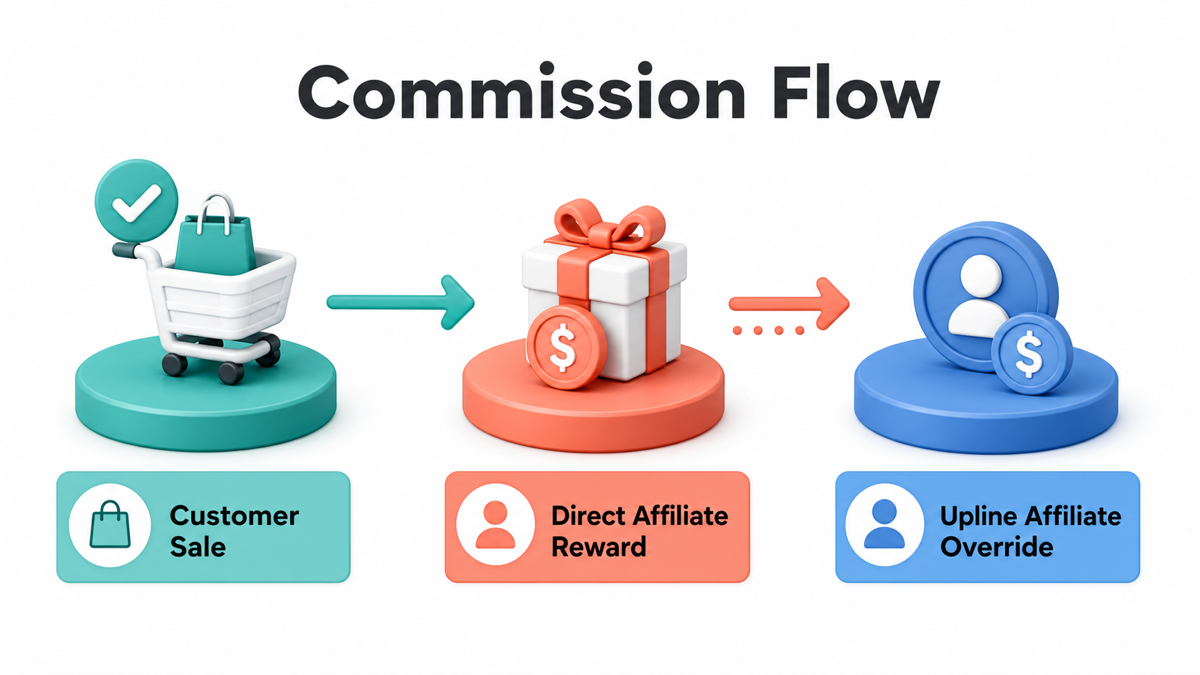
The direct affiliate owns the customer referral. The recruiting affiliate does not take that commission. The system creates a separate override linked to the parent relationship and the same sale record.
For a simple hypothetical example, assume a customer pays $100 in eligible net revenue. The direct affiliate earns 20% of the sale, or $20. If the second-tier override equals 10% of the direct affiliate's commission, the recruiting affiliate earns $2. Total program cost is $22 before payment fees and operations.
That calculation is different from paying the recruiting affiliate 10% of sale revenue, which would add $10 instead of $2. Write the calculation basis explicitly. The AffiliateWP multi-tier commission documentation shows why software may support either a percentage of tier-one earnings or a percentage of the sale amount.
Two Tier Versus Tiered Affiliate Rates
The words sound similar, but the incentives are different.
Two-tier commission: Affiliate A recruits Affiliate B. B earns on B's customer sales, while A may receive an override connected to those sales.
Performance-tiered rate: Affiliate B reaches a threshold, such as approved sales or commission earned, and B's rate increases for future customer sales. No parent affiliate is involved.
Do not use one label for both models. Affiliates need to understand whether a higher rate rewards their own performance or whether part of the program budget rewards a recruitment relationship.
Tools can implement these rules differently. Compare configuration, status handling, export detail, and parent-record controls before choosing software. Program owners can start with the Tapfiliate affiliate program, FirstPromoter affiliate program, Rewardful affiliate program, and PartnerStack affiliate program pages, then verify the exact product capability in current official documentation.
When a Two Tier Model Makes Sense
Two tier affiliate programs fit a narrow set of conditions.
Product demand already exists
Recruitment should expand a working channel, not hide weak product demand. Confirm that direct affiliates can generate approved customers under the one-tier model before adding overrides.
Strong affiliates can source and support partners
The best recruiting affiliates bring relevant publishers, agencies, consultants, or educators. They can explain the product, help a new affiliate choose a first campaign, and reduce the program owner's sourcing work.
Contribution margin supports both rewards
Model the direct commission, override, refunds, discounts, taxes, payment fees, customer support, and platform cost. The affiliate commission rate guide explains why a headline percentage is not a complete budget.
The team can reconcile linked records
Every second-tier commission should point to a direct commission, customer event, parent affiliate, calculation version, and status history. If finance cannot reproduce the amount from exported records, the model is not ready.
Governance is documented
Define who can recruit, whether self-referrals are blocked, how parent relationships are assigned, whether relationships can change, and what happens to open commissions when an affiliate is removed.
When to Keep a One Tier Program
Stay with one tier when the team is still fixing basic attribution, payout, or approval problems. More commission paths multiply weak processes.
A one-tier model is usually better when:
- The product has limited margin or a long refund period.
- The program has only a few active affiliates.
- Recruitment quality is difficult to review.
- The platform cannot export parent and child commission records.
- Affiliates mainly want a higher direct rate, not a recruiting role.
- The company cannot train or monitor claims made by recruiting affiliates.
Use the affiliate fraud prevention guide before adding recruitment rewards. A new incentive can create duplicate accounts, circular recruiting, false leads, or coordinated self-referrals if controls are weak.
Build the Commission Model Before Configuring Software
Write the economics in plain language first.
| Field | Decision to document |
|---|---|
| Direct qualifying event | Paid invoice, approved order, qualified lead, or another event |
| Eligible revenue | Gross, net of discounts, net of refunds, or fixed bounty basis |
| Direct commission | Percentage or fixed amount |
| Override basis | Percentage of direct commission or percentage of eligible revenue |
| Pending window | Time before commission becomes approved |
| Reversal rule | Refund, chargeback, fraud, cancellation, or policy breach |
| Parent relationship | How it is created, verified, changed, and ended |
| Payout threshold | Balance and schedule for each affiliate |
| Data record | IDs and timestamps finance needs to reproduce the result |
Calculate the maximum cost, not only the expected average. Include a full direct commission, full override, sales discount, refund exposure, and payment fees in the same scenario.
Do not take the override from the direct affiliate unless the agreement says so clearly and the incentive still works. Most programs should budget the second-tier reward as an additional program cost.
Keep Customer Sales at the Center
A two-tier structure can resemble parts of multi-level compensation, so the operating model and claims matter. The FTC's business guidance concerning multi-level marketing says assessments are fact-specific and examines the plan, participant experience, marketing representations, and incentives created by the structure.
The safest operational principle is simple: do not pay merely because someone paid to join. Connect rewards to defined customer value, avoid extravagant income claims, disclose participant costs, and make sure recruiting does not become the practical focus of the program.

Two tiers do not automatically make a program unlawful or deceptive. They do create a need for careful legal review, clear claims, and evidence that real customers buy the product without joining the earning structure.
A Practical Setup Checklist
1. Prove the one-tier program
Measure approved customers, refunds, affiliate activation, payout accuracy, and contribution margin. Do not add a recruiting incentive to repair low product conversion.
2. Define eligible recruiters
Start with a small group of active affiliates who understand the product and have a relevant partner network. Make the privilege revocable and document the review criteria.
3. Choose one override calculation
Specify whether the second tier earns a percentage of the direct affiliate's commission or a percentage of eligible sale revenue. Include examples for refunds, discounts, upgrades, and recurring invoices.
4. Lock the parent relationship
Decide when a recruited affiliate becomes attached to a parent, how disputes are handled, and whether a manager can correct an error. Preserve a change log.
5. Map statuses across both commissions
A refund or fraud decision may affect the direct commission and its linked override. Test pending, approved, reversed, rejected, and paid states before launch.
6. Publish plain-language terms
Explain the customer event, rate basis, prohibited behavior, disclosure duties, payout schedule, and termination effect. The guide to affiliate versus referral programs can help teams keep customer advocacy and publisher recruitment as separate tracks.
7. Pilot and reconcile
Run one or two payout cycles with a small cohort. Finance should reproduce each amount from customer, commission, parent, status, and payout records before the program expands.
Common Two Tier Affiliate Program Mistakes
Paying for recruitment alone
This changes the incentive from customer acquisition to participant acquisition. Require a real customer event for sales commissions.
Confusing parent status with customer attribution
The recruiting affiliate owns the affiliate relationship, not the customer click. Keep the direct sale attribution record separate.
Using an ambiguous percentage
Ten percent of sale revenue and ten percent of a direct commission are different amounts. Name the base in the agreement and dashboard.
Ignoring reversals
If the direct commission reverses, the linked override needs a defined status change. Otherwise finance can overpay or create unexplained negative balances.
Letting anyone recruit immediately
New affiliates may optimize for signup volume before they understand the product or policies. Limit recruiting access until an affiliate demonstrates compliant customer acquisition.
Forecasting from signups instead of active sellers
More recruited affiliates do not guarantee more customers. Measure activation, approved revenue, refund rate, and support workload by recruiting affiliate.
Key Takeaways for Two Tier Affiliate Programs Explained for SaaS Teams
Two tier affiliate programs can turn trusted affiliates into a partner-sourcing channel, but the second reward must stay tied to real customer value. Prove the direct program, model total cost, define one calculation, preserve parent and commission records, test reversals, and pilot with a small group.
Browse FindAffiliates to compare affiliate software and program examples, then verify current platform features and obtain legal advice for the structure you plan to operate.
FAQ
What is a two tier affiliate program?
A two-tier affiliate program pays a direct affiliate for a qualified customer referral and may pay a separate override to the affiliate who recruited that direct affiliate. The customer action, not recruitment alone, should trigger the sales commissions.
Are two tier affiliate programs legal?
The answer depends on the full structure, claims, participant costs, customer sales, and applicable law. Two tiers are not automatically illegal, but recruitment-first rewards and deceptive income claims create serious risk. Obtain legal review before launch.
What is the difference between two-tier commissions and tiered rates?
Two-tier commissions connect two affiliates through a recruiting relationship. Performance-tiered rates increase one affiliate's future rate after that affiliate reaches a threshold. They solve different incentive problems.
How should a second-tier commission be calculated?
Choose a defined basis, such as a percentage of the direct affiliate's commission or a percentage of eligible customer revenue. State the basis, status rules, examples, and reversal treatment in the agreement.
When should a SaaS company avoid a two-tier model?
Avoid it when direct attribution is unreliable, margins are tight, few affiliates are active, recruitment quality is hard to control, or finance cannot reconcile parent and child commission records. Fix the one-tier program first.