Affiliate vs Referral Program: A SaaS Decision Guide
Compare affiliate vs referral program models for SaaS, including partner type, incentives, tracking, ownership, economics, and when to run both.

What Should You Compare Before Choosing?
Choose an affiliate program when you want external publishers, creators, consultants, or educators to reach new audiences at scale. Choose a referral program when you want customers or trusted users to introduce people they know. Run both when each motion has a distinct audience, incentive, message, and tracking path.
The label alone is not enough. Some companies call every partner a referrer, while others call customer advocates affiliates. This affiliate vs referral program guide focuses on how the motion actually operates so a SaaS team can choose the right model.
Affiliate vs Referral Program: The Short Answer
| Decision factor | Affiliate program | Referral program |
|---|---|---|
| Typical promoter | Publisher, creator, consultant, agency, educator | Customer, user, community member |
| Relationship to buyer | Audience reach, expertise, or distribution | Personal trust or direct connection |
| Common incentive | Cash commission tied to a qualifying event | Cash, credit, discount, upgrade, or two-sided reward |
| Promotion style | Content, reviews, comparisons, tutorials, newsletters | Direct invitation, in-product sharing, personal recommendation |
| Program owner | Partnerships, affiliate, growth, or marketing | Growth, lifecycle, customer success, or product |
| Tracking emphasis | Links, coupons, partner attribution, commissions | Invites, referral codes, account identity, reward eligibility |
| Best fit | Acquiring new audiences through repeatable content and distribution | Activating satisfied customers to invite relevant peers |
An affiliate program buys accountable distribution. A referral program turns existing trust into introductions. The two can share software and reporting, but they should not share vague rules.
What Is an Affiliate Program?
An affiliate program rewards external partners for driving a defined result. The result may be a lead, trial, subscription, sale, or another approved event. Partners usually promote through content or a repeatable distribution channel rather than a one-to-one introduction.
Typical SaaS affiliates include:
- Review and comparison publishers
- YouTube educators
- Newsletter writers
- Consultants and agencies
- Course creators
- Niche community operators
The program needs clear eligibility, attribution, commission rules, disclosures, approved claims, and a way to review partner quality. Platforms with FindAffiliates listings such as Rewardful, FirstPromoter, and Tapfiliate illustrate the category of tools teams may evaluate for tracking and partner operations.
An affiliate is not automatically a customer. Their value may come from audience access, subject expertise, search visibility, or content production.
What Is a Referral Program?
A referral program asks customers or trusted users to invite people in their network. The recommendation is usually personal and based on direct product experience.
Typical referral actions include:
- Sharing an invite link from inside the product
- Sending a referral code to a colleague
- Inviting another team or workspace
- Recommending the product during a customer conversation
- Giving both the referrer and new customer a benefit
The program should make the action easy and explain eligibility before the user shares. It also needs rules for self-referrals, duplicate accounts, existing leads, reward timing, cancellations, and abuse.
A referral program is not simply an affiliate program with smaller rewards. It uses a different source of trust and often sits closer to product adoption, lifecycle messaging, and customer success.
Choose the Model by Growth Motion

Start with the growth constraint you need to solve.
Choose an Affiliate Program for New Distribution
An affiliate program is usually the better starting point when:
- Buyers research through reviews, tutorials, or comparisons
- Creators and publishers already explain your category
- Consultants influence tool selection across multiple clients
- Your economics can support a commission after validation
- The product has a clear conversion event and reliable attribution
- Your team can recruit, review, enable, and monitor partners
The SaaS affiliate program examples show how audience, partner fit, proof, and application flow should connect on the public program page.
Choose a Referral Program for Customer Advocacy
A referral program is usually the better starting point when:
- Active customers know other likely buyers
- Product value is easy to explain from personal experience
- The invite can appear at a high-satisfaction moment
- A credit, discount, upgrade, or cash reward fits the relationship
- The team can identify eligible accounts and prevent abuse
- The referred buyer can complete a clear signup or purchase path
Referral programs are strongest when the invitation feels like a useful recommendation, not an automated request sent before the customer has received value.
Do Not Launch Either Model Yet When
Delay the launch if retention is weak, product positioning is unclear, conversion tracking is unreliable, reward economics are unknown, or nobody owns partner and customer support. A program amplifies the current customer journey. It does not repair a product people do not recommend.
Compare Incentives and Economics
The right incentive follows the promoter's role and the value of the qualifying customer.
Affiliate incentives often use:
- A fixed amount per approved lead or customer
- A percentage of eligible revenue
- A recurring commission for a defined period
- A tier based on approved performance
- A hybrid of fixed and recurring rewards
Referral incentives may use:
- Account credit
- A subscription discount
- A feature or usage upgrade
- Cash or a gift card
- A two-sided reward for referrer and new customer
Model the economics from approved value, not raw signups. Include gross margin, refund or cancellation risk, validation cost, support cost, reward fulfillment, and the time until a customer becomes valuable.
Do not copy a competitor's commission without understanding its price, margin, retention, attribution, or qualifying action. The correct reward is one your business can sustain and a legitimate promoter can understand.
Design Different Partner Journeys
An affiliate journey usually includes application, review, acceptance, onboarding, tracked assets, content support, reporting, commission approval, and payout. The affiliate application review checklist helps teams screen for real channels, audience fit, content quality, promotion method, and disclosure readiness.
A referral journey is usually shorter. It may include an in-product prompt, an invite link, a reward explanation, a progress state, and fulfillment after the referred account qualifies.
These journeys need different messages:
| Stage | Affiliate message | Referral message |
|---|---|---|
| Invitation | Promote the product to a relevant audience | Invite someone who would benefit |
| Proof | Show channel, audience, and promotion method | Use direct product experience |
| Enablement | Claims guide, links, assets, content angles | Simple share copy and reward terms |
| Reporting | Clicks, conversions, status, commissions | Invites, qualified referrals, reward status |
| Support | Partner manager or program inbox | Customer support or referral help |
The affiliate onboarding sequence gives program owners a practical starting point for activating approved affiliates without overwhelming them.
Set Ownership Before You Pick Software
Software can track a program, but it cannot decide which team owns its outcomes.
For an affiliate program, assign owners for:
- Recruitment and application review
- Partner onboarding and activation
- Claims, assets, and content updates
- Conversion validation
- Commission approval and payouts
- Fraud and policy enforcement
- Partner support
For a referral program, assign owners for:
- In-product placement and lifecycle prompts
- Customer eligibility
- Invite and reward messaging
- Referral validation
- Reward fulfillment
- Abuse controls
- Customer support
PartnerStack describes a partner ecosystem that can include affiliate, referral, and reseller channels. That breadth is useful only when the business rules remain clear for each channel.
Define Tracking and Attribution Rules
For either model, write the rule before launching the link.
At minimum, define:
- The qualifying event
- Who is eligible to receive credit
- The attribution or referral window
- How existing leads and customers are handled
- Whether coupon or code attribution applies
- How duplicate referrals are resolved
- When a reward becomes approved
- What causes rejection or reversal
- When and how rewards are delivered
Rewardful's campaign settings documentation shows how campaigns can carry their own commission structure, cookie duration, and attribution settings. Treat those controls as implementation choices, not a substitute for a public policy.
Keep customer referral and affiliate identifiers separate when possible. That makes reporting, support, and abuse review easier, especially when one person could qualify for both programs.
When to Run Both Programs
Run both only when you have two distinct acquisition motions.
A clean dual-program design might look like this:
- Customers use an in-product referral flow for direct introductions
- Publishers and consultants apply to a managed affiliate program
- Each program has its own landing page, terms, reward, and owner
- Attribution conflicts follow a written priority rule
- Reporting separates customer referrals from partner-driven conversions
- A participant cannot claim two rewards for the same customer
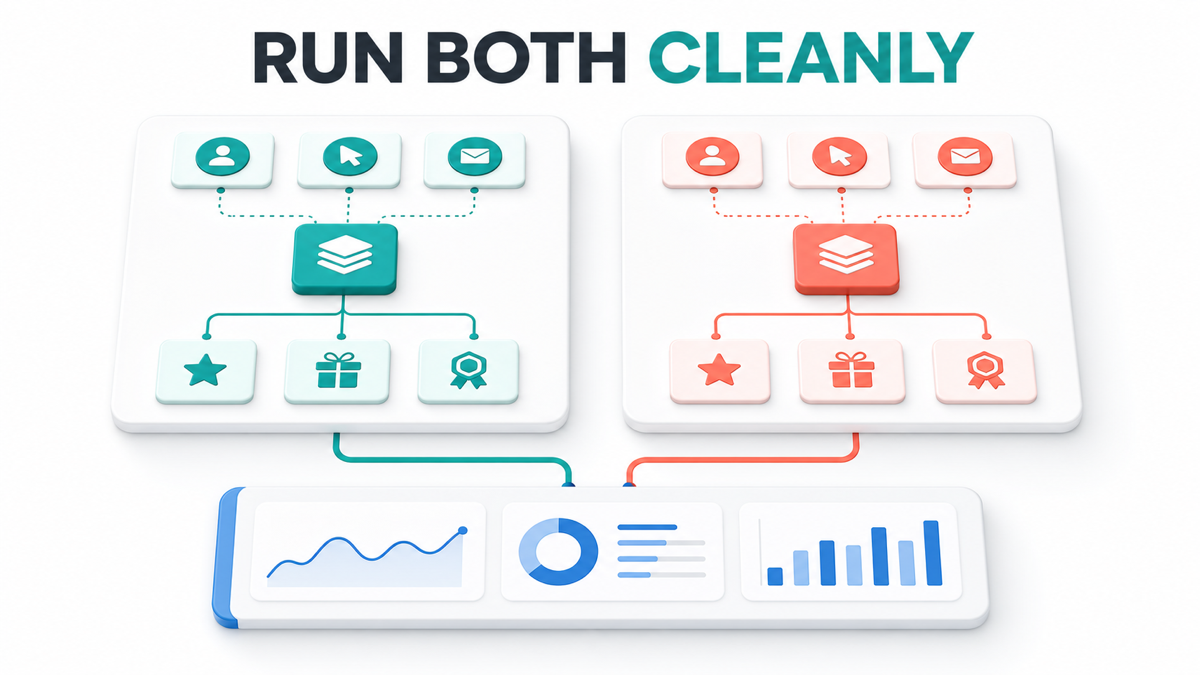
Before choosing, define who influences the buyer, what creates value, who owns the motion, and how overlapping claims are resolved. Start with external distribution for affiliates or customer trust for referrals. Build both only when they are operationally distinct.
The guide to affiliate tracking software can help you evaluate tools after the operating model is clear.
Frequently Asked Questions
What is the main difference between an affiliate and a referral program?
An affiliate program rewards external partners for repeatable audience promotion. A referral program rewards customers or trusted users for direct introductions.
Can a customer also be an affiliate?
Yes. A customer with a relevant public audience may qualify for an affiliate program. Give them the affiliate terms, tracking, disclosure guidance, and support rather than treating every customer invite as affiliate activity.
Is an affiliate program more expensive than a referral program?
Not necessarily. Cost depends on reward size, qualification rules, conversion quality, operations, software, and support. Compare total approved acquisition cost and customer value for each motion.
Should a SaaS company launch affiliate or referral first?
Launch the motion with the strongest existing advantage. Start with referrals if satisfied customers already make introductions. Start with affiliates if credible publishers, educators, or consultants already influence the category.
Key Takeaways for Affiliate vs Referral Program: A SaaS Decision Guide
The affiliate vs referral program decision comes down to the source of influence. Affiliates provide external distribution through content, expertise, and audience reach. Referrers provide direct introductions built on customer trust. Choose one clear motion first, define its economics and rules, then add the second only when it has a distinct job.
Use FindAffiliates to research program examples and partner platforms while you build the operating model that fits your SaaS business.