Two Tier Affiliate Commission Cost Calculator Guide
Use this two tier affiliate commission cost calculator to model direct and upline rewards, recurring costs, refunds, guardrails, and a go or no-go test.
On this page (10)
What Should You Compare Before Choosing?
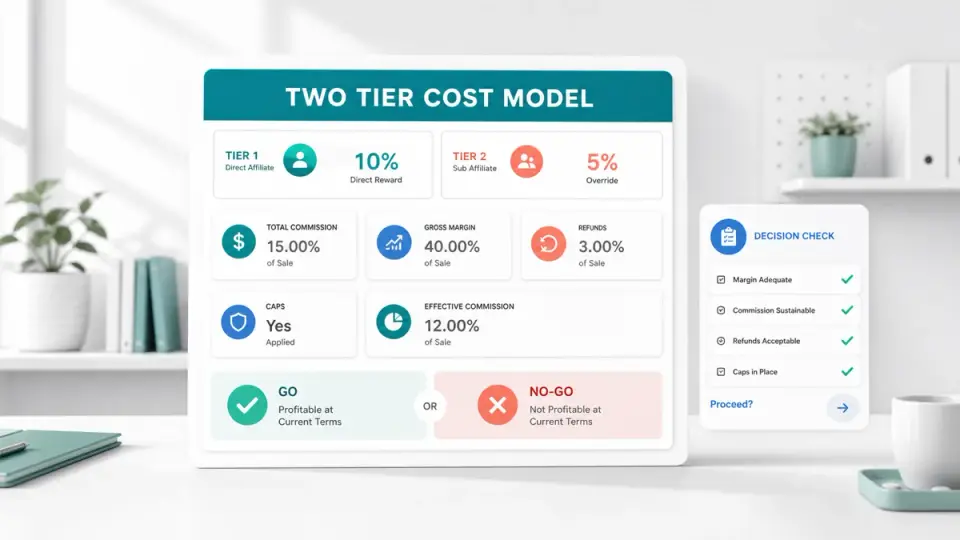
A two tier affiliate commission cost calculator shows the full commission created when a direct affiliate makes a sale and an eligible parent affiliate receives an additional override. It prevents teams from approving a second tier based only on the small-looking upline rate.
This guide gives you transparent formulas, a clearly labeled hypothetical example, recurring-cost adjustments, guardrails, and a go or no-go test. It does not predict revenue or affiliate earnings. Use your own eligible revenue, margin, refund, and operating-cost data.
Quick answer: Calculate the direct commission on all eligible affiliate revenue, add the second-tier override only on eligible sub-affiliate revenue, then subtract refunds and other excluded amounts under the program rules. Compare the result with contribution margin, not gross revenue alone.
Define the Two-Tier Cost Model
The simplest two-tier structure pays the selling affiliate a direct rate and pays one approved parent affiliate an override on that same eligible sale. Recruitment alone should not create a commission. A qualifying customer action should.
Use these inputs for the two tier affiliate commission cost calculator:
| Symbol | Input | Definition |
|---|---|---|
| D | Direct eligible revenue | Revenue attributed to affiliates without an eligible parent override |
| S | Second-tier eligible revenue | Revenue attributed to sub-affiliates that also creates an upline reward |
| d | Direct commission rate | Rate paid to the affiliate that drove the eligible sale |
| u | Upline override rate | Additional rate paid to the eligible parent affiliate |
| O | Other variable program cost | Payout fees, bonuses, or support cost included in your decision model |
| g | Gross margin rate | Gross profit before affiliate commissions and included program costs |
Keep D and S mutually exclusive for a given period. Every sale can receive the direct rate, but only qualifying sub-affiliate sales enter S for the additional override.
Use the Core Formulas
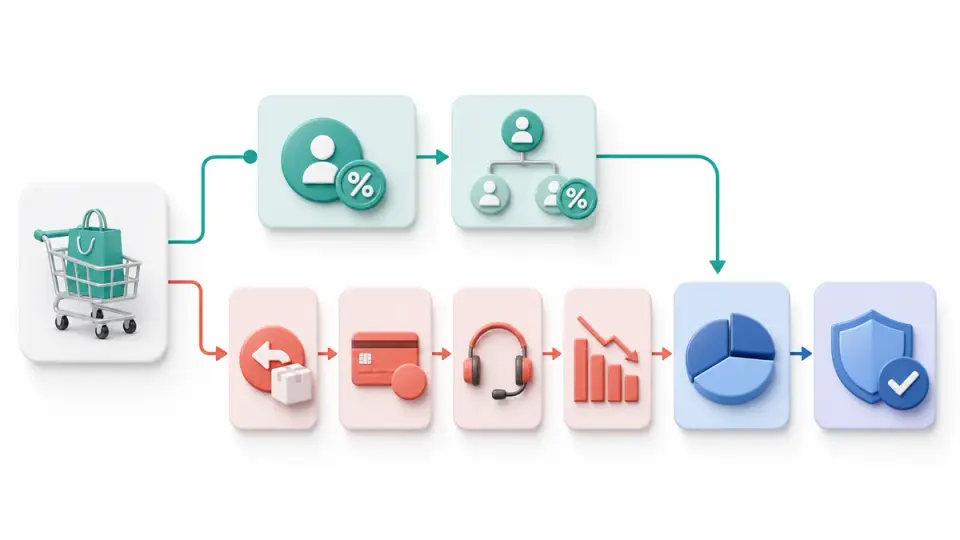
For percentage commissions, calculate direct commission first:
Direct commission = d x (D + S)
Then calculate the upline override:
Upline commission = u x S
Total commission cost is:
C = d x (D + S) + u x S
The incremental cost of adding the second tier is simply:
Incremental second-tier cost = u x S
Commission cost as a share of eligible revenue is:
Commission cost rate = C / (D + S)
To test contribution after commissions and included variable costs:
Remaining contribution = g x (D + S) - C - O
Remaining contribution rate = Remaining contribution / (D + S)
If the program uses fixed rewards, calculate each eligible event count separately. Do not convert a fixed amount into a percentage unless the team understands that the effective rate changes with order value.
Worked Example With Hypothetical Numbers
The following numbers are hypothetical and illustrate the formulas only. They are not earnings claims, market benchmarks, or recommended rates.
Assume one month has:
- D = $40,000 in direct eligible revenue
- S = $20,000 in eligible sub-affiliate revenue
- d = 20% direct commission
- u = 5% upline override
- g = 80% gross margin
- O = $2,000 in other included variable program costs
Direct commission:
20% x ($40,000 + $20,000) = $12,000
Upline commission:
5% x $20,000 = $1,000
Total commission cost:
$12,000 + $1,000 = $13,000
Commission cost rate:
$13,000 / $60,000 = 21.67%
Remaining contribution:
80% x $60,000 - $13,000 - $2,000 = $33,000
Remaining contribution rate:
$33,000 / $60,000 = 55%
Without the second tier, commission cost would be $12,000. The second tier adds $1,000 for this hypothetical month. Whether that passes depends on the company's approved contribution floor, expected incremental behavior, support load, and risk controls.
Adjust for Refunds, Recurring Revenue, and Caps
Run the two tier affiliate commission cost calculator on the same eligible basis used by the agreement. If commissions apply to collected revenue after discounts and refunds, do not model list price. Separate taxes, credits, chargebacks, and excluded products according to the written rules.
For a refunded or reversed sale, use one of two documented methods. Either calculate on net eligible revenue for the period, or calculate original commissions and show linked reversals. The second method creates a clearer audit trail when refunds occur after a payout period.
Recurring programs require a time series:
C over T periods = sum from t=1 to T of [d x (D_t + S_t) + u x S_t]
Do not multiply month one by twelve unless renewals, cancellations, plan changes, and refunds are actually assumed and labeled. Model each period with its own D, S, and eligible-revenue basis.
FirstPromoter's recurring commission documentation describes customer-lifetime, time-span, and charge-count options, plus percentage and flat monetary rewards. Those settings change the cost horizon, so the calculator should match the live campaign configuration.
Caps can limit customer-lifetime cost, total commission count, or the upline reward. Model the cap as a rule applied at the customer or affiliate level, not as an unexplained reduction to the final total.
Match the Formula to Platform Behavior
Software labels vary. Confirm which affiliate is Level 1, whether the parent relationship is fixed, when each party becomes eligible, and what happens after refunds or status changes.
Tapfiliate's official multi-level guidance describes a relative structure in which the affiliate driving the conversion receives the standard Level 1 reward and eligible upline affiliates receive configured higher-level rewards. It also states that both parent and child must be approved for the program to receive these commissions.
When evaluating FirstPromoter, Tapfiliate, Rewardful, or PartnerStack, verify current plan availability and account settings directly. If a public source does not confirm the exact multi-level behavior you need, record it as unknown and request written confirmation.
The two-tier affiliate programs guide explains the operating model. The affiliate commission rate guide helps frame the direct rate. This calculator focuses on the combined cost.

Apply Financial and Program Guardrails
Set guardrails before launch so a successful recruiting push does not create an unplanned liability.
Eligible Revenue Guardrail
Define whether commission uses collected cash, invoice subtotal, net revenue after discounts, or another basis. Specify taxes, refunds, credits, and excluded products.
Relationship Guardrail
Require an approved parent-child relationship before the qualifying event. Prevent retroactive parent changes from silently reallocating historical commissions.
Duration and Cap Guardrail
State whether direct and upline rewards are one-time, recurring for a fixed period, limited by charge count, or customer-lifetime. Put caps in the agreement and platform.
Margin Guardrail
Choose a minimum remaining contribution rate using actual product economics. Include payout fees, bonuses, support, fraud review, and software cost if they change the decision.
Audit Guardrail
Preserve sale, affiliate, parent, rate, commission, refund, approval, and payout IDs. Recalculate a sample before every payout cycle and monitor duplicate or orphaned upline rewards.
Run the Go or No-Go Test
Use the two tier affiliate commission cost calculator under base, downside, and high-adoption scenarios. Change second-tier revenue share, refund rate, recurring duration, direct rate, override rate, and operating cost one input at a time.
Choose go only when all of these are true:
- Remaining contribution stays above the company's approved floor in the downside case.
- The platform can enforce parent eligibility, duration, caps, refunds, and status changes.
- Finance can trace both commission lines to the same qualifying sale without duplicate payment.
- The agreement explains the direct reward, upline reward, eligible revenue, and termination treatment.
- A pilot has a defined owner, limit, review date, and stop condition.
Choose no-go when the model depends on unsupported retention, excludes material costs, cannot explain refund reversals, or leaves parent relationships open to retroactive change. Choose a limited pilot when the economics pass but operational evidence is still incomplete.
Key Takeaways for Two Tier Affiliate Commission Cost Calculator Guide
A two tier affiliate commission cost calculator should separate direct revenue, sub-affiliate revenue, direct commission, and the upline override. Add recurring duration, refunds, caps, and operating costs before comparing the result with contribution margin.
Keep every forecast labeled as an assumption and every worked number labeled hypothetical. Use FindAffiliates to compare program platforms, then test the chosen configuration with controlled transactions before opening the second tier broadly.
FAQ
How do you calculate a two-tier affiliate commission?
Multiply the direct rate by all eligible affiliate revenue, then multiply the upline rate by eligible sub-affiliate revenue. Add those amounts. Apply refunds, exclusions, duration rules, and caps exactly as the agreement defines them.
Is the second-tier rate paid instead of the direct rate?
Usually it is an additional override, but platform structures vary. Confirm whether the selling affiliate receives the standard direct reward and whether the eligible parent receives a separate reward on the same event.
Should recurring commissions be multiplied by twelve?
Not automatically. Model each period using expected eligible revenue after cancellations, refunds, plan changes, and caps. A flat twelve-month multiplication is valid only when that assumption is explicit and appropriate.
What is a safe second-tier commission rate?
There is no universal safe rate. A rate is affordable only when the downside model stays above the company's contribution floor and the program can control eligibility, refunds, caps, payout accuracy, and fraud risk.