Affiliate Marketing Email Sequence: 7 Beginner Emails
Use this affiliate marketing email sequence for beginners to write seven useful emails with clear disclosures, focused offers, and trackable next steps.
On this page (8)
What Should You Compare Before Choosing?
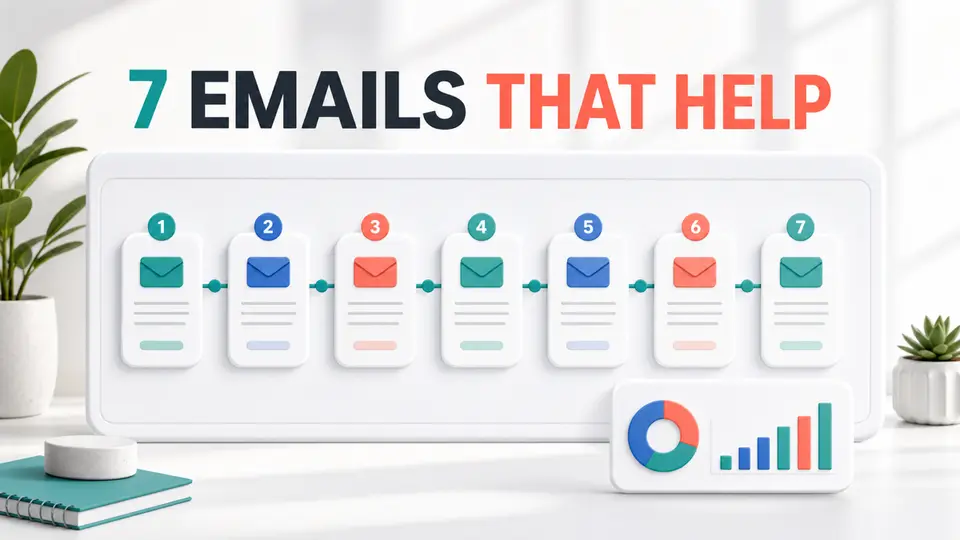
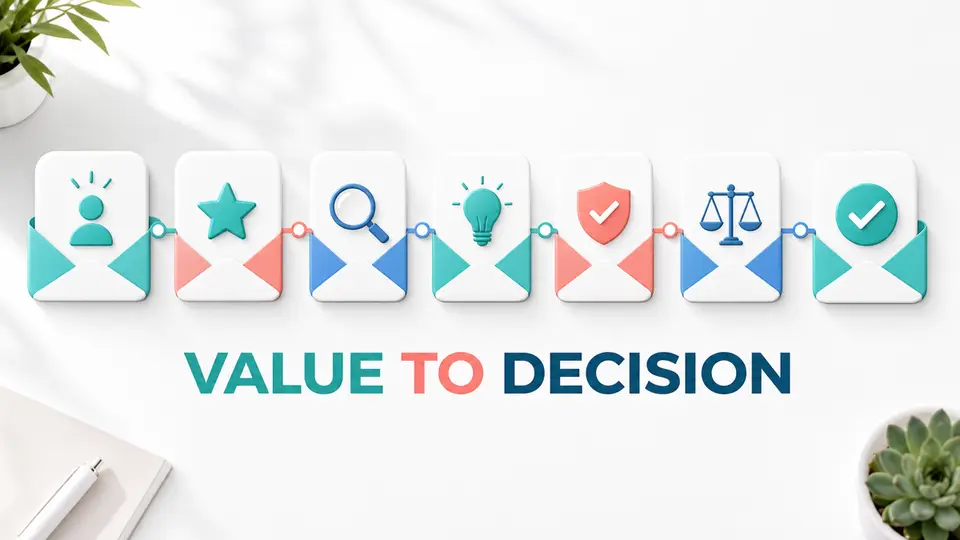
An affiliate marketing email sequence for beginners should help a subscriber solve one problem before it asks for a purchase. A useful seven-email sequence moves from welcome and quick win to problem diagnosis, product fit, proof, objections, and a clear decision.
The safest starting point is one audience, one problem, and one primary recommendation. Each email should have a single job, a plain-language affiliate disclosure when a recommendation could earn a commission, and a next step you can measure.
This guide gives you seven reusable email structures, a schedule, compliance checks, and tracking rules. Replace bracketed prompts with honest details and current sources.
Quick Answer: The Seven-Email Sequence
| Send time | Main job | Primary action | |
|---|---|---|---|
| 1. Welcome and promise | Immediately | Set expectations and deliver value | Use the promised resource |
| 2. Quick win | Day 1 | Help the reader make progress | Complete one small task |
| 3. Problem diagnosis | Day 3 | Explain why the problem persists | Identify the main constraint |
| 4. Recommendation and fit | Day 5 | Introduce one relevant solution | Review fit and limitations |
| 5. Walkthrough or example | Day 7 | Show the solution in context | Follow a practical process |
| 6. Objections and alternatives | Day 10 | Help the reader compare choices | Choose, wait, or use an alternative |
| 7. Decision and next steps | Day 14 | Summarize the decision | Take one clear next action |
This affiliate marketing email sequence for beginners is adaptable. Change the timing to match the reader's problem, the buying cycle, and how often subscribers expect to hear from you.
Keep this affiliate marketing email sequence for beginners focused.
Prepare the Sequence Before You Write
Start with a one-sentence promise: "I help [specific reader] achieve [specific outcome] without [important constraint]." Every email should support that promise.
Choose one offer only after checking audience fit, official terms, allowed traffic sources, and the claims you can support. The guide to choosing affiliate programs provides a practical decision framework.
Email tools can also become relevant recommendations when they fit the lesson. The Kit affiliate program, beehiiv affiliate program, and MailerLite affiliate program are starting points for research, but current official terms and dashboard rules should guide any claim.
Decide what success means before sending. Track useful replies, resource use, qualified clicks, approved commissions, unsubscribes, and complaints. A high click count does not repair a weak audience match.

The 7 Beginner Affiliate Emails
1. Welcome and Deliver the Promise
The first email should confirm why the person subscribed, deliver the promised resource, and explain what will arrive next. Do not turn the welcome into a crowded catalog of links.
Subject: Your [resource] and what comes next
Copy structure:
Hi [first name],
Thanks for joining. Here is the [resource] you requested: [direct resource link].
Over the next two weeks, I will show you how to [specific outcome]. The next email covers [quick win]. If you have one question about [topic], reply and tell me.
[Your name]
If the resource itself contains affiliate recommendations, add a clear disclosure before the first relevant link. If it does not, keep this email focused on delivery and expectations.
2. Create a Quick Win
The second email should help the reader complete one small action without buying anything. This proves that the sequence is useful on its own.
Subject: Try this 10-minute [task]
State the task, explain why it matters, and list no more than three steps. End with one action, such as checking a setting, writing a short brief, or comparing two current options.
For an affiliate newsletter about email tools, the quick win might be writing the welcome promise and choosing a single subscriber action. For a hosting newsletter, it might be checking backup access before comparing plans.
Avoid teasing a solution you refuse to explain. Give the complete quick win, then use the next email to diagnose the larger problem.
3. Diagnose the Real Problem
The third email helps readers identify the constraint behind the visible symptom. A useful diagnosis makes the later recommendation easier to evaluate.
Subject: Why [common problem] keeps happening
Name three likely causes, then give the reader a simple test. For example, weak affiliate email results may come from the wrong audience, an unclear promise, or a recommendation that arrives before useful context.
Use evidence you can support. Do not invent average conversion rates or imply that every subscriber has the same problem. Invite a reply when the diagnosis depends on context.
4. Recommend One Solution and Explain Fit
This is the first email where a focused affiliate recommendation usually belongs. Start with who the product is for, who should skip it, and which limitation matters most.
Subject: When [product category] is worth considering
Use direct disclosure language near the recommendation, such as: "I may earn a commission if you buy through links in this email." The FTC's Endorsement Guides Q&A explains that material connections should be disclosed clearly and conspicuously.
Then separate three things:
- Verified facts from current official sources.
- Your experience or judgment.
- Details the reader should confirm before buying.
Do not call an offer the best without criteria. A more useful statement is: "This fits [reader] when [conditions], but [alternative] may be better when [different conditions]."
5. Show a Walkthrough or Concrete Example
The fifth email turns the recommendation into a process. Show how a reader would use the product to complete one task, or provide a worked example if you have not used the product directly.
Subject: A practical way to use [product] for [outcome]
Explain the starting condition, the steps, the expected output, and what to check afterward. If you did not perform a test yourself, say that the example is based on public product information.
Link to a complete tutorial or comparison only when it adds detail. The guide to building an email list for affiliate marketing can support readers who still need the broader foundation.
6. Answer Objections and Give Alternatives
The sixth email should make it easy to decide against the recommendation. Address cost, setup, fit, maintenance, data access, and any material limitation.
Subject: Before you choose [product], check these points
Use a compact comparison:
| Question | Choose the main recommendation when | Choose an alternative when |
|---|---|---|
| Audience fit | The product solves the reader's current job | The product requires a different workflow |
| Cost | The expected use justifies the plan | A simpler tool covers the same need |
| Setup | The reader can complete the required configuration | The setup creates more work than value |
| Evidence | Current sources support the key claims | Important terms remain unavailable |
An honest alternative builds trust and reduces mismatched clicks. It also protects the sequence from depending on one merchant or one product.
7. Summarize the Decision and Next Steps
The last email should recap the problem, fit criteria, and available choices. It does not need artificial urgency.
Subject: Your next step for [specific outcome]
Give three legitimate paths:
- Choose the recommendation if the fit criteria are met.
- Use the named alternative if a different constraint matters more.
- Wait and complete the quick-win task before buying anything.
Repeat the disclosure near any affiliate link. Tell readers what future emails will cover and how they can change preferences or unsubscribe.
Disclosure and Email Compliance Checks
Commercial email rules depend on location, audience, and message purpose. For U.S. commercial email, the FTC's CAN-SPAM compliance guide covers accurate header information, non-deceptive subject lines, ad identification, a valid postal address, and a working opt-out process.
Use this practical pre-send check:
| Check | What to verify |
|---|---|
| Sender identity | The from name, address, and reply path are accurate |
| Subject line | It matches the actual content |
| Affiliate relationship | The disclosure is clear and close to the recommendation |
| Claims | Objective facts have current support |
| Postal information | Required business address details are present |
| Opt out | The unsubscribe method works and is easy to find |
| Destination | Every link opens the intended current page |
This guide is educational, not legal advice. Check rules that apply to your location and subscribers, especially when sending across borders.
Measure the Sequence Without Chasing Vanity Metrics
Tag each email and link consistently. Record the email number, topic, offer, placement, click, approved commission, reversal, and payout when the program exposes that data.
Use the affiliate link and commission tracking guide to connect clicks with later outcomes. Compare the sequence by reader job, not only by subject-line performance.
Useful questions include:
- Which email earns qualified replies?
- Where do unsubscribes or complaints increase?
- Which recommendation produces approved outcomes?
- Which objection appears repeatedly?
- Which claims or links need a scheduled review?
Review the sequence after enough subscribers complete it. Improve one variable at a time, such as the quick win, recommendation fit, or call to action.
FAQ
How many emails should a beginner affiliate sequence include?
Seven emails are enough to welcome a subscriber, provide value, diagnose a problem, explain a recommendation, answer objections, and support a decision. A shorter sequence can work when the reader's problem is simple.
When should an affiliate link first appear?
There is no universal email number. Add the link after you can explain the reader problem, product fit, limitations, and commercial relationship clearly. In this sequence, that usually happens in email four.
Does every affiliate email need a disclosure?
Use a clear disclosure whenever the email includes an endorsement or recommendation tied to a material relationship. Place it where readers can connect it with the relevant message and link.
How often should the sequence send?
The sample schedule sends seven emails over 14 days. Adjust it to the buying cycle and the frequency subscribers expected when joining.
What should I track in an affiliate email sequence?
Track replies, useful actions, qualified clicks, approved commissions, reversals, payouts, unsubscribes, and complaints. These signals show both commercial performance and audience fit.
Key Takeaways for Affiliate Marketing Email Sequence: 7 Beginner Emails
An affiliate marketing email sequence for beginners works best when each message performs one useful job. Welcome the reader, create a quick win, diagnose the problem, explain one recommendation, show the process, answer objections, and support a clear decision.
Use honest claims, visible disclosures, working opt-out tools, and consistent measurement. When you need another relevant offer, browse the FindAffiliates directory and verify current program terms before adding it to the sequence.