Affiliate Commission Rates by Industry: 5 Examples in 2026
Compare affiliate commission rates by industry with five examples of payout bases, qualifying actions, attribution limits, and a way to shortlist offers.
On this page (6)
What Should You Compare Before Choosing?
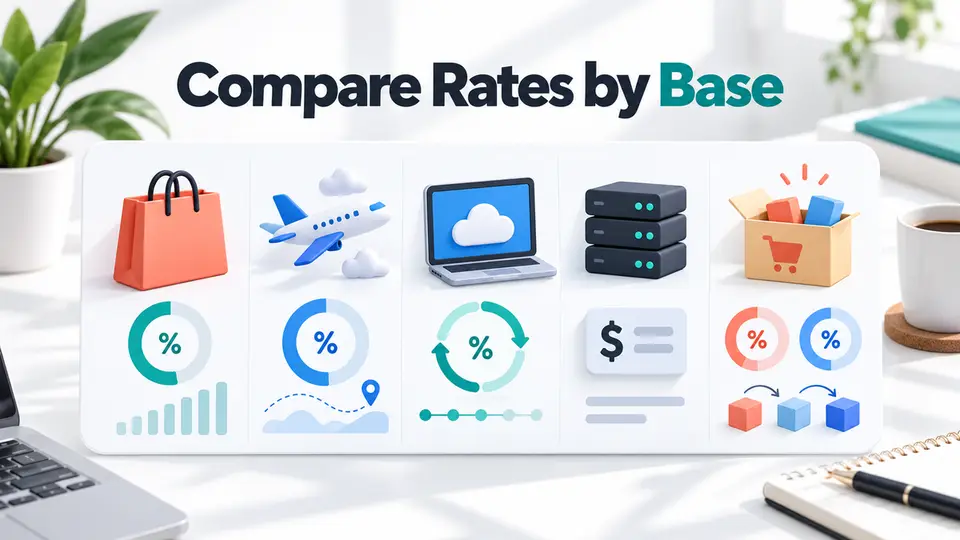
Affiliate commission rates by industry are often presented as if each category has one typical percentage. In practice, programs set their own payout rules. A retailer may pay different rates by product category, a hosting company may offer a flat bounty or a hybrid plan, and a travel partner may pay only after a completed booking.
Quick answer: Compare the qualifying action and commission base before comparing the headline rate. This guide looks at five public program examples across retail, web hosting, travel experiences, freelance services, and VPN subscriptions. They illustrate different payout designs, not industry averages or promised earnings.
| Category example | Program | Public commission example | What earns credit | Important caveat |
|---|---|---|---|---|
| Retail | Amazon Associates | 3% for Sports and Outdoors; 4.5% for Kitchen | Eligible shipped or qualifying order | Rates vary by category and policy |
| Web hosting | Cloudways | Up to $125 per referral in its slab model | Qualified new customer under selected plan | Slab tier rules apply |
| Travel experiences | Viator | 8% | Completed booking | Cancellation and completion rules matter |
| Freelance services | Fiverr | 25% of first-time buyer purchase plus 10% revenue share on other orders for 12 months | Eligible buyer and order under selected plan | First-time buyer and plan rules apply |
| VPN subscriptions | NordVPN | 100% on new one-month signups; 40% on new annual or two-year signups; 30% on renewals | Eligible subscription sale or renewal | Plan and customer status affect the rate |
Rates checked on October 29, 2026. Each figure describes the named offer and its stated base. Read the active terms before applying it to a forecast or recommendation.
What affiliate commission rates by industry can and cannot tell you
A commission rate is meaningful only when you know what amount it applies to and which event qualifies. “Eight percent” could refer to a completed booking, a net eligible order, or a particular product group. A flat bounty may be paid once, while a recurring percentage may depend on later customer payments.
That is why these affiliate commission rates by industry examples are not a benchmark table. They show the range of structures publishers may encounter when comparing actual programs. They do not establish a typical rate for retail, travel, hosting, freelance marketplaces, or VPNs.
The Amazon Associates rate table is a first-party source for category-specific retail rates. The Fiverr commission plan describes its first-time buyer and revenue-share model. FindAffiliates profiles for Cloudways, Viator, Fiverr, and NordVPN provide a discovery shortlist. Confirm final details inside the program or network account.
Five affiliate commission examples to compare
1. Amazon Associates uses category-based retail rates
Amazon's public table assigns different rates to different product categories. The current examples include 3% for Sports and Outdoors and 4.5% for Kitchen. Other categories have different values, and some product groups can have a zero rate. A broad label such as “retail affiliate rate” would hide those differences.
Before recommending Amazon Associates, map the products in the article to the correct category and review the current operating agreement. The rate table does not turn every order into an eligible referral. Product exclusions, qualifying purchases, returns, and policy rules still matter.
2. Cloudways offers distinct bounty and hybrid structures
The Cloudways affiliate profile lists commissions up to $125 through a performance-based slab model and a 90-day cookie. The top amount is not a guaranteed payout for each referral. Do not treat it as a default rate. The accepted plan and its eligibility rules determine what applies to an individual referral.
This is a useful example of why a headline maximum is not the same as the default rate. A publisher should identify the active plan, qualifying customer, credit window, and any tier rules before comparing it with a one-time percentage or recurring revenue share.

3. Viator pays on completed travel bookings
The Viator program listing describes an 8% commission on completed bookings, with a 30-day referral window in its public partner materials. A completed booking is a different event from a click, a search, or a reservation that is later canceled. A travel publisher should check how changes, cancellations, and activity completion affect commission eligibility.
The rate may fit a destination or activity guide when the linked experience is relevant to the traveler's plans. It should not be compared directly with a retail basket percentage without accounting for booking value, cancellations, and the action that gets recorded.
4. Fiverr combines first-time buyer commission and revenue share
Fiverr's current plan includes 25% of the first-time buyer amount and a 10% revenue share on other orders for 12 months under the applicable plan. The distinction between a first-time buyer and other buyers changes the payout. Eligibility also depends on the selected plan and the buyer's status under Fiverr's definitions.
If you promote Fiverr, describe the program's actual plan rather than presenting “25%” as a universal marketplace rate. Review the current plan page and account dashboard before publication. Track whether your content targets new buyers, repeat users, or both, because that changes which part of the plan is relevant.
5. NordVPN changes its rate by subscription plan and renewal
NordVPN's public affiliate information lists 100% for a new one-month subscription, 40% for a new one-year or two-year subscription, and 30% on renewals. These are plan-specific examples, not a single flat rate for every referred customer. The active terms define the eligible conversion and how a renewal is attributed.
The NordVPN profile can help you start the comparison, but verify the current rates, customer eligibility, and tracking window in the account. A percentage paid on a subscription price should not be treated as equal to the same percentage on a higher-priced product or completed travel booking.

A practical method for comparing affiliate rates
Use the same fields for every candidate program. This turns a collection of promotional percentages into a comparison you can update when terms change.
- Name the qualifying event. Is credit triggered by an order, completed booking, new customer, subscription signup, renewal, or another action?
- Record the rate base. Note whether the percentage applies to the full order, a category, an eligible subtotal, a first payment, or later customer revenue.
- Separate plan types. Keep flat bounties, percentage commissions, tiered plans, and recurring revenue share in different rows.
- Capture attribution rules. Record the referral window, last-click or other credit rules, coupon handling, and what happens after a cancellation or return.
- Check the customer and product rules. Existing customers, excluded products, discount codes, regions, and traffic sources can change eligibility.
- Date the source. Keep the official terms, network page, or account screenshot used to support the claim, with a date to review it again.
An illustrative calculation can make the base clearer without predicting earnings. If a qualifying order has an eligible amount of 100 units and the accepted rate is 4%, the pre-adjustment commission would be 4 units. That example excludes returns, taxes, restrictions, and currency conversion. A fixed bounty or recurring plan needs a different calculation.
The affiliate cookie duration benchmarks guide helps explain why tracking windows differ. For normalizing publisher reports, see the affiliate EPC comparison worksheet. Use those guides alongside an offer's current terms, because a benchmark or worksheet cannot confirm the current agreement.
Affiliate commission rates by industry at a glance
| Model | Example in this guide | Compare it by asking... |
|---|---|---|
| Category percentage | Amazon Associates | Which product category and eligible order amount apply? |
| One-time bounty or hybrid | Cloudways | Which plan is selected, and what does the recurring share cover? |
| Completed booking percentage | Viator | Does the action complete, and how are cancellations treated? |
| New-buyer plus follow-on share | Fiverr | What counts as a first-time buyer and which plan is active? |
| Plan-based subscription percentage | NordVPN | Which subscription length and renewal event qualify? |
There is no useful universal winner from these examples. The best offer depends on the reader's intent, the content you can support, the eligible product or action, and the rules in the agreement. Search the FindAffiliates directory to shortlist relevant programs. When comparing affiliate commission rates by industry, confirm each offer's qualifying event, payout base, and current terms before making a rate claim.
FAQ
What is a typical affiliate commission rate by industry?
There is no single typical rate that applies to every program in an industry. Individual offers set different rates, eligible products, customer rules, and qualifying events. Compare named programs and label each public figure by its source and rate basis.
Which industry pays the highest affiliate commission?
A public percentage alone cannot establish which industry pays the most. Fixed bounties, order values, renewals, conversion rates, reversals, and eligible customer rules all affect actual results. Compare the full offer and your audience fit instead of ranking industries by one headline rate.
Are recurring commissions better than one-time commissions?
Not automatically. Recurring commissions can depend on later billing, customer retention, attribution, and renewal eligibility. A one-time bounty may have a clearer event but a different value. Evaluate the complete payout terms and the content's likely reader journey.
How often should I check commission rates?
Check rates before publishing and again when the program or network reports a change. Save the date and source, then update any table or recommendation that relies on the old terms. The active agreement takes priority over an older article or directory snapshot.