How to Set Affiliate Commission Rates That Attract Top Affiliates
Affiliate commission rates should be high enough to motivate partners and low enough to protect unit economics. Start with margin, customer lifetime value, refund risk, and sales cycle, then choose a payout model that matches the partner behavior the program wants to encourage.
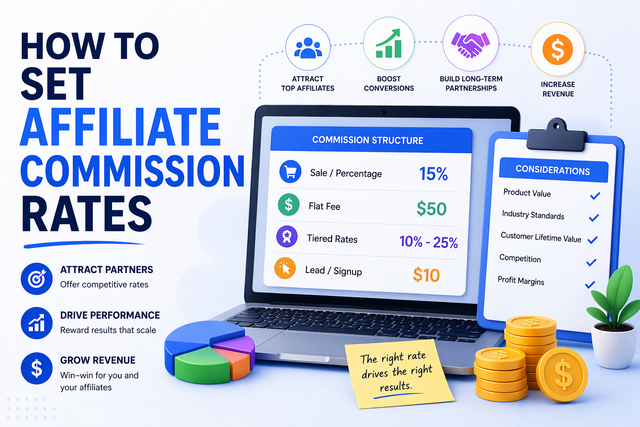
What Should You Compare Before Choosing?
Your affiliate program's commission rate is often the first number a potential affiliate checks. Before they read your landing page, review your products, or consider your brand fit, they look at one thing: what is in it for me?
Getting your commission structure right is not just about being competitive. It is about signaling credibility, attracting the right type of affiliates, and building a program that pays for itself through incremental revenue. Set it too low and serious affiliates scroll past. Set it too high and you erode margins or attract coupon hunters who cannibalize sales you would have made anyway.
This guide walks through how to think about commission structures, what top affiliates actually look for, and how to build a rate that attracts quality partners without wrecking your economics.
What Affiliates Look At Before Joining Your Program
Before you set a number, understand the evaluation process a serious affiliate goes through. Most experienced affiliates compare programs across four factors.
Commission rate and type. Is it a flat fee, a percentage, one-time, or recurring? Recurring models are highly preferred because they compound over time.
Cookie duration. A 30-day cookie is table stakes. Anything shorter than 14 days is often a dealbreaker for affiliates running content or email campaigns where the sales cycle stretches past the click.
Average order value and effective earnings per sale. A 5% commission on a $500 product ($25 per sale) beats a 30% commission on a $10 product ($3 per sale). Affiliates do this math before applying.
Program reliability. They want to know: does this program pay on time? Is there a real team behind it? Is the brand credible enough that their audience will trust the recommendation?
Your commission rate feeds directly into factors one and three. Get those right and the rest of your program becomes easier to sell.
Types of Commission Structures
There is no single correct commission structure. The right model depends on your product, margins, and the affiliates you want to attract.
Flat Percentage
The most common model. You pay affiliates a fixed percentage of each sale. SaaS tools typically offer 20-40%, physical products 5-20%, and services anywhere from 10-30%. The upside is simplicity. The downside is that as your pricing grows, costs scale proportionally.
Flat Fee Per Sale
A fixed dollar amount per conversion regardless of order value. This works well for high-AOV products where a percentage would create unsustainable payouts, and for products with narrow margin bands. Flat fees of $50 to $200 per sale are common in insurance, finance, and B2B software.
Recurring Commission
Affiliates earn a percentage of the customer's subscription for as long as that customer stays subscribed. This is the most attractive structure for professional affiliates, because a single referral builds into compounding monthly income. SaaS products are the natural fit here. If your churn is low, a 20-30% recurring rate can be extremely profitable for affiliates and still sustainable for you.
Tiered Commission
Affiliates earn higher rates once they hit volume thresholds. For example: 20% on the first 10 sales per month, 25% from 11 to 30 sales, 30% above that. Tiered structures reward your best performers and create a built-in incentive to promote more aggressively.
Hybrid
A combination of upfront and recurring. A common structure is a one-time bonus for the first sale plus a lower ongoing percentage. This works well when you want to incentivize fast activation while keeping long-term payouts manageable.
How to Calculate a Sustainable Commission Rate
The most common mistake program owners make is picking a number by benchmarking competitors without accounting for their own unit economics. Here is a more reliable framework.
Start with your customer lifetime value (LTV). If an average customer is worth $300 over 18 months, you have more room to pay for that customer than if they are worth $80. A higher LTV means you can afford a more generous upfront or recurring commission and still come out ahead.
Factor in your customer acquisition cost (CAC). If you are already spending $40 to acquire a customer through paid ads, what is the incremental value of an affiliate channel? If affiliates convert at a similar rate with lower overhead, you have room to pay 30-40% of the first sale and still improve your blended CAC.
Set a ceiling from gross margin. If your gross margin is 70%, you can afford to pay up to 30-40% in affiliate fees and still operate profitably before accounting for operating costs. If your margin is 20%, a 15% affiliate commission is already aggressive. Work backward from margin, not forward from what sounds impressive.
Match the rate to the affiliate type you want. Coupon and cashback sites drive volume at lower rates. Content creators and newsletter operators expect higher rates because their recommendations carry more trust and require more effort to produce. If you want quality affiliates, price your program for quality affiliates.
Recurring vs One-Time: What Top Affiliates Actually Prefer
If you have a subscription product, recurring commissions are one of the most powerful levers for attracting serious affiliates. Professional affiliate marketers consistently rank recurring commissions as the top program feature they look for in SaaS.
The reason is simple: a content creator who publishes one review can earn $20 per month from that single piece of content for years. That changes the economics of affiliate marketing from a constant content treadmill into a scalable passive income stream. A well-placed review that earns $20/month for 36 months is worth $720. That same review earning a one-time $30 commission is not even close.
If recurring is not economically viable at your current stage, consider a middle ground: offer recurring commissions for the first 6 to 12 months post-signup rather than the full lifetime of the customer. This limits your exposure while still making your program meaningfully more attractive than a flat one-time payout.
Common Mistakes That Make Affiliates Pass on Your Program
Rates that are too low with no explanation. A 5% commission on a $20/month SaaS is $1 per referral. That is not a motivating number. If your margins require a low rate, explain the economics, offer strong performance bonuses, or invest heavily in tools that make promotion effortless.
Mismatched cookie windows. A 40% commission with a 3-day cookie is worse than a 25% commission with a 60-day cookie for most content-driven affiliates. They need enough time to move a reader from initial click through to purchase, especially for higher-ticket products with longer consideration cycles.
No tiered upside. Flat rates with no room to grow give your best affiliates no reason to prioritize your program over a competitor that rewards scale. Even a modest tier system signals that you value high performers.
Changing rates without notice. Cutting commissions retroactively, or with only a few days' notice, is the fastest way to destroy affiliate trust. If your economics require a rate adjustment, grandfather existing affiliates at the old rate and communicate changes with at least 30 days' notice.
Paying only on the first purchase. If you sell subscriptions or consumables, single-purchase commission structures miss the point. Affiliates who drive customers with strong retention are adding disproportionate lifetime value. Your commission structure should reflect that.
Testing and Adjusting Your Structure Over Time
Your first commission rate is a hypothesis. Set it deliberately, but treat it as a starting point rather than a permanent decision.
Track affiliate performance by tier: what does your top 10% of affiliates earn per month? If your best performers are capping out and not growing, your rate structure may not reward scale sufficiently. If you have a high sign-up rate but low activation (affiliates who join but never promote), your rate may be too low relative to the effort required, or your creative assets are too weak to make promotion feel worthwhile.
Run quarterly reviews comparing your affiliate cost-per-acquisition against your other acquisition channels. Raise rates when the channel is outperforming its cost ceiling and you have room to invest more. Reduce them carefully and only when you have clear data showing the current rate is above what the market requires to retain your best affiliates.
Managing tiered commissions, performance tracking, and rate adjustments manually gets unwieldy fast. Tools like Affonso are built specifically for this: they handle tiered commissions, affiliate dashboards, and payout tracking without the spreadsheet overhead. If you are running a growing program, purpose-built affiliate management software pays for itself quickly.
Key Takeaways for How to Set Affiliate Commission Rates That Attract Top Affiliates
A well-structured commission is not just a cost line. It is a recruitment tool, a retention signal, and a statement about how seriously you take your affiliate partners. The programs that attract the best affiliates are not always the ones with the highest rates. They are the ones that clearly communicate the economics, make it easy to earn, and reward performance over time.
If you are building or refining your affiliate program and want to benchmark what competitive programs actually look like, browse the directory at FindAffiliates. Seeing how programs across dozens of niches structure their offers is one of the fastest ways to calibrate your own commission strategy.