# FindAffiliates
> FindAffiliates is the leading directory for discovering and comparing affiliate programs. Businesses list their affiliate programs, and content creators, marketers, and affiliates find high-paying programs to promote and earn commissions. Browse programs by category, commission rate, cookie duration, and more.
## What is FindAffiliates?
FindAffiliates is the fastest way to find high-paying affiliate programs for your content and business. The platform lets you:
- Search and filter affiliate programs by niche, commission type, and payout structure (free for signed-in visitors)
- PRO adds full directory access (updated weekly), personalized suggestions, best deals filter, bookmarks, scouting/apply/bookmark stats, priority features, and coming soon exclusive deals
- Access public program profile pages with commission rates, descriptions, and sign-up context
- Submit and list your own affiliate program to reach thousands of active marketers and content creators
Whether you're a blogger, YouTuber, social media influencer, or business owner, FindAffiliates helps you discover programs in AI, SaaS, Marketing, SEO, E-commerce, and dozens more categories.
## How It Works
1. **Discover Programs**: Visit the homepage or latest-programs preview to discover public affiliate program profiles.
2. **Compare Details**: Each program page shows commission rates, cookie duration, payment methods, and a description.
3. **Join Programs**: Click through to the affiliate program's sign-up page to start earning.
4. **Submit Your Program**: Businesses can list their affiliate program for free to attract quality affiliates.
## Key Pages
- [Home](https://www.findaffiliates.online/): Discover FindAffiliates and featured affiliate programs
- [Latest Affiliate Programs](https://www.findaffiliates.online/latest-affiliate-programs): Preview of newest public affiliate programs
- [Submit Your Program](https://www.findaffiliates.online/submit): List your affiliate program
- [FAQ](https://www.findaffiliates.online/find-affiliates-faq): Common questions
- [Blog](https://www.findaffiliates.online/blogs): Affiliate marketing guides and strategies
## Pricing
### For Affiliates — PRO Access
- **Monthly:** $4.95/mo (cancel anytime)
- **Lifetime:** $19.95 one-time (save 66% over a year)
- Full directory access, updated weekly with new programs
- Personalized suggestions and best deals filter
- Bookmarks to save favorite programs
- Priority access to new features
- Coming soon: exclusive FindAffiliates-only deals
### For Companies — List Your Affiliate Program
**Lifetime Listing — $19 one-time**
- Permanent listing on FindAffiliates
- Visible to PRO users
- Permanent do-follow backlink (DR 46+)
- SEO-optimized listing format
- Optimized for AI and chatbot recommendations
- No recurring fees, upgrade to top spot anytime
**Premium Top Listing — $29/mo or $39 one-time (most popular)**
- Everything in Lifetime, plus:
- Visible to all visitors (not just PRO)
- Featured at the top of the homepage
- Newsletter mention to 2,000+ subscribers
- Mention on social media profiles
- Optimized for AI and chatbot recommendations
**Exclusive Package — $149/year or $179 one-time**
- Everything in Premium, plus:
- Featured in the Exclusive Deals category
- Editorial blog post about your program
- Top visibility and exclusive deal status
- Optimized for AI and chatbot recommendations
All plans: [Submit your program](https://www.findaffiliates.online/submit)
## Blog Posts
---
## Affiliate Review Disclosure Examples That Build Trust
*Published: 2026-05-08*
*URL: https://www.findaffiliates.online/blogs/affiliate-review-disclosure-examples*

## Introduction
Affiliate review disclosure examples matter because readers should know when a recommendation may earn you money. That does not make the review weaker. It makes the relationship clear before the reader acts on your link.
The practical goal is simple: use plain words close to the recommendation, then write a review that proves you still made an honest judgment. This guide gives you copy-and-paste examples for blog posts, comparison pages, emails, videos, and social posts.
Use these examples as editorial templates, not legal advice. If your business has unusual claims, regulated products, or paid sponsorship terms, ask a qualified attorney to review your final disclosure language.
---
## The Simple Rule Behind Good Disclosures
The FTC's [Endorsement Guides](https://www.ftc.gov/business-guidance/resources/ftcs-endorsement-guides) say material connections should be disclosed clearly and conspicuously when readers would not otherwise expect them. For affiliates, that usually means saying you may earn a commission when someone buys through your link.
The strongest affiliate review disclosure examples share three traits:
1. They are easy to understand.
2. They appear near the recommendation or link.
3. They explain the financial relationship without vague wording.
A disclosure should not hide behind a footer, a legal page, a tooltip, or a phrase many readers may not understand. "Affiliate link" can be too vague by itself. "I may earn a commission if you buy through this link" is clearer.
This also fits Google review quality guidance. Google recommends reviews with original evidence, quantitative details, benefits, drawbacks, and useful comparisons. In other words, a disclosure is only the first trust signal. The review still needs a real point of view.
---
## Affiliate Review Disclosure Examples You Can Use
Start with the channel where the reader sees the recommendation. A blog review can use a slightly longer note near the top. A short social post needs fewer words. A video should make the relationship clear in the video itself and near the links in the description.
### Blog Review Disclosure
Use this near the top of a review, before the first affiliate link:
> We may earn a commission if you buy through links in this review. Our recommendation is based on the fit, pricing, features, and tradeoffs described below.
This works well for reviews of tools like [Teachable](https://www.findaffiliates.online/teachable-affiliate-program), where readers need to understand both the product fit and the affiliate relationship before they compare course platforms.
If you write a detailed review, pair this disclosure with a clear verdict, pricing context, pros and cons, and alternatives. The structure from the [affiliate product review template](https://www.findaffiliates.online/blogs/affiliate-product-review-template) is a good starting point because it keeps the disclosure connected to a real buying decision.
### Comparison Post Disclosure
Use this when comparing two or more products:
> Some links in this comparison are affiliate links. We may earn a commission if you choose a paid plan through those links, at no extra cost to you.
This fits a comparison like [Thinkific](https://www.findaffiliates.online/thinkific-affiliate-program) versus Teachable because the reader may click several product links before choosing. Put the disclosure near the top, then include another short reminder before a comparison table if the page is long.
### Email Newsletter Disclosure
Use this before or immediately after the first recommendation:
> Disclosure: this email includes affiliate links. If you buy through them, we may earn a commission. We only include tools we think are relevant to this issue.
Email feels personal, so do not bury the relationship at the bottom after the call-to-action. A disclosure near the recommendation respects the reader and reduces the risk that the promotion feels hidden.
### YouTube or Video Disclosure
Use both spoken and written language:
> This video includes affiliate links. If you buy through the links in the description, I may earn a commission.
Then repeat it in the video description near the links:
> Some links below are affiliate links. I may earn a commission if you buy through them.
This is especially important when the video itself contains the endorsement. If a creator reviews [Canva](https://www.findaffiliates.online/canva-affiliate-program), shows a paid feature, and sends viewers to a link in the description, the relationship should be clear in both places.
### Social Post Disclosure
Use short language that appears before the link or code:
> Ad: I may earn a commission if you buy through this link.
or:
> Affiliate link: I may earn from purchases made through this link.
Short posts leave little room for nuance, so clarity beats cleverness. If the platform truncates captions, place the disclosure early enough that readers can see it before tapping.
### Product Card or Button Disclosure
Use this next to a button or card:
> Paid link. We may earn a commission.
This can work on product grids, ranked lists, and sidebar cards. For example, if a roundup mentions [Rewardful](https://www.findaffiliates.online/rewardful-affiliate-program) as an affiliate tracking option, a small disclosure near the button is more useful than one hidden on a separate legal page.
---
## Where to Place Review Disclosures
Placement matters as much as wording. The disclosure should appear before the reader clicks, buys, signs up, or treats the endorsement as independent advice.
For a blog review, put the first disclosure above the first affiliate link. If the article is long, repeat a shorter version near major recommendation blocks, comparison tables, and final verdict sections.
For videos, say the disclosure near the point where you recommend the product. Also write it in the description near the purchase links. A single sentence at the very end of a long video is easy to miss.
For newsletters, put the disclosure before the first affiliate link or directly after the recommendation paragraph. Do not save it for a tiny footer after the reader has already seen the call-to-action.
For social posts, put the disclosure at the start or close to the link. Hashtags at the end of a long caption are weaker because many readers will never see them.
Good placement also supports audience trust. The more obvious the disclosure is, the less defensive your content has to sound. Readers can focus on whether your recommendation is useful.
---
## How to Keep the Review Trustworthy After the Disclosure
Disclosure does not fix a thin review. Once you tell readers how you may get paid, the content still has to earn the recommendation.
Start with fit. Say who the product is best for and who should skip it. A good review of a course platform might say it fits beginner creators, but not teams that need advanced learning management features.
Then show the tradeoff. If a product is easy to use but limited, say that. If it pays a strong commission but has strict approval rules, mention that too. Readers trust reviews that help them avoid a bad fit.
Finally, use proof. Screenshots, workflow examples, pricing notes, setup details, and limitations all make the review feel researched. This is also how to build the trust habits covered in [building trust with your affiliate audience](https://www.findaffiliates.online/blogs/building-trust-with-your-audience).
The best affiliate review disclosure examples work because they are paired with useful judgment. The disclosure tells readers about the relationship. The review tells them whether the product actually fits.
---
## Mistakes That Make Disclosures Weak
The first mistake is using language that only marketers understand. "Commissionable link" is not plain enough for many readers. "I may earn a commission" is better.
The second mistake is separating the disclosure from the link. A footer note may not help a reader who clicked a recommendation halfway through the page.
The third mistake is hiding behind a general legal page. A dedicated disclosure page can be useful, but it should not replace visible disclosures near endorsements.
The fourth mistake is writing a perfect disclosure, then publishing a biased review. If every product is "the best," the disclosure will not save trust. Balanced reviews need alternatives, drawbacks, and decision criteria.
The fifth mistake is forgetting short-form channels. A disclosure policy for blog posts does not automatically cover YouTube descriptions, TikTok captions, Instagram Stories, podcasts, emails, and product cards.
---
## Quick Disclosure Checklist
Use this checklist before publishing a review, roundup, or comparison.
| Check | Standard |
|-------|----------|
| Plain wording | Readers understand you may earn money |
| Visible placement | The disclosure appears before or near the link |
| Channel fit | Blog, email, video, and social versions are handled |
| Review balance | Pros, cons, alternatives, and fit are included |
| Evidence | The review includes examples, screenshots, tests, or specifics |
| Internal support | Related trust and SEO content is linked naturally |
This last point matters for SEO. If you are building a review cluster, connect disclosure content to stronger review and comparison resources. The [affiliate SEO guide](https://www.findaffiliates.online/blogs/affiliate-seo-that-actually-works) explains why internal links help readers and search engines understand the role each page plays.
---
## Conclusion
Good affiliate review disclosure examples are short, clear, and close to the recommendation. They tell readers you may earn a commission, then let the rest of the review prove that your judgment is still useful.
Use the examples in this guide as defaults, then adapt them to each channel. Blog reviews need visible top-of-page language. Videos need spoken and written disclosure. Emails and social posts need the relationship stated before the click.
To find strong programs worth reviewing with clear, reader-first content, browse the [FindAffiliates directory](https://www.findaffiliates.online) and choose offers that match your audience before you write the review.
---
## FAQ
### What is a good affiliate disclosure example?
A good example is: "We may earn a commission if you buy through links in this review. Our recommendation is based on the fit, pricing, features, and tradeoffs described below." It is clear, direct, and close to the recommendation.
### Where should I put an affiliate disclosure in a review?
Put it before the first affiliate link and near important recommendation sections. If the review is long, repeat a shorter reminder near tables, product cards, and the final verdict.
### Is saying affiliate link enough?
Not always. Some readers may not understand that "affiliate link" means you may earn money from purchases. Add plain language such as "I may earn a commission."
### Do I need disclosures in emails and videos?
Yes, if the email or video includes endorsements tied to affiliate links. For videos, disclose in the video and in the description near the links. For email, place the disclosure before or near the recommendation.
### Will an affiliate disclosure hurt conversions?
Usually no. A clear disclosure can improve trust when the review is balanced, useful, and specific. Hidden relationships are more likely to hurt credibility than honest wording.
---
## Kit vs Beehiiv Affiliate: Newsletter Payouts Compared
*Published: 2026-05-07*
*URL: https://www.findaffiliates.online/blogs/kit-vs-beehiiv-affiliate*

## Introduction
The Kit vs Beehiiv affiliate decision matters because both tools sit in the creator newsletter category, but they convert for different reasons. Kit is built around email-first creator businesses. beehiiv is built around newsletter growth, publication workflows, and media-style audience building.
For affiliates, the winner is not only the one with the highest headline commission. It is the one readers understand quickly, trust enough to try, and keep paying for after the first upgrade.
This guide compares commission structure, cookie window, audience fit, content angles, and promotion strategy.
---
## Quick Verdict
Choose Kit if your audience includes creators who sell courses, digital products, coaching, memberships, or paid newsletters from an owned email list. The [Kit affiliate program](https://www.findaffiliates.online/kit-affiliate-program) is strongest when your content teaches audience ownership, email funnels, automation, and creator monetization.
Choose beehiiv if your audience includes newsletter operators, media founders, writers, and growth-focused creators who care about publication design, referral growth, analytics, and sponsorship potential. The [beehiiv affiliate program](https://www.findaffiliates.online/beehiiv-affiliate-program) is easier to frame around the newsletter business model itself.
If your site covers creator tools broadly, you can promote both. Use Kit for creator business systems and beehiiv for newsletter growth. That split keeps your recommendations useful instead of making the comparison feel like a generic payout table.
---
## How the Kit Affiliate Program Works
Kit, formerly ConvertKit, positions itself as an email-first operating system for creators. Its [official affiliate page](https://kit.com/affiliate/) currently says affiliates earn 50% of what a referred paid customer pays during the first 12 months. It also says higher-volume affiliates can unlock 10% to 20% recurring revenue beyond month 12 when they maintain Bronze, Silver, or Gold status.
That structure rewards affiliates who can attract serious creators rather than casual free users. A creator with products, courses, sponsors, or a paid newsletter is more likely to treat email as revenue infrastructure, not a side tool.
Kit also runs through PartnerStack for affiliate access and payout operations. Kit's help center says commissions are generated after a refund buffer and generally become available around the middle of the following month. For content planning, that means Kit is a strong recurring offer, but it is not an instant-cash program.
The strongest Kit affiliate content teaches a system. Good angles include creator email funnels, lead magnets for course sellers, newsletter launch plans, digital product follow-up sequences, and audience ownership for social media creators. Those readers already understand why a better email platform matters.
---
## How the beehiiv Affiliate Program Works
beehiiv is more newsletter-native. Its [official partner materials](https://www.beehiiv.com/partners/affiliate) currently promote up to 60% of referred revenue for 12 months, with a 60-day cookie window. The live FindAffiliates listing shows 50%, so affiliates should verify the active tier before publishing exact payout math.
The public partner page also describes tiers, monthly PayPal payouts on the 15th, partner resources, trainings, and restrictions around branded search ads. Those details matter because beehiiv is recruiting creators who can teach newsletter growth and send qualified traffic.
beehiiv converts best when the reader wants to build a publication. That includes solo newsletter writers, niche media operators, creator educators, agency newsletters, and operators comparing newsletter tools by growth mechanics.
The main limitation is fit. If your reader wants deep creator commerce, course funnels, and flexible email automation, Kit may be easier to defend. If your reader wants to publish, grow, and monetize a newsletter audience, beehiiv often has the clearer story.
---
## Kit vs Beehiiv Affiliate Comparison
| Factor | Kit | beehiiv |
|---|---|---|
| Best reader | Creators selling products, coaching, courses, or services | Newsletter writers, media founders, growth-focused creators |
| Headline commission | 50% for the first 12 months | Up to 60% for 12 months, with 50% shown on FindAffiliates |
| Long-term upside | 10% to 20% beyond 12 months for qualifying status tiers | Tier-based partner rewards and commission upgrades |
| Cookie window | Verify in PartnerStack before publishing exact claims | 60 days according to beehiiv partner materials |
| Payout method | PartnerStack wallet after review and approval timing | Monthly PayPal payouts on the 15th |
| Best content angle | Creator business email systems | Newsletter growth and publication monetization |
| Main caution | More compelling for serious creators than hobby beginners | Less suited to broad email automation tutorials |
The Kit vs Beehiiv affiliate comparison is close on first-year commission. The practical difference is buyer intent. Kit is easier to sell as the central email layer for a creator business. beehiiv is easier to sell as the operating system for a newsletter.
---
## Which Program Converts Better by Audience?
### Creator Businesses
Kit usually has the stronger fit for creators who already sell something. A coach selling a workshop, an educator launching a course, or a writer building a paid resource library needs email sequences, segmentation, commerce connections, and simple automations.
That buyer is asking, "How do I turn subscribers into revenue without losing trust?" Kit content can answer with lead magnet funnels, product launch sequences, and simple segmentation examples.
This is where Kit pairs naturally with broader SaaS content, including [high-converting SaaS affiliate programs](https://www.findaffiliates.online/blogs/high-converting-saas-affiliate-programs-2026), because the reader is evaluating software that can produce durable recurring value.
### Newsletter Operators
beehiiv usually has the stronger fit for creators who think like publishers. They care about writing, referral growth, audience analytics, sponsorship readiness, and making the newsletter itself the product.
That buyer needs a clean publishing workflow, growth loops, and a path from free subscribers to monetization. beehiiv content should focus on launch playbooks, referral strategies, sponsorship preparation, and creator media examples.
If your reader talks about Substack, paid newsletters, niche media, or audience growth, beehiiv will often feel more obvious than Kit.
---
## Which Pays Better in Practice?
On the first-year commission headline, beehiiv may look higher when you qualify for its promoted tiers, while Kit is clearer at 50% for the first 12 months. In practice, payout depends on retention, plan size, and traffic quality.
Kit may pay better when referrals are serious creators with a monetization plan. Those users stay because email is tied to revenue.
beehiiv may pay better when referrals are newsletter-first operators who care about growth features and media-style publishing.
Creator traffic is not all equal. Match the offer to the job the reader is trying to do.
---
## Best SEO Angles for Kit
Kit works well in educational content that shows the reader how to build a business asset. Use terms like creator email funnel, lead magnet sequence, course launch email plan, digital product email marketing, and best email platform for creators.
For a related email-platform comparison, pair this article with [ConvertKit vs MailerLite affiliate payouts](https://www.findaffiliates.online/blogs/convertkit-vs-mailerlite-affiliate).
For stronger conversion, include a concrete example. Show how a creator captures subscribers with a checklist, sends a welcome sequence, tags interests, then promotes a paid offer. That kind of content earns more trust than a simple feature list.
You can also connect Kit content with [affiliate SEO that actually works](https://www.findaffiliates.online/blogs/affiliate-seo-that-actually-works), because email capture helps affiliates turn one search visit into a longer relationship.
---
## Best SEO Angles for beehiiv
beehiiv content should focus on newsletter growth and publication strategy. Good keywords include beehiiv affiliate, best newsletter platform for creators, how to start a newsletter, beehiiv vs Substack, newsletter referral program, and newsletter monetization tools.
The best beehiiv article feels like a growth plan. Teach the reader how to pick a newsletter topic, design the landing page, set up referral incentives, publish consistently, and measure subscriber growth.
beehiiv also works in content for creators who want a media business instead of only a marketing list. That lets you talk about sponsorships, audience quality, and referral loops.
For a comparison post, make the central question simple: do you need a creator business email system, or do you need a newsletter publishing engine?
---
## Offers to Pair With Newsletter Content
A Kit or beehiiv article can link naturally to adjacent tools without distracting from the main comparison. For lead capture and reader surveys, [Tally](https://www.findaffiliates.online/tally-affiliate-program) is a useful companion because creators need forms for waitlists, research, and sponsor intake.
For polished surveys or quiz-style lead magnets, [Typeform](https://www.findaffiliates.online/typeform-affiliate-program) can fit a newsletter stack article. It is not a direct email platform competitor, so frame it as an adjacent recommendation.
Newsletter creators rarely buy one tool. Your content can reflect the full workflow while still keeping the primary recommendation focused.
---
## Mistakes to Avoid
Do not choose only by commission rate. If the reader does not match the product, a higher commission will not save the recommendation.
Do not promote beehiiv like a generic email automation tool. Its stronger story is newsletter growth, publishing, and media-style monetization.
Do not promote Kit only as a newsletter tool. Its stronger story is creator business infrastructure, especially when the reader sells products, services, or education.
Do not overstate cookie or payout details without checking the official partner page before publishing. Terms can change, and comparison content loses trust when exact claims are stale.
Do not bury the recommendation. Give a clear verdict early, then support it with the table, audience fit, and use cases.
---
## FAQ
### Is Kit or beehiiv better for affiliates?
Kit is usually better for affiliates with creator business audiences, while beehiiv is usually better for newsletter growth and media operator audiences. The better choice depends on the reader's intent.
### Does Kit have a recurring affiliate program?
Yes. Kit's current affiliate page says affiliates can earn 50% during the first 12 months, with 10% to 20% recurring revenue beyond 12 months for qualifying status tiers.
### Does beehiiv have a recurring affiliate program?
Yes. beehiiv's current partner materials promote up to 60% of referred revenue for 12 months, with a 60-day cookie window and tier-based rewards.
### Which affiliate program has the better cookie window?
beehiiv publicly states a 60-day cookie window. Kit affiliates should verify the active tracking window inside PartnerStack or the current Kit affiliate documentation before publishing an exact claim.
### Can I promote Kit and beehiiv together?
Yes. Promote Kit for creator business email systems and beehiiv for newsletter growth. That positioning gives readers a real choice instead of forcing one tool into every use case.
---
## Conclusion
The Kit vs Beehiiv affiliate choice comes down to the reader's business model. Kit is the better fit when email supports products, courses, coaching, services, or creator commerce. beehiiv is the better fit when the newsletter itself is the business.
Affiliates should not treat these programs as interchangeable. Lead with Kit for creator monetization systems. Lead with beehiiv for newsletter publishing and growth. Then use the [FindAffiliates directory](https://www.findaffiliates.online/) to compare adjacent creator tools that round out the stack.
---
## Rewardful Setup Guide for SaaS Affiliate Programs 2026
*Published: 2026-05-06*
*URL: https://www.findaffiliates.online/blogs/rewardful-setup-guide*

## Introduction
This Rewardful setup guide is for SaaS teams that want to launch an affiliate program without turning the first month into a messy operations project. Rewardful can be fast to set up, especially if your billing already runs through Stripe, but the software only works well when your commission rules, landing page, onboarding, and payout process are clear before partners arrive.
The goal is not just to install a script. By the end of this guide, you will know what to decide before signup, how to configure your first campaign, what to test before inviting affiliates, and how to launch with a small partner cohort that gives you clean data.
---
## Quick Setup Plan
Rewardful's own launch guide says most SaaS teams can get live quickly by creating an account, connecting Stripe or Paddle, configuring commissions, creating a campaign, and completing setup. That is the technical path, but program quality depends on the decisions around it.
For most teams, the smarter sequence looks like this:
1. Confirm Rewardful fits your billing model and partner motion.
2. Connect the right payment processor.
3. Create one simple campaign.
4. Configure partner-facing details.
5. Test referral tracking with a real checkout path.
6. Invite a small first cohort.
7. Review activation before scaling recruitment.
If you are still comparing platforms, start with the broader [best affiliate tracking software for SaaS](https://www.findaffiliates.online/blogs/best-affiliate-tracking-software-2026) guide first. This article assumes Rewardful is the leading option and focuses on getting the first version live.
Use this Rewardful setup guide as a launch checklist, not as a reason to skip partner strategy. The faster the tool is to configure, the more important it is to decide the program rules before affiliates arrive.
---
## Step 1: Confirm Rewardful Fits Your Program
Rewardful is strongest for SaaS businesses that want a clean affiliate or referral program tied to subscription billing. The [Rewardful affiliate program listing on FindAffiliates](https://www.findaffiliates.online/rewardful-affiliate-program) describes the tool as affiliate and referral management software for SaaS companies, with direct Stripe and Paddle integration.
That fit matters. Rewardful is a good choice when your first requirement is reliable referral attribution, recurring commission logic, simple campaign setup, and a self-service affiliate portal. It is less ideal if your real goal is a broad partner ecosystem with agencies, resellers, marketplace recruitment, and heavy segmentation.
Before creating your account, answer three questions:
- Do we sell through Stripe or Paddle Classic today?
- Do we want affiliates, customer referrals, or both?
- Can we explain our commission, cookie window, and payout timing in one paragraph?
If the answer to the first question is no, Rewardful may still work through custom integration paths, but the setup is no longer the simplest version. If the answer to the second or third question is fuzzy, pause and define the program before you touch software.
This is also where alternatives can clarify the decision. [Tapfiliate](https://www.findaffiliates.online/tapfiliate-affiliate-program) may fit teams that need more custom workflows across e-commerce and SaaS. [FirstPromoter](https://www.findaffiliates.online/firstpromoter-affiliate-program) is another subscription-focused option worth comparing if payout operations and portal customization are higher priorities. For a deeper platform-stage comparison, read the [Tapfiliate vs Rewardful vs PartnerStack](https://www.findaffiliates.online/blogs/tapfiliate-vs-rewardful-vs-partnerstack) guide before you commit.
---
## Step 2: Connect Stripe or Paddle Correctly
Stripe is the cleanest Rewardful path for most SaaS teams. Rewardful's Stripe help documentation explains that the platform monitors Stripe activity so it can attribute customers, calculate commissions, and adjust commission records when billing events change.
That makes your Stripe setup the foundation. Before connecting, clean up your product catalog, trial behavior, checkout flow, coupon rules, and customer metadata assumptions. Rewardful can calculate commissions from billing events, but it cannot fix confusing pricing architecture.
For Paddle users, the important detail is version support. Rewardful's Paddle documentation currently covers Paddle Classic and notes that Paddle Billing is separate. If your team has moved to Paddle Billing, confirm your path before assuming the standard Paddle Classic instructions apply.
After connecting the processor, test the checkout route you actually expect affiliates to send traffic into. A setup that works for one Stripe Checkout flow may not prove every landing page, trial, or upgrade route is covered.
---
## Step 3: Build Your First Campaign
Rewardful campaigns control how affiliates earn. The official campaign documentation says Rewardful supports percentage-based and fixed-amount commissions, and that commissions are recurring by default until the referred customer cancels unless you limit them by payment count or time.
For a first SaaS affiliate program, keep the campaign simple. One public campaign is usually enough:
| Setting | Recommended first version | Why it matters |
|---------|---------------------------|----------------|
| Commission type | Percentage recurring | Easy for affiliates to understand |
| Rate | 20% to 30% if margins allow | Competitive enough for SaaS creators |
| Duration | Lifetime, 12 months, or fixed payments | Controls long-term payout exposure |
| Cookie window | 30 to 60 days | Gives content and email traffic time to convert |
| Minimum payout | Set a practical threshold | Reduces tiny payout runs |
| Approval model | Manual approval at first | Protects quality while you learn |
If you need help deciding the number, use the [affiliate commission rates](https://www.findaffiliates.online/blogs/how-to-set-affiliate-commission-rates) guide before publishing the campaign. A 30% recurring commission can be attractive, but it only works if your gross margin, churn, and payback period support it.
Do not create five campaigns on day one. Multiple commission groups, VIP tiers, coupon partners, and customer referral offers can come later. The first campaign should prove that qualified partners can drive qualified customers.
---
## Step 4: Prepare the Partner Experience
Your Rewardful setup is not finished when tracking works. Affiliates also need enough context to promote accurately.
Rewardful's post-install checklist recommends adding program terms, customizing the affiliate dashboard, setting a landing page if the program is public, seeding promotion ideas, creating assets and swipe copy, and importing or inviting existing affiliates. Treat that checklist as your launch readiness list, not optional polish.
Start with the basics:
- a clear program name
- a plain-language commission explanation
- allowed and restricted traffic sources
- payout timing and minimum threshold
- one recommended first campaign angle
- one product summary
- two to three approved screenshots or visuals
- a short FAQ for pricing, trials, demos, attribution, and refunds
This is where many teams overbuild the portal and underwrite the message. Affiliates do not need twenty banners. They need to know who buys, why the product converts, which claim is safe to make, and what first action should happen this week.
If partner activation has been weak in other tools, pair Rewardful with a tighter [affiliate onboarding sequence](https://www.findaffiliates.online/blogs/affiliate-onboarding-sequence). The portal can hold resources, but onboarding creates momentum.
---
## Step 5: Test Tracking Before Inviting Affiliates
Run a full test before you invite anyone. Do not rely on a dashboard status message alone. A Rewardful setup guide is only useful if it forces you to test the real buyer journey, not just the ideal demo path.
Use a private browser window and follow this path:
1. Click a test affiliate link.
2. Land on the exact public page affiliates will promote.
3. Start the same trial or purchase flow a real customer would use.
4. Complete payment or a test-mode checkout.
5. Confirm the referral appears in Rewardful.
6. Confirm the customer appears in Stripe or Paddle as expected.
7. Confirm the commission value matches the campaign rule.
Then test failure and edge cases. What happens if the customer uses a coupon? What happens if a subscription is refunded? What happens if a customer upgrades from monthly to annual? What happens if the affiliate link is clicked on one page but checkout happens from another?
Rewardful is designed around billing events, but your checkout journey still determines whether attribution is clean. Testing one happy path is not enough if your site has multiple signup routes.
---
## Step 6: Launch With Your First Partner Cohort
Once tracking is verified, launch small. Invite 5 to 15 partners who already understand your category. Existing customers, consultants, newsletter operators, agency partners, and niche educators are better first testers than a generic public application blast.
Your first message should include the partner link, the commission summary, the best-fit buyer, one recommended promotion angle, and one specific next action. If you have already built an affiliate program landing page that converts, send partners there for the public version, but still include a personal note for early invitees.
For the first 30 days, track activation instead of vanity signups. Watch for these milestones:
| Milestone | Healthy signal | Fix if weak |
|-----------|----------------|-------------|
| Affiliate accepted | Partner understands the offer | Improve invite copy |
| Link created | Partner can access the portal | Simplify dashboard instructions |
| First click | Partner promoted somewhere real | Suggest a first campaign angle |
| First lead or trial | Audience is relevant | Sharpen buyer fit |
| First paid customer | Offer converts | Build more assets around that angle |
If nobody promotes, the issue is probably partner fit or onboarding. If people promote but traffic does not convert, the issue may be the landing page, pricing page, or offer promise. If conversions happen but partners complain, review payout clarity and dashboard support.
---
## Rewardful Setup Checklist
Use this checklist before you open the program publicly.
| Area | Ready when |
|------|------------|
| Billing | Stripe or Paddle path is confirmed |
| Campaign | Commission, cookie, duration, and payout threshold are clear |
| Tracking | Test affiliate link produces the expected referral and commission |
| Terms | Traffic rules, self-referral rules, and payout timing are written |
| Portal | Affiliates can find links, assets, and program notes |
| Landing page | Public program page explains who should join |
| Onboarding | First email gives one specific action |
| Reporting | You review clicks, trials, sales, refunds, and activation weekly |
The main mistake is treating setup as a technical task only. Rewardful can handle a lot of the tracking and commission math, but the program still needs positioning, partner criteria, and weekly management.
---
## Conclusion
A good Rewardful setup guide should end with a simple point: launch the smallest version that can teach you something. Connect billing cleanly, create one campaign, write clear terms, test tracking, invite a focused first cohort, and review activation before you scale.
Rewardful is strongest when your SaaS program is subscription-led and you want a practical affiliate system without a heavy partner-ops stack. If you need to compare more tools or benchmark program examples, browse the affiliate software listings on [FindAffiliates](https://www.findaffiliates.online).
---
## FAQ
### How long does Rewardful setup take?
The simplest Stripe-based setup can be completed quickly, but a useful launch usually takes longer because you need to define commissions, write terms, prepare partner assets, and test attribution before inviting affiliates.
### What should a Rewardful setup guide include?
A practical Rewardful setup guide should cover billing connection, campaign rules, commission structure, partner terms, tracking tests, onboarding assets, payout workflow, and the first 30 days of partner activation.
### Is Rewardful only for Stripe?
No. Rewardful supports Stripe and Paddle paths, but the easiest setup is usually Stripe. Paddle users should confirm whether their billing version matches Rewardful's current Paddle support before planning the launch.
### What commission should I use in Rewardful?
Many SaaS programs start between 20% and 30% recurring if margins allow. The right rate depends on lifetime value, churn, gross margin, and how much effort affiliates must invest to generate a sale.
### What should I test before inviting affiliates?
Test the full path from affiliate click to checkout, then confirm the referral, customer, and commission appear correctly. Also test coupons, refunds, upgrades, and every signup route affiliates may promote.
---
## Canva vs Adobe Express Affiliate: Better 2026 Pick
*Published: 2026-05-05*
*URL: https://www.findaffiliates.online/blogs/canva-vs-adobe-express-affiliate*

## Introduction
The Canva vs Adobe Express affiliate decision is not only about which design app is easier to use. It is about buyer intent, payout clarity, and whether your readers are casual creators or serious visual operators.
Canva usually converts faster with beginners because almost everyone understands the product. Adobe Express has a clearer current public affiliate page and sits inside the broader Adobe ecosystem, which can raise trust with design-aware audiences.
This guide compares both from an affiliate point of view: commission clarity, audience fit, SEO angles, and when to recommend adjacent design programs instead.
---
## Quick Verdict
Canva is the better first recommendation for broad creator audiences. If your readers make thumbnails, Pinterest pins, course worksheets, lead magnets, or small business graphics, the [Canva affiliate program](https://www.findaffiliates.online/canva-affiliate-program) is easy to explain because the product already has massive name recognition.
Adobe Express is the better angle for readers who care about polished design, Adobe compatibility, AI-assisted creative workflows, PDF assets, and professional-looking brand content.
Lead with Canva when your audience wants speed and templates. Lead with Adobe Express when your audience wants a lightweight Adobe entry point with more professional creative context.
---
## How the Canva Affiliate Angle Works
Canva is built for people who need visuals without becoming designers. That includes bloggers, educators, coaches, social media managers, and small businesses.
The live FindAffiliates listing describes Canva as a design platform with templates for social media and marketing, and lists a 25% commission on Pro. Because Canva's official affiliate access can vary by country and partner channel, affiliates should verify current terms before writing copy that depends on an exact payout number.
That does not make Canva weak. It changes the content strategy. Canva converts when a reader feels the pain of slow design work and wants a faster way to produce assets.
Strong Canva content includes "Canva Pro worth it," "how to make Pinterest pins in Canva," "Canva templates for course creators," and "best design tools for small business owners." The paid plan pitch works best when you show the moment a free user needs Pro features such as brand kits, premium templates, team collaboration, background removal, or faster resizing.
---
## How the Adobe Express Affiliate Angle Works
Adobe Express is Adobe's lighter design, video, photo, and PDF app for creators who do not need the full weight of Photoshop, Illustrator, or Premiere. It gives affiliates a useful middle position: easier than the full Creative Cloud stack, but still backed by a brand designers recognize.
Adobe's current affiliate documentation says eligible Adobe plans can earn 85% of the first month's subscription price for monthly and annual-paid-monthly plans, or 8.33% of the first year for annual prepaid plans. The Adobe page also states that valid sales are tracked within 30 days, and that Adobe Express subscriptions are eligible.
That clarity matters. If your review needs clean public terms, Adobe Express is easier to document than Canva in this environment. You can point readers to the [official Adobe affiliate page](https://www.adobe.com/affiliates/) or Adobe's dedicated [Adobe Express affiliate page](https://www.adobe.com/uk/express/affiliate) for current details.
On FindAffiliates, the closest relevant listing is [Adobe CC](https://www.findaffiliates.online/adobe-cc-affiliate-program), which reflects the broader Adobe creative software opportunity. In the article itself, be clear that Adobe Express is promoted through Adobe's wider affiliate program.
---
## Commission Clarity and Cookie Windows
For affiliates, Adobe currently has the clearer public terms. Adobe states a 30-day cookie window and specific commission treatment for eligible monthly, annual-paid-monthly, and annual prepaid subscriptions. It also names Adobe Express among eligible products.
Canva is still attractive, but exact public terms are harder to confirm from Canva's own page here. The safer phrasing is to cite the live FindAffiliates listing, which currently shows 25% commission on Pro, then tell readers to verify the active Canva partner terms before building a campaign around exact payout math.
That difference affects content trust. A Canva article can still convert well, but it should sell the product fit first and mention that program access should be checked. An Adobe Express article can lean more confidently into official commission mechanics.
Here is the affiliate takeaway: Canva may win more casual clicks, while Adobe Express may win more trust from readers who want documented terms before applying.
---
## Audience Fit: Casual Creators vs Design-Aware Buyers
Canva fits readers who want a fast answer. They are not usually asking for a full design system. They want a better thumbnail, a cleaner lead magnet, a branded Instagram carousel, or a quick sales deck.
That makes Canva strong for beginner creator blogs, side-hustle newsletters, teacher resources, small business tutorials, Pinterest SEO content, and social media workflows. These readers often start free, then upgrade when the template library or brand kit becomes valuable.
Adobe Express fits a more design-aware buyer. They may already trust Adobe, use Acrobat, edit photos, or want AI creative tools without paying for the full Creative Cloud bundle.
This makes Adobe Express stronger for creators who compare visual quality, agencies making simple client assets, marketers who publish across formats, and content teams that want Adobe polish without asking every user to learn Photoshop.
For broader category context, the [graphic design affiliate programs 2026](https://www.findaffiliates.online/blogs/graphic-design-affiliate-programs-2026) guide already frames Canva and Adobe inside a larger design software cluster.
---
## Best SEO Angles for Canva
Canva content should be practical and task-led. Broad "Canva review" posts are crowded. Narrow tutorials and upgrade-intent comparisons usually have a better chance to convert.
Start with workflows where the paid plan solves a visible bottleneck. Examples include "Canva Pro for Pinterest creators," "Canva templates for coaches," "Canva for Etsy product images," and "Canva vs Adobe Express for social media managers."
The strongest content format is usually a tutorial with examples. Show the reader how to build an asset, then explain when the paid plan becomes worth it.
Canva also pairs well with adjacent software categories. A creator designing landing page graphics may compare [website builder affiliate programs](https://www.findaffiliates.online/blogs/website-builder-affiliate-programs-2026), while an AI design audience may care about the [AI image generation affiliate programs](https://www.findaffiliates.online/blogs/10-ai-image-generation-affiliate-programs-that-pay-well-in-2026) cluster.
---
## Best SEO Angles for Adobe Express
Adobe Express content should lean into quality, brand trust, and cross-format workflows. The best reader is not simply looking for "easy design." They want a tool that can handle social graphics, short videos, simple photo edits, PDFs, and brand assets without leaving Adobe's ecosystem.
Good angles include "Adobe Express vs Canva for small business," "Adobe Express for YouTube thumbnails," "Adobe Express for PDFs and social content," and "best Adobe tools for non-designers."
Adobe Express also works well in comparison posts because it gives you a clean contrast. Canva is speed and template familiarity. Adobe Express is Adobe trust, creative polish, and a bridge into broader Adobe tools.
If your audience is already advanced, route them from Adobe Express into broader Adobe content. If they are still beginner-focused, explain why Adobe Express may be enough before full Creative Cloud.
---
## Side by Side Comparison
| Factor | Canva | Adobe Express |
|---|---|---|
| Best audience | Beginners, creators, teachers, small teams | Design-aware creators, marketers, Adobe-curious users |
| Strongest affiliate pitch | Fast templates and easy Pro upgrade path | Adobe trust with a lighter creative workflow |
| Current public term clarity | FindAffiliates lists 25% on Pro, verify active partner terms | Adobe publishes 30-day attribution and eligible plan commissions |
| Product learning curve | Very low | Low to moderate |
| Best content format | Tutorials, templates, use-case guides | Comparisons, creative workflows, Adobe ecosystem guides |
| Main risk | Free users may not upgrade quickly | Some readers may choose full Adobe apps instead |
| Best first article | Canva Pro worth it for creators | Adobe Express vs Canva for small business |
The Canva vs Adobe Express affiliate decision becomes clearer when you separate conversion volume from documentation clarity. Canva is easier for broad traffic. Adobe Express is easier to support with current official affiliate terms.
---
## When to Recommend Alternatives
Some readers should not be pushed into either tool. If they mainly create reports, infographics, and presentation decks, [Piktochart](https://www.findaffiliates.online/piktochart-affiliate-program) may be a cleaner fit because its positioning is built around visual communication.
If they sell merch, build storefront visuals, or need mockups more than a full design workspace, [Placeit](https://www.findaffiliates.online/placeit-affiliate-program) may convert better. Its use case is narrow, but that can be an advantage for print-on-demand and ecommerce content.
This matters for SEO because a reader searching for "Canva vs Adobe Express affiliate" may still need a third option if their real job is mockups, infographics, or client reports.
Use Canva and Adobe Express as the main comparison, then add alternatives only when the reader's use case points elsewhere.
---
## Which Program Should You Promote First?
Promote Canva first if your audience is broad, beginner-friendly, and template-driven. It is the safer first article for creators who publish social content, sell digital products, teach online, or help small businesses.
Promote Adobe Express first if your audience already trusts Adobe or wants better creative polish. It is especially strong for design-aware marketers, solo business owners, and creators who need social, video, photo, and PDF tools in one place.
Many affiliates should cover both, but not with the same pitch. Use Canva for fast creation and low-friction design. Use Adobe Express for Adobe-backed quality and documented affiliate terms. Then route readers to the [FindAffiliates directory](https://www.findaffiliates.online/) when they need more creator tool programs.
---
## FAQ
### Is Canva or Adobe Express better for affiliates in 2026?
Canva is better for broad beginner audiences, while Adobe Express is better for design-aware audiences that trust Adobe. The better affiliate choice depends on your reader's design skill and buying intent.
### Does Adobe Express have an affiliate program?
Yes. Adobe's affiliate documentation says Adobe Express subscriptions are eligible through the broader Adobe affiliate program, with a 30-day attribution window for valid sales.
### Does Canva have an affiliate program?
Canva has affiliate and partner access, and FindAffiliates currently lists Canva with 25% commission on Pro. Affiliates should verify active Canva terms before publishing exact payout claims.
### What content converts best for Canva affiliates?
Task-based tutorials usually work best. Examples include Canva Pro for Pinterest, Canva templates for coaches, Canva brand kits, and Canva for small business marketing assets.
### What content converts best for Adobe Express affiliates?
Comparison and workflow content works well. Adobe Express vs Canva, Adobe Express for PDFs, and Adobe Express for social media assets are stronger than generic reviews.
---
## Kajabi vs Teachable Affiliate: Better 2026 Partner
*Published: 2026-05-04*
*URL: https://www.findaffiliates.online/blogs/kajabi-vs-teachable-affiliate*

## Introduction
The kajabi vs teachable affiliate decision looks simple until you compare access, payout structure, and audience fit side by side. Teachable has a clear public affiliate offer. Kajabi has a higher-priced product, but its current partner path is more selective.
That difference matters if you write for course creators, coaches, consultants, or experts who sell knowledge online. The best affiliate offer is not always the one with the highest platform price. It is the one your audience can understand, trust, and buy after reading your review.
This guide compares Teachable and Kajabi from an affiliate perspective, including commission terms, eligibility friction, expected earnings, and content angles that convert in 2026.
---
## Quick Verdict
Teachable is the better default affiliate partner for most creators, bloggers, and YouTubers. Its [Teachable affiliate program](https://www.findaffiliates.online/teachable-affiliate-program) listing is straightforward, and Teachable advertises 30% recurring commission for a full year with a 30-day cookie window.
Kajabi is the better fit for affiliates who already use Kajabi, sell to advanced creators, or work with coaches and consultants who need an all-in-one business platform. The [Kajabi affiliate program](https://www.findaffiliates.online/kajabi-affiliate-program) has stronger high-ticket potential, but current Kajabi help documentation says the partner application is open only to active Kajabi Heroes.
So the practical answer is this: lead with Teachable if your audience is beginner-friendly and price-sensitive. Lead with Kajabi if your audience is already earning, wants funnels and email in one place, and can justify a premium platform.
---
## How the Teachable Affiliate Program Works
Teachable is one of the easiest creator-platform offers to explain. The product helps creators build and sell online courses, coaching, memberships, and digital downloads without needing a custom tech stack.
According to [Teachable's current partner page](https://www.teachable.com/partners), affiliates earn 30% recurring commission for one year on every referred sale. Teachable also states that the program uses a 30-day cookie window and tracks referrals across Teachable.com.
For affiliates, the main advantage is clarity. Teachable is for creators who want a simple course platform with a trusted brand. It pairs naturally with tutorials, creator business guides, and comparisons like [Teachable vs Thinkific affiliate](https://www.findaffiliates.online/blogs/teachable-vs-thinkific-affiliate).
The main limitation is the 12-month commission cap. Teachable can still produce strong first-year revenue, but it does not compound forever.
---
## How the Kajabi Partner Program Works
Kajabi is positioned higher in the market. It combines courses, coaching, memberships, email marketing, landing pages, funnels, payments, and community features in one platform. That makes it attractive to established creators who want fewer tools and more control over their business.
Kajabi's [partner documentation](https://help.kajabi.com/articles/resources/kajabi-partner-program/partner-program-overview) describes a tiered structure. Starter Partners with 1 to 4 active referred Heroes earn a one-time bounty revenue share for each new active referred Hero. Builder Partners with 5 to 24 active referrals earn 10% recurring commission. Accelerator Partners with 25 to 49 earn 15%, and Premium Partners with 50 or more earn 20%.
The upside is tied to Kajabi's higher pricing and advanced buyer profile. A serious coach or consultant may pay more for Kajabi than for a lighter course tool, which can make even a lower percentage valuable.
The friction is access. Kajabi's FAQ says the partner application is currently open only to Kajabi Heroes. If you are not already a Kajabi customer, you may not be able to apply today. That is why this kajabi vs teachable affiliate comparison has to cover eligibility, not just commission rates.
---
## Commission Math and Earning Potential
Teachable is simpler to model. If a referred customer pays $59 per month, a 30% commission is about $17.70 per month for up to 12 months. If the customer pays $159 per month, the affiliate earns about $47.70 per month for the first year.
Kajabi math depends on partner tier. A Starter Partner earns a one-time bounty, so the first few referrals may not create monthly recurring revenue. Once the affiliate reaches Builder tier, a $149 per month customer would be worth about $14.90 per month at 10%. At Premium tier, that same customer would be worth about $29.80 per month at 20%.
The higher Kajabi tiers can be attractive, but they require volume. You need enough active referred customers to move beyond Starter, and those customers need to stay active through Kajabi's payout timing.
For most affiliate publishers, Teachable is more predictable. For experienced Kajabi users with an audience of high-intent business owners, Kajabi can win on total account value.
---
## Audience Fit: Beginner Creators vs Advanced Operators
Teachable converts well when the reader wants a clear path to launch a first course. It fits audiences like beginner creators, educators, coaches, freelancers, and subject matter experts who want to turn knowledge into a paid product.
The sales story is easy: create a course, publish a checkout, enroll students, and start selling. That makes Teachable especially useful for search content around "how to create an online course," "best platform for a first course," and "course launch checklist."
Kajabi fits a different buyer. It is better for creators who already have an offer, a list, a coaching model, or a consulting business. They may not want separate tools for email marketing, landing pages, payments, funnels, and courses. They want one platform that can handle more of the business.
That is why Kajabi often works better in content for advanced creators, premium coaches, consultants, and service providers. It is not just a course tool comparison. It is a business operating system decision.
For broader context on this category, see the [best online course platform affiliate programs in 2026](https://www.findaffiliates.online/blogs/online-course-platform-affiliate-programs-2026) guide.
---
## Access, Cookies, and Payout Timing
Access is the biggest operational gap. Teachable's public partner page gives affiliates a clear path to understand the offer and apply. Kajabi's current documentation says applications are accepted only from Kajabi Heroes with an active account.
Cookie windows also differ. Teachable states a 30-day cookie window on its current partner page. Kajabi's public partner documentation focuses more on partner tiers, active referral status, and payout timing than one universal affiliate cookie claim. That makes Teachable easier to explain in public affiliate content.
Payout timing matters because course software buyers may start with a trial, pay later, refund, or churn. Kajabi documentation says partner payouts have a 60-day hold from the referral's payment, then are paid on the next 25th of the month. Teachable also uses recurring first-year commissions, so affiliates should expect software-style payout delays rather than instant commissions.
If your audience is new to affiliate marketing, Teachable's simpler terms reduce confusion. If your audience is already inside Kajabi, the eligibility requirement may be less of a problem.
---
## Best Content Angles for Each Program
Teachable content should focus on speed, simplicity, and first-course confidence. Strong angles include course launch tutorials, beginner creator tool stacks, online course platform comparisons, and practical walkthroughs for selling a first paid product.
The best Teachable affiliate pages usually answer one focused buyer question. For example, "Teachable pricing explained for new creators" or "Teachable vs Thinkific for coaching programs" will often convert better than a generic review.
Kajabi content should focus on business consolidation, premium positioning, and growth systems. Good angles include funnels for coaches, email plus course comparisons, and high-ticket coaching tech stacks.
Kajabi can also work well in comparison content against all-in-one creator platforms. The existing [Podia vs Kajabi affiliate](https://www.findaffiliates.online/blogs/podia-vs-kajabi-affiliate) guide covers one version of that decision, while [Podia alternatives for creators](https://www.findaffiliates.online/blogs/podia-alternatives-for-creators) places Kajabi in a broader shortlist.
---
## Side by Side Comparison
| Factor | Teachable | Kajabi |
|---|---|---|
| Best audience | Beginner to intermediate course creators | Advanced creators, coaches, consultants |
| Public commission model | 30% recurring for one year | Tiered bounty or 10% to 20% recurring |
| Access friction | Lower, public partner path | Higher, currently Hero-only application |
| Cookie clarity | 30-day cookie stated publicly | Less simple in public docs |
| Product positioning | Course and digital product platform | All-in-one creator business platform |
| Best content angle | First course launch, simple course selling | Premium funnels, coaching, business systems |
| Main affiliate risk | Commission stops after year one | Must qualify and scale active referrals |
This table shows why the kajabi vs teachable affiliate decision is not only about price. Teachable is easier to promote broadly. Kajabi can be more valuable when the reader is close to buying a premium business platform.
---
## Which One Should You Promote First?
Promote Teachable first if your audience is early-stage. These readers want lower friction, fewer moving parts, and a recognizable course platform. They are often deciding whether to launch at all, so a simple recommendation usually converts better.
Promote Kajabi first if your audience is already monetizing. Coaches, consultants, and established creators often care less about the cheapest plan and more about reducing tool sprawl. Kajabi gives you a stronger pitch when the reader already has revenue, an email list, and an offer.
Many affiliates should cover both, but not with the same angle. Use Teachable as the accessible course launch recommendation. Use Kajabi as the premium creator business recommendation. Then connect those posts to adjacent offers like [Thinkific](https://www.findaffiliates.online/thinkific-affiliate-program) and [LearnWorlds](https://www.findaffiliates.online/learnworlds-affiliate-program).
If you are building a course-platform affiliate cluster, start with Teachable for volume, add Kajabi for high-intent buyers, then use the [FindAffiliates directory](https://www.findaffiliates.online/) to discover related creator tools.
---
## FAQ
### Is Kajabi or Teachable better for affiliates in 2026?
Teachable is better for most affiliates because its public offer is easier to explain and promote. Kajabi can be better for affiliates who already use Kajabi and serve advanced creators.
### Does Teachable pay recurring affiliate commissions?
Yes. Teachable's current partner page says affiliates earn 30% recurring commission for a full year on every referred sale, with a 30-day cookie window.
### Do you need to be a Kajabi customer to join the partner program?
Kajabi's current help documentation says the partner program application is open only to Kajabi Heroes, which means active Kajabi customers.
### Which program has higher earning potential?
Kajabi can have higher account value because the product is more expensive, but Teachable is more predictable for most affiliate publishers because the commission model is simpler.
### Should affiliates write about both Kajabi and Teachable?
Yes. The two platforms serve different creator segments. Covering both lets you match beginner course creators with Teachable and advanced business owners with Kajabi.
---
## Podia Alternatives for Creators: 2026 Affiliate Picks
*Published: 2026-05-03*
*URL: https://www.findaffiliates.online/blogs/podia-alternatives-for-creators*

## Introduction
If you are searching for podia alternatives for creators, the affiliate angle matters as much as the software comparison. Podia is still a strong creator platform, but its own help center says the affiliate program is currently closed to new applicants.
That does not mean the creator-platform niche is closed. It means affiliates need a smarter shortlist. The best replacement depends on whether your readers want simple course hosting, a customizable learning site, a premium business system, or a paid community.
This guide compares the strongest Podia alternatives for creators from an affiliate perspective, including commission structure, access friction, audience fit, and the content angles most likely to convert in 2026.
---
## Why Affiliates Need Podia Alternatives
Podia is easy to recommend because it speaks directly to solo creators selling courses, downloads, webinars, and memberships. The product positioning is clear, the pricing is approachable, and the platform fits beginners who do not want to stitch together five tools.
The problem is program access. Podia's current help documentation says its affiliate program pays up to 20% commission, capped at 12 months, but is closed to new applicants. Existing affiliates may still be able to promote it, but new content creators should not build their whole monetization plan around an application they cannot submit.
That makes this topic different from a normal software roundup. You are not just asking "which platform is most similar to Podia?" You are asking "which platform can I recommend today, to the same creator audience, with realistic affiliate earning potential?"
For context, the broader category is covered in our guide to the [best online course platform affiliate programs in 2026](https://www.findaffiliates.online/blogs/online-course-platform-affiliate-programs-2026). This article narrows the decision to Podia-style alternatives.
---
## The Best Podia Alternatives for Creators
### Teachable
[Teachable](https://www.findaffiliates.online/teachable-affiliate-program) is the cleanest Podia alternative for affiliates who write for beginner creators. Its partner page says affiliates earn 30% recurring commission for the first year on referred sales, with a 30-day cookie window.
Teachable is not as all-in-one as Podia for digital downloads and lightweight email, but it is strong for online courses, coaching products, and creators who want a familiar course platform. That makes it a natural replacement offer when your reader wants to launch an education product without building a complex tech stack.
The best content angle is simplicity plus trust. Tutorials like "how to sell your first course" and comparisons like [Teachable vs Thinkific affiliate](https://www.findaffiliates.online/blogs/teachable-vs-thinkific-affiliate) can convert because readers are already close to choosing a platform.
### Thinkific
[Thinkific](https://www.findaffiliates.online/thinkific-affiliate-program) is a better fit for creators who care about course design, learning experience, and brand control. Thinkific's support documentation says affiliates can earn 30% lifetime recurring commission on standard paid plans, while Plus plans earn a recurring flat monthly commission.
That makes Thinkific one of the strongest Podia alternatives for creators if your audience includes educators, consultants, small teams, or subject matter experts. The product is less "quick digital product storefront" and more "build a polished learning business."
Promote Thinkific when the reader asks for customization, communities, quizzes, certificates, or a more structured course business. It also pairs well with content about choosing an affiliate niche, since education creators often need help matching platform features to their market.
### Kajabi
[Kajabi](https://www.findaffiliates.online/kajabi-affiliate-program) is the premium alternative. It is usually too much platform for someone selling a first $29 download, but it can convert very well for coaches, experts, consultants, and creators already earning revenue.
Kajabi's current partner documentation describes a tiered commission model. Starter partners earn a one-time bounty for each active referred customer. Builder, Accelerator, and Premium partners can earn 10%, 15%, or 20% recurring revenue share as active referrals increase. Kajabi's FAQ also says the partner application is currently open only to Kajabi Heroes, so access friction is real.
The right affiliate angle is not "Kajabi is cheaper than Podia." It is not. The stronger angle is "Kajabi gives established creators a more complete growth system." For a deeper comparison, see our [Podia vs Kajabi affiliate](https://www.findaffiliates.online/blogs/podia-vs-kajabi-affiliate) guide.
### LearnWorlds
[LearnWorlds](https://www.findaffiliates.online/learnworlds-affiliate-program) works best for affiliates who serve educators, trainers, and serious course builders. Its affiliate terms page references 25% commission and a 60-day tracking period, while its platform content highlights built-in affiliate management for course sellers.
Compared with Podia, LearnWorlds is more learning-focused. It is a stronger recommendation when your reader wants interactive courses, certificates, assessments, and a branded academy experience. It is less ideal for creators who only need a simple checkout page for downloads.
The best promotion angle is "build a real online school." This can rank for creator searches that are more advanced than Podia's beginner sweet spot, especially when paired with course-launch tutorials and LMS comparison content.
### Mighty Networks
Mighty Networks is a strong alternative when the reader's core product is community. Mighty Networks documentation says its partner program offers 30% lifetime commission, uncapped on referred sales, for hosts who continue renewing paid subscriptions.
This is not a direct Podia clone. It is better for creators who sell memberships, cohorts, communities, live events, and network-led experiences. If your audience is full of creators trying to move away from Facebook Groups or Discord into paid community, Mighty Networks can be a better fit than a course-first platform.
Promote it with content around community monetization, membership pricing, and cohort-based learning. The buyer is usually less interested in a quick digital download store and more interested in retention, engagement, and recurring revenue.
### FreshLearn
[FreshLearn](https://www.findaffiliates.online/freshlearn-affiliate-program) is worth watching as a Podia alternative for creators who want a practical all-in-one course and digital product platform. FindAffiliates lists the program with commission up to $500.
FreshLearn's positioning overlaps heavily with Podia: courses, digital products, communities, live classes, quizzes, certificates, and checkout in one place. That makes it useful for content aimed at solo creators who want a lower-friction path than enterprise LMS tools.
The caveat is brand recognition. Teachable, Thinkific, and Kajabi will usually convert better from cold search traffic because more readers already know them. FreshLearn may work better in listicles, comparison tables, and "hidden gem" creator tool roundups.
---
## Podia Alternatives Compared
| Platform | Affiliate appeal | Best creator fit | Main caveat |
|----------|------------------|------------------|-------------|
| Teachable | 30% recurring for one year | Beginner course creators and coaches | Shorter 30-day cookie than some course platforms |
| Thinkific | 30% lifetime recurring on standard paid plans | Educators and branded course businesses | Less focused on quick digital product storefronts |
| Kajabi | Tiered bounty or 10% to 20% recurring | Established experts and premium creators | Partner access is limited to Kajabi Heroes |
| LearnWorlds | 25% commission, 60-day tracking per terms | Serious course builders and academies | More LMS-oriented than Podia |
| Mighty Networks | 30% lifetime commission | Paid communities and memberships | Not a direct course storefront replacement |
| FreshLearn | Up to $500 commission on FindAffiliates | All-in-one creator platform shoppers | Lower brand recognition for cold traffic |
---
## How to Choose the Right Alternative to Promote
Start with reader stage. Beginners usually respond best to Teachable or FreshLearn because the setup story is easy to understand. They want to publish, get paid, and avoid technical decisions.
Intermediate creators often compare Teachable, Thinkific, and LearnWorlds. They care about student experience, course structure, certificates, community, and whether the platform can grow with them.
Advanced creators usually evaluate Kajabi or Mighty Networks. Kajabi fits experts who want funnels, email, products, and premium positioning. Mighty Networks fits creators whose community is the product.
Then look at affiliate access. Podia and Kajabi both have access friction right now. Teachable, Thinkific, LearnWorlds, Mighty Networks, and FreshLearn are better candidates for new affiliates who need an application path they can act on today.
Finally, match the content format to the offer. Search comparison posts work well for Teachable, Thinkific, and Kajabi. Tutorial content works well for Teachable and LearnWorlds. Community monetization content works better for Mighty Networks. Roundups work well for FreshLearn because they introduce the brand beside better-known names.
---
## Promotion Angles That Convert
The strongest angle is not "Podia is bad." It is "Podia may not be available to new affiliates, so here are the creator tools that still make sense to promote."
Build one main alternatives post, then support it with focused comparisons. A cluster could include "Podia vs Kajabi," "Teachable vs Thinkific," "Teachable vs Kajabi," and "best platforms for paid communities." This gives search engines clear topical depth and gives readers several paths based on their stage.
Use transparent caveats. If a program requires approval, say so. If a commission is capped, say so. If the product is better for advanced creators than beginners, say so. Honest caveats usually improve conversion because they make the final recommendation feel earned.
Link readers to the right program page only when the product is actually relevant. For example, a beginner course creator may start with Teachable, while a community-first founder may be better served by Mighty Networks. The more precise the routing, the better your affiliate content will perform.
---
## FAQ
### What is the best Podia alternative for affiliates?
Teachable is the cleanest Podia alternative for beginner creator audiences because it has strong brand recognition and a clear 30% recurring first-year commission. Thinkific is better when your audience wants more course customization.
### Is the Podia affiliate program open to new applicants?
Podia's current help documentation says its affiliate program is closed to new applicants. Existing affiliates may still have access, but new affiliates should verify availability before planning a campaign around Podia.
### Which Podia alternative pays recurring commission?
Teachable, Thinkific, Kajabi, LearnWorlds, and Mighty Networks all have recurring-style earning potential in different forms. The terms vary by program, so confirm the current commission, cookie window, and eligibility rules before applying.
### Is Kajabi a good Podia alternative for beginners?
Kajabi is usually better for established creators than beginners. It is more expensive and more advanced, but it can convert well for coaches, consultants, and experts who need a full business platform.
### Should I still mention Podia in affiliate content?
Yes, if the search intent calls for it. Just be clear that Podia may not be open to new affiliate applicants, then route readers to accessible alternatives that fit their creator stage and business model.
---
## Conclusion
The best podia alternatives for creators are not identical replacements. Teachable is the safest beginner course-platform pick. Thinkific is stronger for branded learning businesses. Kajabi fits premium creator businesses. LearnWorlds fits academy-style education. Mighty Networks fits paid communities. FreshLearn is a practical all-in-one option worth testing in roundups.
For affiliates, the practical move is to treat Podia as the comparison anchor, then monetize through accessible alternatives that match the reader's stage. That gives you a stronger content cluster, fewer dead-end applications, and a better chance of turning creator-platform searches into affiliate revenue.
Browse more creator software and course-platform offers in the [FindAffiliates directory](https://www.findaffiliates.online/).
---
## ClickUp vs monday.com Affiliate: Better 2026 Pick
*Published: 2026-05-02*
*URL: https://www.findaffiliates.online/blogs/clickup-vs-monday-affiliate*

## Introduction
The clickup vs monday affiliate decision looks simple at first: both products are famous project management platforms, both sell to teams, and both can work for SaaS affiliates with productivity or operations audiences.
The better choice depends on how your readers buy. ClickUp is easier to pitch as an all-in-one productivity workspace with low entry friction. monday.com is stronger for teams that want a polished visual Work OS and are ready to evaluate a structured business tool.
This guide compares the current affiliate angles, payout models, buyer fit, content strategy, and realistic conversion paths so you can decide which program deserves the top spot in your comparison content.
---
## Quick Verdict
If your audience is made of creators, solo operators, startup teams, or productivity fans, ClickUp is usually the easier first recommendation. Its free workspace angle gives readers a low-risk way to try the product, and ClickUp has enough features to support tutorials, templates, and workflow content.
If your audience is made of operations managers, agencies, sales teams, or business owners with budget, monday.com often has the stronger revenue ceiling. The official monday.com affiliate page says affiliates can earn up to 100% commission on first-year sales through a tier model, and the brand has broad business recognition.
For most affiliate sites, the best answer is not choosing one forever. Put ClickUp first in beginner-friendly productivity content, put monday.com first in visual work management and team operations content, then use a comparison table to route readers by use case.
---
## How the ClickUp Affiliate Program Works
ClickUp positions its affiliate program around productivity adoption. Its official affiliate page says starter affiliates can earn up to $25 for every new free workspace referral, with extra support and custom assets available at higher volume tiers. ClickUp also routes affiliate signups through PartnerStack, according to its help center.
That model changes how you should promote it. ClickUp can convert before the reader is ready for a paid project management rollout because a free workspace is a small ask. That is useful for YouTube tutorials, workflow templates, creator newsletters, and blog posts aimed at people replacing scattered docs, tasks, and spreadsheets.
The tradeoff is that ClickUp can feel broad. Tasks, docs, goals, whiteboards, chat, dashboards, and automation all live under one roof. In a clickup vs monday affiliate comparison, that breadth is a strength for readers who want one flexible system, but it can become a weakness for teams that want a cleaner, more guided buying path.
Promote [ClickUp on FindAffiliates](https://www.findaffiliates.online/clickup-affiliate-program) when your content helps readers build a workspace, choose a productivity stack, or compare flexible project management software for startups and small teams.
---
## How the monday.com Affiliate Program Works
monday.com pitches its affiliate program around business work management. Its official affiliate page describes a tier model where affiliates can earn up to 100% commission on first-year sales. It also highlights monthly payments through PayPal or Stripe, marketing resources, and real-time performance statistics.
That makes monday.com a better fit for affiliates who can attract team buyers, not just individual tool testers. The product is easy to explain visually: boards, dashboards, automations, CRM workflows, project tracking, and department-level operating systems. Readers who search for monday.com comparisons often already know they need a real work management platform.
The challenge is that monday.com is not always the fastest conversion for lightweight audiences. A solo creator may open an account, explore, and leave if the product feels too team-oriented. A marketing manager, agency lead, or operations owner is more likely to see the value quickly.
Promote [monday.com on FindAffiliates](https://www.findaffiliates.online/monday-affiliate-program) in content for agencies, marketing teams, sales operations, founders, and department leaders who care about visibility across projects.
---
## Payouts, Cookies, and Attribution
The most important rule is to avoid treating public affiliate numbers as permanent. SaaS programs change tiers, networks, bonuses, and approval rules. Your article can compare the public positioning, but your call-to-action should still tell affiliates to verify exact rates after approval.
ClickUp's official public page currently emphasizes up to $25 for new free workspace referrals for starter affiliates. Third-party affiliate databases differ on whether higher tiers include recurring commission or longer cookie windows, so the safer editorial framing is simple: ClickUp is attractive when your audience can produce volume from low-friction signup intent.
monday.com's official page emphasizes up to 100% commission on first-year sales through its tier model. Many affiliate databases also reference a 90-day cookie and first-year revenue share, but the public monday.com page is the stronger source for the article because it comes from the vendor.
For the clickup vs monday affiliate choice, that means ClickUp may be easier to generate clicks and starter conversions from, while monday.com may be better when fewer readers convert but each customer is a higher-value team account.
---
## Audience Fit by Content Type
ClickUp works best when the reader wants a practical system they can try today. Strong content angles include "ClickUp setup for creators," "startup operating system template," "agency task workflow," "remote team project tracker," and "ClickUp vs Notion for project management."
monday.com works best when the reader is evaluating team process. Strong angles include "monday.com for marketing teams," "monday.com CRM setup," "agency client dashboard," "operations workflow examples," and "monday.com vs Asana for teams."
This matters because affiliate SEO rewards intent match. A reader searching for a template may start with ClickUp because the product feels hands-on. A reader searching for a team operations platform may trust monday.com because the product is framed around work management at company scale.
If you already cover [project management affiliate programs](https://www.findaffiliates.online/blogs/project-management-affiliate-programs-2026), this comparison should sit underneath that broader listicle. It gives searchers a decision-stage page after they narrow the category to two major tools.
---
## Which Program Converts Better?
ClickUp is likely to convert better for high-volume content where the first conversion action is free, fast, and easy to understand. That includes creator tutorials, productivity newsletters, free template libraries, and comparison posts for small teams.
monday.com is likely to convert better for business-intent content where the reader has budget, a team, and a real process problem. That includes agency operations content, marketing workflow guides, CRM comparisons, and software stack recommendations for growing companies.
The difference is not just product quality. It is buying friction. ClickUp can win when the reader thinks, "I can try this now." monday.com can win when the reader thinks, "This looks like the system my team needs."
For affiliate revenue, you should track both click-through rate and downstream value. ClickUp may send more signups from broad productivity content. monday.com may produce fewer but more valuable customers from narrower team-focused pages.
---
## Best Promotion Strategy for Affiliates
Start with one broad comparison page, then build supporting articles around the winner for each audience segment. This mirrors the comparison-post formula explained in the [affiliate SEO guide](https://www.findaffiliates.online/blogs/affiliate-seo-that-actually-works): capture buying intent, answer the decision directly, and support the page with related cluster content.
For ClickUp, build content around templates and workflows. Show how a creator plans launches, how a startup tracks product work, or how a consultant manages client tasks. The more concrete the workflow, the easier it is for readers to imagine opening a free workspace.
For monday.com, build content around team visibility. Show dashboards, automations, approvals, campaign calendars, and CRM boards. The reader should see a cleaner way to run a department, not just another task list.
You can also connect this comparison to broader [SaaS affiliate programs](https://www.findaffiliates.online/blogs/high-converting-saas-affiliate-programs-2026). Project management tools are part of the same recurring software economy, so internal links help readers move from category research to specific program decisions.
---
## Side-by-Side Comparison
| Factor | ClickUp | monday.com |
|--------|---------|------------|
| Best audience | Creators, startups, small teams, productivity readers | Agencies, operations teams, marketing teams, business owners |
| Public affiliate angle | Up to $25 for new free workspace referrals | Up to 100% commission on first-year sales through tiers |
| Network notes | PartnerStack signup path referenced by ClickUp help center | Official page highlights affiliate platform resources |
| Conversion strength | Low-friction signup and broad feature set | Strong business trust and visual team workflows |
| Main risk | Feature breadth can overwhelm beginners | Team positioning may not fit solo creators |
| Best content type | Templates, tutorials, startup workflow examples | Operations guides, team dashboards, agency systems |
| Better default pick | Broad productivity audiences | Higher-intent team software audiences |
---
## Mistakes to Avoid
Do not rank the program with the biggest public payout first unless it matches the reader. A high-value team commission is not useful if your traffic is mostly solo creators searching for simple task management.
Do not rely on stale third-party payout numbers without context. Use official program pages where possible, and explain that exact commission, cookie, and approval terms should be checked inside the affiliate dashboard.
Do not write a generic "which is better" article. The better comparison is "which is better for this audience." ClickUp and monday.com both sell project management software, but they convert for different reasons.
Do not forget internal links. A clickup vs monday affiliate article should link to the broader project management listicle, a SaaS affiliate programs hub, and at least one guide that teaches readers how comparison content drives affiliate revenue.
---
## Conclusion
The clickup vs monday affiliate verdict comes down to reader intent. ClickUp is the better first pick for broad productivity audiences, creators, startup teams, and tutorial-driven content. monday.com is the stronger pick for business audiences, agencies, operations teams, and readers evaluating a polished team work platform.
If your site covers both audiences, promote both with clear segmentation. Put ClickUp in the "try this now" lane and monday.com in the "run your team better" lane. Then watch which page sections get clicks, because your own analytics will tell you which program your audience trusts.
You can find more project management and SaaS offers in the [FindAffiliates affiliate program directory](https://www.findaffiliates.online/).
---
## FAQ
### Is ClickUp or monday.com better for affiliates?
ClickUp is usually better for broad productivity and creator audiences, while monday.com is usually better for business teams, agencies, and operations audiences. The best choice depends on what your readers already want to solve.
### Does ClickUp have an affiliate program?
Yes. ClickUp has an affiliate program and its help center says applicants can sign up through PartnerStack. Its public affiliate page currently promotes rewards for new free workspace referrals.
### Does monday.com have an affiliate program?
Yes. monday.com has an affiliate program. Its official affiliate page says affiliates can earn up to 100% commission on first-year sales through a tier model.
### Which project management affiliate program converts best?
The best-converting project management affiliate program depends on audience fit. ClickUp often fits low-friction signup content, while monday.com fits team workflow and operations content.
### Should I promote both ClickUp and monday.com?
Yes, if your audience includes both solo productivity readers and team buyers. Use comparison content to explain the difference, then send each reader toward the tool that matches their use case.
---
## Affiliate Fraud Prevention for SaaS Programs in 2026
*Published: 2026-05-01*
*URL: https://www.findaffiliates.online/blogs/affiliate-fraud-prevention*

## Introduction
Affiliate fraud prevention is not about treating every partner like a risk. It is about building a program where good partners know the rules, suspicious activity gets reviewed early, and commissions only pay out when the sale is real.
For SaaS teams, the risk usually grows after the first signs of traction. More applications arrive, more coupon traffic appears, and more partner links show up in places you did not expect. This affiliate fraud prevention guide gives you a practical system that protects revenue without making serious affiliates feel unwelcome.
---
## What Affiliate Fraud Looks Like in a SaaS Program
Affiliate fraud is any partner activity designed to earn commissions without creating legitimate customer demand. Some fraud is obvious, such as fake signups, stolen payment details, or repeated self-referrals. Other abuse is harder to spot because it looks like normal affiliate activity until you compare it against customer quality.
Common patterns include cookie stuffing, trademark bidding, fake lead generation, card testing, coupon poaching, duplicate accounts, and affiliates claiming credit for customers who were already buying. In a SaaS program, the most damaging version is low-quality paid traffic that produces trial starts, chargebacks, quick cancellations, or support-heavy accounts.
The goal is not to block every imperfect partner. The goal is to separate normal learning from intentional abuse. A new partner with low conversion may need better assets. A partner sending ten signups from the same IP range in one hour needs review before commissions move to payout.
This is why fraud prevention should sit beside onboarding, not after it. If you recently built an [affiliate onboarding sequence](https://www.findaffiliates.online/blogs/affiliate-onboarding-sequence), add fraud rules to the same flow so partners understand the boundaries before they promote.
---
## Step 1: Define the Rules Before You Recruit
Affiliate fraud prevention starts with clear program terms. If your rules are vague, you will struggle to reject suspicious commissions later without creating partner conflict.
At minimum, your terms should explain:
- allowed and banned traffic sources
- whether paid search is allowed
- whether brand bidding is allowed
- whether coupon, loyalty, or deal sites can join
- whether self-referrals are allowed
- refund, chargeback, and cancellation rules
- the review window before commissions are approved
- disclosure expectations for affiliate links
Be specific. "No spam" is weaker than "No unsolicited email, automated direct messages, fake social accounts, misleading browser extensions, or traffic generated by bots." Good partners prefer clear rules because they do not want to compete against partners using shortcuts.
The [FTC's endorsement guidance](https://www.ftc.gov/business-guidance/resources/ftcs-endorsement-guides) also matters here. Affiliates need clear and conspicuous disclosure when they may earn a commission from a recommendation. Build that requirement into your terms, welcome email, and asset library so compliance is not an afterthought.
If your program still hides payout timing or traffic rules, fix that before expanding recruitment. Our guide to [affiliate commission rates](https://www.findaffiliates.online/blogs/how-to-set-affiliate-commission-rates) is a useful companion because clear economics improve both conversion and partner quality.
---
## Step 2: Screen Partners Without Slowing Down Good Ones
A strong partner approval workflow is a core affiliate fraud prevention control. It should be fast for obvious fits and slower for risky applications. The mistake is using one process for everyone.
Ask applicants for their main website, social profile, audience description, promotion method, country, and expected channel. You do not need a long form, but you do need enough context to judge whether the partner has a real audience and a plausible plan.
Use a simple three-lane review:
| Lane | Signal | Action |
|------|--------|--------|
| Approve | Real site, relevant audience, clear promotion method | Approve and send onboarding |
| Review | Thin site, unclear traffic source, mismatch with target customer | Ask one follow-up question |
| Reject | Fake profile, suspicious domain, prohibited traffic plan | Reject or keep out of payouts |
This keeps legitimate partners moving while giving your team room to inspect risk. Tools such as [FirstPromoter](https://www.findaffiliates.online/firstpromoter-affiliate-program), [Tapfiliate](https://www.findaffiliates.online/tapfiliate-affiliate-program), and [Rewardful](https://www.findaffiliates.online/rewardful-affiliate-program) can support this process, but the approval logic still needs to come from your policy.
[PartnerStack's fraud documentation](https://support.partnerstack.com/hc/en-us/articles/5301967077395-Using-Fraud-Management) is a useful model. It describes fraud review around partner behavior, email signals, IP data, device fingerprinting, and unusual activity. Even if you use a different platform, those are the categories your team should think about.
---
## Step 3: Hold Commissions Until Customer Quality Is Clear
Immediate payouts create avoidable risk. For most SaaS programs, commissions should stay pending until the customer survives the refund, chargeback, and trial abuse window.
A practical default is a 30-day pending period for monthly SaaS and a longer review window for annual contracts, high-ticket plans, or channels with known abuse risk. The point is not to delay partner trust. The point is to avoid paying for customers who cancel before revenue is real.
Your payout rules should state what happens when:
- the customer requests a refund
- the payment fails
- the account cancels during the first month
- the account is tied to self-referral
- the sale violates traffic rules
- the commission is flagged for manual review
PartnerStack says flagged commissions can be placed on hold while suspicious partner activity is reviewed. That is the right principle for any program. Commissions should move through states: tracked, pending, approved, paid, reversed, or held for review.
If partners complain about payout delays, the fix is usually communication. Tell them the approval window in advance, show commission status in the dashboard, and pay reliably once the review period passes. Predictable friction is better than surprise reversals.
---
## Step 4: Monitor the Right Fraud Signals
Affiliate fraud prevention works best when you watch patterns, not isolated events. A single odd signup may mean nothing. A cluster of odd signups from the same partner can reveal a real problem.
Track these signals weekly:
- high signup volume with low product activation
- many customers from the same IP range or device pattern
- mismatched countries between partner profile, traffic, and customers
- high refund or chargeback rate by partner
- trial starts that never complete onboarding
- coupon use where coupons are not part of the partner's role
- sudden click spikes with no matching conversion quality
- traffic from sites not disclosed in the application
PartnerStack recommends checking internal systems for high customer creation volume, customers canceling in under a month, and chargebacks. That is a useful shortlist because it connects affiliate activity to real customer quality, not vanity metrics.
Impact's affiliate fraud guidance also points to the core categories program owners need to understand: fake traffic, suspicious conversion behavior, policy abuse, and brand-damaging tactics. Do not wait until finance notices the problem. Build a simple weekly fraud review before payout approval.
---
## Step 5: Protect Brand Search and Coupon Traffic
Brand bidding and coupon poaching are two of the most common sources of conflict in affiliate programs. They may not look like classic fraud, but they can move commissions away from partners who created demand and toward partners who intercepted buyers at the end.
Decide whether affiliates can bid on your brand name, misspellings, competitor terms, or "your brand coupon" queries. If you allow paid search, define exact rules for ad copy, landing pages, negative keywords, and direct linking.
Coupon partners need the same clarity. Some programs benefit from coupon exposure. Others lose margin because coupon pages catch users who were already checking out. If you accept coupon sites, specify approved codes, expired code rules, and whether partners can rank for coupon intent.
A good policy might say: content partners can promote approved offers in reviews, tutorials, and comparison pages; paid search partners need written permission; coupon partners must use current approved codes only; browser extensions are not allowed unless separately approved.
This protects honest partners too. A creator who writes a detailed review should not lose credit to a last-click coupon page that added no real influence.
---
## Step 6: Review, Warn, Remove, and Document
Fraud handling should follow a consistent path. If every case becomes an improvised argument, your team will either overreact or avoid enforcement.
Use a four-step review process:
1. Flag the partner or commission for review.
2. Check partner profile, traffic source, customer account, payment quality, and policy fit.
3. Decide whether to approve, warn, reverse, suspend, or remove.
4. Document the reason in your partner management system.
Not every issue requires removal. A good affiliate may misunderstand a traffic rule once. A warning plus updated terms may solve it. But intentional fraud, fake accounts, stolen payments, undisclosed paid search, or repeat policy abuse should lead to commission reversal and removal.
The documentation matters. It helps finance understand why commissions changed, helps support answer partner questions, and helps the next manager avoid repeating the same debate. It also makes your program more fair because similar cases get similar outcomes.
---
## Mistakes to Avoid
### Approving everyone to look partner-friendly
Open approval feels welcoming, but it invites low-quality applications. You can still be fast and friendly while rejecting partners with no audience, unclear traffic, or obvious policy risk.
### Paying before the refund window closes
Fast payouts are attractive, but paying before customer quality is clear can turn fraud into cash quickly. Keep commissions pending until the sale has enough proof behind it.
### Hiding fraud rules in legal language
Partners should not need a lawyer to understand your rules. Put the plain-English version in onboarding, then link to the formal terms.
### Treating fraud prevention as a software-only problem
Software can flag risk, but your offer rules, approval standards, payout policy, and partner communication decide whether the program is actually protected. Start with process, then use tooling to scale it.
---
## Affiliate Fraud Prevention Checklist
| Area | Minimum standard |
|------|------------------|
| Terms | Traffic, coupon, paid search, self-referral, refund, and disclosure rules are explicit |
| Application | Partner must provide a real site, audience, and promotion method |
| Approval | Clear approve, review, and reject lanes |
| Payouts | Commissions remain pending through the refund or abuse review window |
| Monitoring | Weekly review of refunds, chargebacks, quick cancels, and traffic spikes |
| Enforcement | Warnings, reversals, suspensions, and removals are documented |
This affiliate fraud prevention checklist is intentionally simple. A small SaaS team can run it in a spreadsheet at first, then move the workflow into affiliate software as the program grows. If you are still choosing that software, compare the options in our guide to [best affiliate tracking software for SaaS](https://www.findaffiliates.online/blogs/best-affiliate-tracking-software-2026).
---
## FAQ
### What is affiliate fraud prevention?
Affiliate fraud prevention is the set of rules, checks, payout controls, and review workflows that stop partners from earning commissions through fake, misleading, or prohibited activity.
### What are the most common types of affiliate fraud?
Common types include cookie stuffing, fake leads, self-referrals, stolen payment details, brand bidding violations, coupon poaching, bot traffic, and partners claiming credit for customers they did not influence.
### How long should affiliate commissions stay pending?
For many SaaS programs, 30 days is a practical starting point because it covers early cancellations, failed payments, refunds, and obvious trial abuse. Higher-risk programs may need a longer review window.
### Should small affiliate programs worry about fraud?
Yes. Small programs often have weaker review processes, which can make them easier targets. The good news is that simple rules, manual approval, and payout holds can prevent most early problems.
### Can fraud prevention scare away good affiliates?
Not if the rules are clear and fair. Good affiliates usually prefer programs with predictable terms, reliable payouts, and enforcement against partners who use abusive tactics.
---
## Conclusion
Affiliate fraud prevention is a growth system, not just a defense system. Clear rules attract better partners. Review workflows protect your margins. Payout holds give your team time to confirm customer quality before money leaves the business.
Start with the basics: define traffic rules, screen applicants, hold commissions until the sale is real, watch customer quality by partner, and document enforcement decisions. That gives good affiliates room to grow while making abuse harder to profit from.
For more program-owner guides and partner tools, browse [FindAffiliates](https://www.findaffiliates.online).
---
## Accounting Software Affiliate Programs 2026 Picks
*Published: 2026-04-30*
*URL: https://www.findaffiliates.online/blogs/accounting-software-affiliate-programs-2026*

## Introduction
Accounting software affiliate programs 2026 are a practical fit for creators who serve freelancers, founders, bookkeepers, agencies, and small business owners. The buyer need is not abstract. Readers need invoices, tax records, payment workflows, expense tracking, and clean books before the next deadline.
The best opportunity is matching each tool to the right business stage. A freelancer may respond to a simple invoicing workflow, while a growing team may care more about payroll, approvals, app integrations, or accountant access.
This guide compares the strongest accounting and invoicing affiliate angles for 2026, including payout notes, audience fit, content angles, and where each program sits in a broader affiliate content plan.
---
## Why Accounting Tools Convert
Accounting tools convert because the pain is recurring. A business owner does not need bookkeeping once. They need invoices sent, expenses categorized, payments reconciled, sales tax tracked, reports prepared, and financial decisions made every month.
That creates strong affiliate intent. Searchers comparing accounting tools are often close to choosing software, especially when their current spreadsheet, bank feed, or manual invoice process has become too messy.
The category also sits beside other high-value software topics. If you already write about [CRM affiliate programs](https://www.findaffiliates.online/blogs/crm-affiliate-programs-2026), [project management affiliate programs](https://www.findaffiliates.online/blogs/project-management-affiliate-programs-2026), or [business affiliate programs](https://www.findaffiliates.online/blogs/top-business-affiliate-programs-2026), accounting content gives you a natural bridge into finance operations.
The caution is simple: exact commission terms can change by network, country, and approval tier. Use the public numbers below as research guidance, then verify inside the partner dashboard before publishing exact payout claims in your own campaign.
---
## Best Accounting Software Affiliate Programs in 2026
### FreshBooks
[FreshBooks on FindAffiliates](https://www.findaffiliates.online/freshbooks-affiliate-program) is the cleanest fit for freelancer, consultant, and service-business audiences. FreshBooks publicly promotes an affiliate program through Awin and says affiliates can earn up to $200 per paid subscriber, which gives the offer a clear earnings hook.
FreshBooks is easiest to promote around invoicing, time tracking, proposals, expenses, and simple client management. It is not trying to be enterprise finance software, which helps affiliates write direct content for solo operators and small teams.
The best FreshBooks content angles are practical: "how to invoice clients faster," "FreshBooks for freelancers," "best accounting software for consultants," and "how to track billable hours." It also works well in comparison tables where ease of use matters more than advanced inventory or enterprise controls.
### Xero
Xero is one of the strongest accounting brands for small businesses that want cloud accounting, bank reconciliation, accountant collaboration, and a broad app ecosystem. Xero's own affiliate page says partners can earn competitive commissions for eligible new paying subscribers, while giving readers access to promotions and discounts.
Because Xero is widely used by accountants and small business teams, it fits audiences that have outgrown basic invoicing. It is especially relevant for content about online businesses, agencies, retailers, and companies that want stronger reporting than a lightweight invoice app can provide.
Promote Xero with education-heavy content. Good angles include "Xero setup checklist," "Xero vs FreshBooks for service businesses," and "best accounting software for businesses with an accountant." Avoid overpromising exact payout rates unless you have verified terms in the active affiliate dashboard.
### QuickBooks
QuickBooks has massive brand recognition in the United States. Intuit describes the QuickBooks Business Affiliate Program as a way for approved organizations to offer discounts and earn commissions on new QuickBooks Online subscriptions, with PartnerStack supporting the program.
For affiliates, the biggest advantage is trust. Many readers already know QuickBooks, so your content can focus less on explaining the category and more on choosing the right plan, avoiding setup mistakes, or deciding whether QuickBooks is better than a simpler tool.
The main caution is audience fit. QuickBooks affiliate access may suit organizations, developers, publishers, referral partners, and business service providers differently depending on the program route. It is a strong recommendation for small business and tax content, but affiliates should confirm eligibility before building a campaign around it.
### Zoho Books
Zoho is attractive because it is not only accounting software. Zoho's affiliate program covers a broad business software suite, with public terms showing 15% commission on qualified sales for the first 12 months and a 90-day cookie window. That makes Zoho useful for affiliates who serve cost-conscious small businesses.
Zoho Books fits readers who want accounting tied to CRM, email, forms, projects, inventory, and other operations tools. If your audience is international or price-sensitive, Zoho can be easier to position than premium accounting suites.
The best angle is the ecosystem. Instead of pitching Zoho Books as a standalone invoice tool, show how a small business can use Zoho for sales, finance, support, and admin work. That gives you more internal content opportunities and a stronger reason for readers to evaluate the platform.
### Sage
Sage is a trusted accounting and business management software brand with affiliate opportunities in several regions. Sage's public affiliate pages emphasize Impact tracking, competitive commissions, tiered partner levels, and use cases across accounting and payroll.
Sage is not always the beginner-friendly pick, but it can be strong for audiences that include accountants, finance teams, established small businesses, and companies with more formal operations. It also works well in content about payroll, compliance, and business management.
Affiliates should be specific with geography. Sage affiliate availability and product focus can vary by region, so a UK, Ireland, US, or global audience may see different landing pages and conversion paths. That makes regional intent keywords especially useful.
### Melio
Melio is more payments workflow than full accounting software, but it belongs in this category because many small businesses discover it while trying to fix accounts payable and bill payment problems. Melio publicly describes an affiliate program through PartnerStack with payouts for referred businesses and accounting firms that meet payment milestones.
The program can be compelling because the public payout examples are high, including business and accounting-firm referral paths. It fits bookkeepers, accountants, finance operations creators, and small business educators who talk about paying vendors, managing cash flow, and replacing manual payment processes.
Use Melio as an adjacent recommendation rather than a direct replacement for FreshBooks, Xero, or QuickBooks. It is strongest when the reader already has bookkeeping software but still needs a cleaner way to pay bills or manage vendor payments.
---
## Comparison Table
| Program | Best audience | Public payout angle | Main caution |
|---------|---------------|---------------------|--------------|
| FreshBooks | Freelancers, consultants, service businesses | Up to $200 per paid subscriber | Best for simple service workflows |
| Xero | Small businesses and accountant-led teams | Competitive commission language | Exact public rates may vary |
| QuickBooks | US small businesses and tax-focused readers | Commissions on new subscriptions | Approval route and eligibility matter |
| Zoho Books | Cost-conscious and international SMBs | 15% for first 12 months, 90-day cookie | Cross-sell rules can limit scope |
| Sage | Accountants and established businesses | Competitive tiered affiliate model | Region-specific program details |
| Melio | Bookkeepers, SMB finance teams, accountants | Referral payouts tied to payment milestones | More payments than full accounting |
---
## How to Choose Which Program to Promote
Start with the reader's business model. Freelancers usually want fast invoicing and simple expense tracking. FreshBooks is easy to explain to that audience. Small businesses with accountants often care more about reconciliation, reports, and collaboration, which gives Xero and QuickBooks stronger angles.
Next, look at the buying trigger. A reader searching "best invoicing software for consultants" is not in the same mindset as someone searching "best accounting software for inventory." Build separate pages for these jobs instead of forcing every program into one generic roundup.
Then compare affiliate access. Some programs are open through affiliate networks, while others review applicants more closely. Your content calendar should favor programs you can actually join, track, and measure.
Finally, think about content depth. Accounting software rewards hands-on examples. Screenshots, invoice workflows, tax-time checklists, and setup walkthroughs will usually convert better than a thin list of commissions.
---
## Common Mistakes to Avoid
The first mistake is treating accounting software as one category. A solo designer, a Shopify store, a construction contractor, and a bookkeeping firm may all need accounting tools, but they do not evaluate the same features.
The second mistake is leading only with commission. Readers in this niche are trusting you with financial operations. If the tool is a poor fit, the recommendation damages credibility quickly.
The third mistake is ignoring regional availability. Accounting, payroll, tax, and bank-feed features can vary by country. If your audience is global, say when a tool is strongest in a specific market.
The fourth mistake is forgetting adjacent tools. Payment processors, CRM systems, project management apps, and document tools often connect to accounting decisions. Use related content to help readers build the full workflow, not just pick one app.
---
## FAQ
### What are the best accounting software affiliate programs 2026?
The best accounting software affiliate programs 2026 include FreshBooks, Xero, QuickBooks, Zoho Books, Sage, and Melio. The right choice depends on whether your audience needs simple invoicing, full small-business accounting, payments, payroll, or an integrated business suite.
### Which accounting affiliate program is best for freelancers?
FreshBooks is often the easiest accounting affiliate program to explain to freelancers because it focuses on invoices, time tracking, expenses, and client work. Xero and QuickBooks may fit better when the freelancer is growing into a small team.
### Does QuickBooks have an affiliate program?
Yes. Intuit describes a QuickBooks Business Affiliate Program for approved organizations and also references other partner routes for publishers, accountants, and current customers. Affiliates should confirm the best route for their audience before promoting.
### Are accounting software affiliate programs recurring?
Some accounting software affiliate programs pay recurring or time-limited revenue share, while others use flat bounties or milestone-based payouts. Zoho publicly lists 15% on qualified sales for the first 12 months, while FreshBooks publicly promotes up to $200 per paid subscriber.
### How should affiliates promote accounting software?
Promote accounting software through use-case content: invoicing for freelancers, bookkeeping for agencies, tax prep for small businesses, bill payment workflows, and comparisons for specific business types. Practical examples usually convert better than generic software lists.
---
## Conclusion
Accounting software affiliate programs 2026 are worth building around because the buyer need is urgent, recurring, and tied to real business outcomes. The best recommendations help readers send invoices, get paid, organize expenses, and make tax season less painful.
Start with FreshBooks for freelancer and service-business content. Use Xero and QuickBooks for broader small-business accounting comparisons. Add Zoho Books, Sage, and Melio when the reader needs ecosystem depth, regional business software, or accounts payable workflows.
Browse more business software opportunities on [FindAffiliates](https://www.findaffiliates.online) when you are ready to compare related programs for finance, operations, and growth.
---
## Affiliate Product Review Template That Converts
*Published: 2026-04-29*
*URL: https://www.findaffiliates.online/blogs/affiliate-product-review-template*

## Introduction
An affiliate product review template is useful only if it helps readers make a cleaner decision. A review that repeats a vendor page, hides tradeoffs, or buries the affiliate relationship may still get clicks, but it rarely earns trust.
This guide gives you a practical structure for reviews that convert without sounding pushy. You will get a reusable section-by-section template, examples of what to include, and a checklist for keeping your review useful, compliant, and easy to compare.
The goal is not to make every product look perfect. The goal is to help the right reader decide whether a tool fits their budget, workflow, and level of experience.
---
## Start With the Decision, Not the Product
Most weak affiliate reviews start with a long product history. Readers usually arrive with a job to do. They want to know whether the tool solves a specific problem, who it is best for, what it costs, and what catches buyers off guard.
Open with the buying decision. In the first 100 words, state who the product is for, who should skip it, and the main reason it stands out. For example, a review of ConvertKit can start by saying it fits creators who want email automation without enterprise complexity, while a review of MailerLite may fit cost-conscious newsletters that need a simple starter plan.
This framing also helps with product review SEO. Google says strong reviews should provide original analysis, evidence, and decision-making context, not thin summaries of merchant claims. That means your review needs a point of view before it needs a feature list.
Use this opening pattern:
1. Name the reader and use case.
2. State the short verdict.
3. Mention the biggest tradeoff.
4. Tell readers what the review will compare.
Example: "Rewardful is a strong fit for SaaS founders who want Stripe-native affiliate tracking and simple partner payouts. It is less ideal if you need marketplace discovery or a large partner network on day one. In this review, I will compare setup, tracking depth, partner experience, pricing fit, and the situations where a platform like PartnerStack may make more sense."
---
## Use This Affiliate Product Review Template
Copy this structure into your content brief before you write. It works for software, creator tools, services, and most recurring commission offers listed on FindAffiliates.
### 1. Quick Verdict
Give a plain-language recommendation in two or three short paragraphs. Do not save the answer for the end. Readers should know your conclusion early, then keep reading because they want the reasoning.
Include a clear fit statement. A review of [Teachable](https://www.findaffiliates.online/teachable-affiliate-program) might say it is best for creators who want a known course brand and a broad audience of beginner educators. A review of [Thinkific](https://www.findaffiliates.online/thinkific-affiliate-program) might emphasize course builders who care more about flexible site and learning tools.
Add one sentence about the main drawback. This makes the positive parts more credible.
### 2. Product Snapshot
Create a small table with the details readers compare first. For affiliate content, include the customer use case and the affiliate program details when available.
| Field | What to include |
|-------|-----------------|
| Best for | The audience or workflow that benefits most |
| Starting price | Public plan price or pricing model |
| Standout feature | The feature that changes the buying decision |
| Main limitation | The tradeoff readers should know before buying |
| Affiliate commission | Public commission details if verified |
| Cookie window | Public cookie duration if verified |
If commission or cookie data is not public, say that directly. Do not invent numbers. A transparent "not publicly listed" is better than a confident guess.
### 3. Hands-On Use Case
Show the product in a realistic workflow. Instead of saying "the dashboard is easy to use," describe a task the reader can imagine.
For example, in a review of [Tally](https://www.findaffiliates.online/tally-affiliate-program), you could walk through creating a lead capture form, adding conditional logic, connecting a notification, and publishing the form. In a review of [ClickUp](https://www.findaffiliates.online/clickup-affiliate-program), you could describe setting up a content calendar with tasks, owners, due dates, and dashboard views.
This is where many affiliate reviews win or lose trust. Google recommends evidence of experience, such as visuals, quantitative measurements, and details that show the reviewer understands the product. Even if you do not publish screenshots, your writing should prove you looked beyond the homepage.
### 4. Pros and Cons
Keep pros and cons specific. "Easy to use" is vague. "The form builder supports conditional steps without forcing a full automation tool" is useful.
A good product review includes at least three strengths and two limitations. The limitations should matter to real buyers. If the product is expensive, say who can justify the cost. If the free plan is limited, explain where the upgrade pressure starts. If the affiliate program is closed or invite-only, say that before readers plan a campaign around it.
### 5. Alternatives
Every strong review compares the product to nearby options. This is not just good for readers, it also creates natural internal links.
If you review a course platform, link readers to your broader guide to [online course platform affiliate programs](https://www.findaffiliates.online/blogs/online-course-platform-affiliate-programs-2026) and comparison content like [Teachable vs Thinkific](https://www.findaffiliates.online/blogs/teachable-vs-thinkific-affiliate) or [Podia vs Kajabi](https://www.findaffiliates.online/blogs/podia-vs-kajabi-affiliate). If you review an email tool, point readers to [ConvertKit vs MailerLite affiliate payouts](https://www.findaffiliates.online/blogs/convertkit-vs-mailerlite-affiliate) when the choice is more about audience fit than feature count.
The key is to explain why an alternative belongs in the conversation. Do not add comparison links just to fill a quota.
---
## Add Disclosure Without Killing Conversions
Affiliate disclosures do not weaken a good review. They make the review easier to trust.
The FTC guidance for affiliate marketers is clear: readers should understand when you may earn a commission from links in the review, and the disclosure should be clear and close enough to the recommendation that readers can connect the two. A vague phrase like "affiliate link" may not be enough for every reader.
Use a simple disclosure near the top:
> We may earn a commission if you buy through links in this review. We only recommend tools when we think they fit the use case described.
Then keep the rest of the review balanced. If your template includes real drawbacks, alternatives, and audience fit, the disclosure feels like part of a trustworthy review rather than a warning label.
For social posts, videos, newsletters, and short-form content, adapt the same principle. The relationship should be obvious before the reader acts on the recommendation.
---
## Write the Review Body Like a Buyer Journey
The middle of your affiliate product review template should follow the questions a buyer asks in order.
### What Problem Does It Solve?
Start with the pain point. A buyer considering [Canva](https://www.findaffiliates.online/canva-affiliate-program) may want faster social graphics, not a lecture on design history. A buyer considering [Rewardful](https://www.findaffiliates.online/rewardful-affiliate-program) may want reliable affiliate tracking without stitching together spreadsheets and coupon codes.
Name the problem, then explain how the product solves it.
### What Is the Setup Experience?
Describe the first hour. Does the user need technical setup? Can they import data? Are templates available? What will confuse a beginner?
Setup content converts because it lowers perceived risk. Readers can picture themselves getting value.
### What Are the Best Features?
Pick three to five features that affect the buying decision. Skip minor features unless they change the user experience.
For each feature, use this mini format:
1. What it does.
2. Why it matters.
3. Who benefits most.
4. What limitation to watch.
### What Does It Cost?
Pricing deserves plain language. Explain the entry price, the plan most readers will probably need, and when the product becomes expensive.
If the product has usage limits, mention them. If the free plan is good enough for a specific audience, say so. If the best value sits in a middle plan, explain why.
### Who Should Choose an Alternative?
This section is where your review becomes genuinely useful. Tell some readers not to buy.
For example, a solo creator may not need a heavy affiliate management platform when a simpler tool does the job. A large SaaS team may outgrow lightweight tracking once it needs partner tiers, co-selling workflows, or detailed attribution.
---
## Template You Can Paste Into a Brief
Use this version when planning your next review:
| Section | Purpose | Minimum standard |
|---------|---------|------------------|
| Disclosure | Explain the affiliate relationship | Clear, visible, and near the recommendation |
| Quick verdict | Answer the buying question fast | Best for, skip if, main reason |
| Product snapshot | Make facts scannable | Price, use case, standout feature, limits |
| Hands-on workflow | Prove practical understanding | One realistic task or scenario |
| Feature analysis | Show what matters | Three to five decision-making features |
| Pricing fit | Explain value | Entry plan, likely plan, upgrade pressure |
| Pros and cons | Build trust | Specific strengths and real drawbacks |
| Alternatives | Help readers compare | Two to four relevant options |
| Final verdict | Make the next step clear | Who should buy, trial, or skip |
| FAQ | Capture long-tail questions | Three to five buyer questions |
This table is also a quality check. If a section has only generic claims, keep researching before you publish.
---
## Mistakes That Make Affiliate Reviews Feel Thin
The most common mistake is copying the vendor's positioning. A review should translate product claims into buyer guidance. If the vendor says "powerful automation," your review should explain what that automation lets a reader do, how hard it is to set up, and whether cheaper tools cover the same need.
The second mistake is hiding the affiliate angle. Readers can usually tell when a page is monetized. Clear disclosure plus balanced analysis is safer than pretending the link is neutral.
The third mistake is writing for everyone. A review that says a product is good for freelancers, agencies, enterprises, beginners, and advanced teams is not a review. It is a sales page. Choose the best-fit reader and write for that person.
The fourth mistake is ignoring alternatives. If your review never mentions competing products, readers will leave to search for comparisons. Keep them on your site by answering the next question before they ask it.
The fifth mistake is treating word count as quality. Google has said helpful content is not about hitting a preferred word count. A 1,200-word review with evidence, tradeoffs, and clear comparisons beats a 3,000-word rewrite of a pricing page.
---
## Conclusion
The best affiliate product review template is a decision tool. It gives readers a verdict, shows proof, explains tradeoffs, compares alternatives, and makes the affiliate relationship clear.
Before you publish your next review, ask one question: would a reader feel ready to choose, shortlist, or skip the product after reading it? If the answer is yes, the review has a real chance to convert.
To find programs worth reviewing next, browse the FindAffiliates directory at [findaffiliates.online](https://www.findaffiliates.online) and choose offers that match your audience, not just the highest commission.
---
## FAQ
### What should an affiliate product review include?
An affiliate product review should include a clear disclosure, quick verdict, product snapshot, hands-on use case, feature analysis, pricing fit, pros and cons, alternatives, and a final recommendation.
### How long should an affiliate product review be?
Most affiliate reviews work well at 1,200 to 1,800 words when they include real analysis. Complex software comparisons may need more, but length should follow usefulness.
### Where should I put an affiliate disclosure?
Put the disclosure near the top of the review and close to the recommendation or affiliate links. The reader should understand the relationship before making a buying decision.
### Do product reviews still rank in Google?
Yes, but thin reviews are risky. Google recommends reviews with original analysis, evidence of experience, useful comparisons, and details that help readers decide.
### Should every review recommend the product?
No. Strong reviews tell some readers to skip the product or choose an alternative. That honesty makes the recommendation more credible for readers who are a good fit.
---
## Tapfiliate vs Rewardful vs PartnerStack 2026 Guide
*Published: 2026-04-28*
*URL: https://www.findaffiliates.online/blogs/tapfiliate-vs-rewardful-vs-partnerstack*

## Introduction
If you are comparing Tapfiliate vs Rewardful vs PartnerStack, you are probably past the point of asking whether affiliate tracking matters. The harder question is which platform fits the way your program will actually grow.
Rewardful is built for simple, subscription-first affiliate programs. Tapfiliate gives teams more workflow flexibility without jumping straight to enterprise partner software. PartnerStack is for companies that want a larger partner ecosystem, not just affiliate link tracking.
This guide compares the three tools by fit, pricing model, tracking depth, partner operations, and program stage.
---
## Quick Verdict
Choose Rewardful if you run a Stripe or Paddle-based SaaS business and want the shortest path from idea to live affiliate program. It is the cleanest option when recurring commissions and fast setup matter more than complex partner segmentation.
Choose Tapfiliate if you need more control over how your program works. It is a better fit when you want multiple commission structures, custom partner onboarding, coupon tracking, and broader integrations.
Choose PartnerStack if your affiliate program is part of a larger B2B partner motion. It is built for affiliates, referral partners, agencies, resellers, marketplace discovery, automated payouts, and partner management.
If you are still deciding whether you need a tracking platform at all, start with our broader guide to [best affiliate tracking software for SaaS](https://www.findaffiliates.online/blogs/best-affiliate-tracking-software-2026), then use this article to narrow the decision.
---
## How Rewardful Works
[Rewardful on FindAffiliates](https://www.findaffiliates.online/rewardful-affiliate-program) is strongest when your business already runs on Stripe or Paddle and you want affiliate tracking that follows subscription billing events cleanly. Its product is designed around SaaS programs, referrals, recurring commission rules, and a simple affiliate portal.
The main appeal is focus. Rewardful does not try to be every kind of partner platform. It helps you create a program, generate affiliate links, track referrals, and pay partners based on customer revenue. That makes it especially useful for small SaaS teams that do not have a dedicated partner operations role.
Rewardful's official pricing page lists self-serve plans starting at $49 per month and positions the product around predictable pricing, unlimited affiliates, and no transaction fee on the entry plan.
The tradeoff is scope. Rewardful is not the strongest fit if you need a marketplace to recruit partners, multiple partner types, or a full channel program. It is best when the program is affiliate-led and the operational goal is simplicity.
---
## How Tapfiliate Works
[Tapfiliate on FindAffiliates](https://www.findaffiliates.online/tapfiliate-affiliate-program) sits in the middle of this comparison. It gives program owners more configuration than Rewardful while staying more accessible than PartnerStack.
Tapfiliate supports affiliate links, coupon tracking, recurring commissions, performance dashboards, branded partner pages, partner groups, and a wide set of integrations. That flexibility matters when your program is not completely standard.
Its official pricing page shows a self-serve Launch plan starting at $89 per month, with higher tiers adding more program management capacity. That is more expensive than Rewardful's entry point, but easier to evaluate than custom-only pricing.
The biggest benefit is control. Tapfiliate can fit SaaS, e-commerce, memberships, subscriptions, and hybrid offers. The downside is that more control means more setup responsibility.
For teams still shaping those rules, pair the platform decision with a clear [affiliate onboarding sequence](https://www.findaffiliates.online/blogs/affiliate-onboarding-sequence) so new partners know what to promote, how to use links, and when they get paid.
---
## How PartnerStack Works
PartnerStack is the most complete partner platform in this comparison. It is not just for tracking affiliate links. It is built for B2B companies that want to recruit, onboard, manage, and pay different kinds of partners in one system.
PartnerStack highlights its partner marketplace, automated payouts, partner journey tools, and support for affiliate, referral, and reseller motions. That makes it meaningfully different from a lightweight affiliate platform.
Pricing is custom, which usually means PartnerStack is more often a fit when the company already knows partner revenue will be a serious channel, or when it needs structured partner management from the start.
The strength is leverage. PartnerStack can help you reach more partners and manage a more complex ecosystem. The weakness is that it may be too much platform for a small affiliate program with a simple recurring commission.
If you are not yet getting quality partner applications, platform depth may not be the real bottleneck. First review your [affiliate program landing page](https://www.findaffiliates.online/blogs/creating-an-affiliate-program-landing-page-that-converts) and your offer positioning before upgrading to heavier software.
---
## Tapfiliate vs Rewardful vs PartnerStack Comparison
| Factor | Rewardful | Tapfiliate | PartnerStack |
|--------|-----------|------------|--------------|
| Best fit | Simple SaaS affiliate and referral programs | Flexible affiliate programs with custom workflows | B2B partner ecosystems |
| Pricing style | Self-serve, starts at $49 per month | Self-serve, starts at $89 per month | Custom pricing |
| Setup complexity | Low | Medium | High |
| Strongest use case | Stripe or Paddle subscription tracking | Configurable affiliate operations | Partner recruitment and lifecycle management |
| Partner types | Affiliates and referrals | Affiliates, ambassadors, and custom groups | Affiliates, referrals, agencies, resellers, and channel partners |
| Main tradeoff | Less depth for complex ecosystems | Needs clearer setup decisions | More expensive and operationally heavier |
There is no universal winner in Tapfiliate vs Rewardful vs PartnerStack. Each tool is strong when the program stage matches the product.
Rewardful is best when the program is simple and subscription-led. Tapfiliate is best when the program needs flexibility but still has a lean team. PartnerStack is best when partners are a strategic channel with enough revenue potential to justify heavier operations.
---
## Which Tool Fits Your Stage?
### Early SaaS Program
If you are launching your first affiliate program, Rewardful is usually the easiest place to start. You can get tracking live quickly, invite a small group of partners, and test whether affiliates can produce qualified customers.
At this stage, avoid overbuying. Your first goal is to prove that your offer, commission, landing page, and partner enablement can turn attention into revenue.
Tapfiliate can also work for an early program if you already need custom rules or broader integrations. PartnerStack is usually too heavy unless you have a partner strategy from day one.
### Growing Program With More Partner Types
Once the program has traction, Tapfiliate becomes more compelling. You may need different groups, coupon attribution, branded partner pages, and more control over commission logic.
This is where Tapfiliate often beats Rewardful. Rewardful still works well for a clean SaaS program, but Tapfiliate gives you more room to adapt as the partner base gets less uniform.
At this stage, watch for partner quality. If more applications create more review work without more sales, tighten the criteria you use to accept, reject, and activate partners.
### Serious B2B Partner Channel
PartnerStack is the strongest choice when you want partners to become a repeatable growth channel, not a side campaign. That includes referral partners, agencies, consultants, and resellers.
The question is not whether PartnerStack has more partner features. It does. The question is whether your team is ready to use them. If no one owns activation and enablement, a bigger platform will expose the gap.
Companies with a clear partner owner and a strong offer are more likely to get value from PartnerStack.
---
## Pricing and ROI Considerations
The cheapest platform is not always the best value, but pricing should match the maturity of the program. Rewardful's lower entry point makes sense when you are still proving the channel. Tapfiliate's higher entry price can make sense when added flexibility prevents manual work. PartnerStack's custom pricing makes sense only when partner revenue is expected to be meaningful.
Think about cost in three layers: software subscription cost, partner payout cost, and internal time spent managing partners.
Rewardful tends to minimize setup time. Tapfiliate gives you more control over operations. PartnerStack can reduce manual partner management at scale.
For commission planning, revisit [how to set affiliate commission rates](https://www.findaffiliates.online/blogs/how-to-set-affiliate-commission-rates). A platform cannot rescue a commission plan that affiliates do not understand or care about.
---
## Common Mistakes When Choosing
The first mistake is buying for a fantasy future. Many teams choose the tool they imagine needing in two years, then struggle to launch.
The second mistake is ignoring partner experience. Affiliates care about clear links, reliable attribution, fast answers, and predictable payouts.
The third mistake is treating marketplace access as a shortcut. PartnerStack's marketplace can be valuable, but recruitment still depends on offer quality, positioning, and activation.
The fourth mistake is forgetting internal ownership. If nobody owns partner approval, onboarding, and follow-up, every platform will eventually feel messy.
---
## FAQ
### Is Tapfiliate better than Rewardful?
Tapfiliate is better if you need more configuration, more integrations, and more flexible partner workflows. Rewardful is better if you run a Stripe or Paddle-based SaaS program and want a simpler recurring commission setup.
### Is PartnerStack worth it for a small SaaS company?
PartnerStack can be worth it for a small SaaS company only if partners are already a strategic channel. If you have a small affiliate test with a few creators, Rewardful or Tapfiliate will usually be easier to justify.
### Which tool is best for recurring commissions?
Rewardful is the most focused on simple SaaS recurring commission tracking. Tapfiliate also supports recurring commissions and gives more workflow flexibility. PartnerStack can support more complex partner motions, but it is not the lightest option for basic recurring affiliate tracking.
### What is the main difference between Tapfiliate vs Rewardful vs PartnerStack?
The main difference is program maturity. Rewardful fits simple SaaS affiliate programs, Tapfiliate fits flexible growing programs, and PartnerStack fits larger B2B partner ecosystems.
### Can I move from Rewardful or Tapfiliate to PartnerStack later?
Yes, but migration takes planning. You need to preserve partner records, commission history, links, payout data, and partner communication. Choose the tool that fits your next six to twelve months, then migrate only when partner revenue justifies the work.
---
## Conclusion
The Tapfiliate vs Rewardful vs PartnerStack decision comes down to stage and operating model. Rewardful is the simplest SaaS-first choice. Tapfiliate is the flexible middle option. PartnerStack is the deeper platform for serious partner ecosystems.
Start with the tool your team can run well now. Then build the missing process around it: commissions, landing page clarity, partner onboarding, fraud rules, and payout communication. When your program is ready for more depth, the upgrade path becomes clearer.
Browse more affiliate and partner tools on [FindAffiliates](https://www.findaffiliates.online) when you are ready to compare your next option.
---
## ConvertKit vs MailerLite Affiliate Payouts in 2026
*Published: 2026-04-27*
*URL: https://www.findaffiliates.online/blogs/convertkit-vs-mailerlite-affiliate*

## Introduction
ConvertKit vs MailerLite affiliate is a smart comparison because both tools serve creators and small businesses, but they do not fit the same buyer. Kit, formerly ConvertKit, is built around creator monetization. MailerLite is built around approachable email marketing for lean teams.
That difference matters for affiliates. You are not only comparing commission terms. You are deciding which product your readers are most likely to trust, adopt, and keep paying for.
This guide compares the Kit affiliate program and the MailerLite affiliate program by audience fit, recurring commission appeal, cookie window, content angles, and long-term conversion potential.
---
## Quick Verdict
Choose Kit if your audience is made of creators, newsletter writers, coaches, course sellers, podcasters, authors, or solo experts. Its positioning is creator-first, and that makes it easier to promote through creator business content.
Choose MailerLite if your audience includes small businesses, e-commerce operators, nonprofits, local services, and budget-conscious marketers. It is often easier to explain as a practical email marketing tool with landing pages, automation, forms, and strong value.
If you write broad email marketing content, include both. Kit is stronger for creator monetization narratives. MailerLite is stronger for affordability and simple execution.
For a wider category view, use this comparison alongside our guide to [email marketing affiliate programs with recurring commissions](https://www.findaffiliates.online/blogs/email-marketing-affiliate-programs-recurring-commissions-2026).
---
## How the Kit Affiliate Program Works
[Kit on FindAffiliates](https://www.findaffiliates.online/kit-affiliate-program) is one of the most creator-aligned email marketing programs. The product is designed for people building audiences, selling digital products, running newsletters, and turning subscribers into revenue.
Kit's affiliate program has commonly promoted a 30 percent recurring commission for referred customers, with a cookie window affiliates should verify against the current official partner page before publishing exact claims. The recurring angle is the main draw. A creator who stays on Kit can generate ongoing commission instead of a one-time payout.
Kit converts best when the reader already sees email as a business asset. A blogger with a lead magnet, a course creator launching a paid offer, or a writer growing a newsletter can understand why a creator-focused platform matters.
The challenge is price sensitivity. Kit is not always the cheapest option for beginners. Affiliates need to show why its creator workflows, automations, commerce features, and subscriber-focused experience justify the upgrade.
---
## How the MailerLite Affiliate Program Works
[MailerLite on FindAffiliates](https://www.findaffiliates.online/mailerlite-affiliate-program) is easier to position for readers who want capable email marketing without complexity. It is known for clean UX, automation, landing pages, signup forms, and accessible pricing.
MailerLite's affiliate program has also commonly offered recurring commissions, with official terms that affiliates should verify before citing exact payout or cookie details. The important promotion angle is value. MailerLite often feels less intimidating than heavier marketing platforms.
MailerLite converts well for small businesses, service providers, local brands, nonprofits, bloggers, and founders who need email basics plus room to grow. It is less narrowly creator-branded than Kit, which can be a strength for broader audiences.
The tradeoff is positioning. If your audience is focused on creator monetization, Kit may feel more purpose-built. MailerLite can still work, but you may need to frame it around practical email execution rather than creator identity.
---
## ConvertKit vs MailerLite Affiliate Comparison
| Factor | Kit, formerly ConvertKit | MailerLite |
|--------|--------------------------|------------|
| Best audience | Creators, writers, coaches, course sellers | Small businesses, bloggers, nonprofits, lean teams |
| Main affiliate angle | Creator monetization and recurring revenue | Affordable email marketing and easy launch |
| Commission type | Commonly recurring, verify current terms | Commonly recurring, verify current terms |
| Buyer motivation | Build an audience business | Send better email without complexity |
| Content fit | Creator funnels, newsletters, digital products | Email basics, landing pages, automation, small business marketing |
| Main caution | Can feel pricey for beginners | Less creator-specific positioning |
The ConvertKit vs MailerLite affiliate decision comes down to reader intent. If the reader wants to build a creator business, Kit is easier to make aspirational. If the reader wants a practical email tool, MailerLite may remove more friction.
---
## Which Program Is Easier to Promote?
### Kit Promotion Angles
Kit works best in content about creator businesses. Strong examples include "how to start a paid newsletter," "email funnel for course creators," "newsletter tools for authors," and "how creators can sell digital products from an email list."
The product has a clear story: own your audience, grow a list, automate trust, and sell without depending only on social platforms. That story pairs well with content about [affiliate SEO that actually works](https://www.findaffiliates.online/blogs/affiliate-seo-that-actually-works), because email lets affiliates capture traffic instead of losing every visitor after one session.
Kit also fits comparison content against creator tools like Kajabi, Teachable, and Podia. If your audience builds educational or digital products, Kit can sit beside creator-platform recommendations naturally.
### MailerLite Promotion Angles
MailerLite works best in content that promises clarity and quick execution. Strong examples include "best email marketing tool for small business," "how to build a landing page and welcome email," "newsletter software for nonprofits," and "MailerLite tutorial for beginners."
The product is easier to frame around simplicity. You can show a reader how to create a form, send a campaign, build an automation, or publish a landing page without making email marketing feel like a giant operations project.
MailerLite also pairs naturally with broader software categories. A reader comparing [CRM affiliate programs](https://www.findaffiliates.online/blogs/crm-affiliate-programs-2026) or [marketing tools affiliate programs](https://www.findaffiliates.online/blogs/marketing-tools-affiliate-programs-2026) may also need a lightweight email platform.
---
## Which Pays Better?
On paper, Kit and MailerLite can both be attractive because recurring commissions are possible. That means your earnings depend less on the first signup and more on whether the customer stays active.
Kit may produce higher long-term value when the referred creator treats email as a revenue engine. A course creator or newsletter writer with serious intent may grow into higher plan usage and stay longer.
MailerLite may produce better conversion volume when the audience is earlier, broader, or more price-sensitive. A lower-friction signup can matter more than a larger potential payout if your readers are not ready for a premium creator platform.
The practical answer is to test both. Use Kit for creator business content. Use MailerLite for small business email content. Track which pages send qualified trials and which customers stay beyond the first billing cycle.
---
## Common Mistakes Affiliates Make
The first mistake is comparing only commission rates. A higher commission does not help if your audience does not trust the product or cannot afford it.
The second mistake is using the same pitch for both tools. Kit should be promoted around creator revenue, audience ownership, and monetization. MailerLite should be promoted around ease, affordability, and getting email done.
The third mistake is ignoring the free plan or trial path. Many readers will start free. Your content should explain what they can do at the free level and when upgrading makes sense.
The fourth mistake is linking too early. Teach the workflow first: capture subscribers, send a welcome sequence, segment readers, and promote offers. The affiliate link should feel like the next step, not the entire article.
If you need help structuring that kind of content, our guide on [how to choose the right affiliate niche](https://www.findaffiliates.online/blogs/how-to-choose-the-right-affiliate-niche) is a useful companion.
---
## FAQ
### Which is better for affiliates, ConvertKit or MailerLite?
Kit is usually better for affiliates with creator audiences, while MailerLite is often better for small business and beginner email marketing audiences. The best choice depends on reader intent.
### Does Kit have a recurring affiliate program?
Kit has commonly promoted recurring affiliate commissions, but affiliates should verify the current terms on the official partner page before publishing exact commission or cookie details.
### Does MailerLite have an affiliate program?
MailerLite has offered an affiliate program with recurring commission potential. Check MailerLite's current affiliate documentation before citing exact payout, approval, or cookie terms.
### Is MailerLite easier to promote than Kit?
MailerLite can be easier to promote to beginners because it is simple and value-focused. Kit is easier to promote when the audience identifies as creators and wants to monetize an audience.
### Can I promote both Kit and MailerLite?
Yes. Promoting both can work well if you segment your content. Use Kit for creator monetization topics and MailerLite for practical small business email marketing topics.
---
## Conclusion
The ConvertKit vs MailerLite affiliate choice is really about audience fit. Kit is the creator-first recommendation. MailerLite is the practical, accessible email marketing recommendation.
If your readers are writers, course creators, podcasters, and solo experts, lead with Kit. If they are small businesses, nonprofits, service providers, or beginners, lead with MailerLite.
Browse more email and creator tool programs on [FindAffiliates](https://www.findaffiliates.online) when you are ready to compare the next offer.
---
## Best Graphic Design Affiliate Programs 2026 Ranked
*Published: 2026-04-26*
*URL: https://www.findaffiliates.online/blogs/graphic-design-affiliate-programs-2026*

## Introduction
Graphic design affiliate programs 2026 searches are rising because creators, marketers, and small businesses all need better visuals. The opportunity is simple: if your audience builds brands, social posts, pitch decks, ads, websites, courses, or newsletters, design tools are easy to recommend naturally.
The catch is that this category changes fast. Some huge design brands limit public affiliate access, while smaller visual platforms may offer cleaner partner terms and easier conversion paths.
This guide compares the strongest graphic design affiliate programs in 2026, including where each one fits, what kind of audience converts, and how to promote design software without sounding like a generic tool roundup.
---
## Why Design Tools Convert Well
Design software has three traits affiliates should like. First, the need is visible. A bad thumbnail, landing page, or sales deck creates obvious friction, so readers understand why the tool matters before you pitch it.
Second, design tools are used repeatedly. A creator does not make one social graphic and disappear. They come back for templates, brand kits, thumbnails, PDFs, presentations, and product images.
Third, the buyer pool is broad. Design tools fit creators, coaches, agencies, freelancers, educators, newsletter operators, e-commerce sellers, and SaaS marketers. That gives affiliates room to create content around use cases instead of only chasing brand keywords.
If you already publish about [website builder affiliate programs](https://www.findaffiliates.online/blogs/website-builder-affiliate-programs-2026) or [AI image generation affiliate programs](https://www.findaffiliates.online/blogs/10-ai-image-generation-affiliate-programs-that-pay-well-in-2026), this category is a natural internal link bridge.
---
## Best Graphic Design Affiliate Programs in 2026
### Canva
[Canva on FindAffiliates](https://www.findaffiliates.online/canva-affiliate-program) is the most familiar name in this space for non-designers. That matters because affiliates often win by reducing buyer hesitation. Canva is already trusted by creators, social media managers, teachers, and small businesses.
The public affiliate details can vary by region and program access, so affiliates should verify the current partner terms before building a campaign around exact payout numbers. Even with that caveat, Canva remains one of the strongest conversion candidates because the product has a generous free tier, clear upgrade path, and high brand recognition.
Canva works best for audiences that need speed over design purity. Think bloggers making Pinterest pins, YouTubers making thumbnails, course creators making workbooks, and small teams building social content calendars.
### Adobe Creative Cloud
[Adobe on FindAffiliates](https://www.findaffiliates.online/adobe-cc-affiliate-program) is the professional-grade option. Adobe's affiliate program has historically paid on Creative Cloud subscriptions, and the current Adobe affiliate documentation should be checked before publishing exact regional terms.
Adobe converts best when the audience already understands the value of professional creative software. Designers, photographers, video editors, agencies, and advanced creators may not need a basic design pitch. They need help choosing the right Adobe plan or deciding whether Creative Cloud is worth the monthly cost.
The upside is strong brand trust and high buyer intent. The downside is that Adobe is not always the easiest beginner recommendation. For broad creator audiences, Canva may convert faster. For professional creative audiences, Adobe often carries more authority.
### Visme
Visme is a strong pick for affiliates focused on presentations, infographics, reports, and business content. It sits between casual design tools and heavier professional software.
Visme's partner positioning is attractive because the product solves a specific problem: turning information into visual assets. That makes it easier to write focused content like "best tools for pitch decks," "how to make an infographic," or "client report design software."
This is a better fit for B2B creators, consultants, educators, coaches, marketers, and agencies than for pure logo or illustration audiences. Promote Visme around outcomes, not just templates.
### Piktochart
[Piktochart on FindAffiliates](https://www.findaffiliates.online/piktochart-affiliate-program) is another visual communication tool that fits infographics, reports, presentations, and internal business visuals. It can convert well for education, nonprofit, HR, and marketing audiences.
The strongest angle for Piktochart is clarity. If your audience needs to explain data, summarize research, or make visual reports without hiring a designer, Piktochart is easy to position.
Affiliates should avoid putting Piktochart in a generic "Canva alternative" box only. It works better when the content focuses on communication tasks: annual reports, data visuals, classroom graphics, and stakeholder presentations.
### Placeit
[Placeit on FindAffiliates](https://www.findaffiliates.online/placeit-affiliate-program) is a useful design-adjacent program for creators who need mockups, logos, gaming assets, apparel visuals, and brand templates. It is especially relevant for print-on-demand sellers and small e-commerce brands.
Placeit tends to convert when readers want a finished-looking asset quickly. A seller launching a T-shirt store or a creator building a brand kit may not want a complex design app. They want mockups, templates, and visual polish.
This program pairs nicely with content about side hustles, e-commerce, creator brands, and merch. It may not be the first recommendation for professional designers, but it can be practical for audiences who need usable graphics fast.
---
## Comparison Table
| Program | Best audience | Strongest angle | Main caution |
|---------|---------------|-----------------|--------------|
| Canva | Creators, small businesses, educators | Easy design and templates | Verify current affiliate availability |
| Adobe | Designers, photographers, agencies | Professional creative suite | Higher commitment for beginners |
| Visme | Marketers, consultants, educators | Presentations and infographics | Less useful for pure illustration |
| Piktochart | Education, nonprofit, HR, marketing | Visual reports and data stories | Position around communication tasks |
| Placeit | E-commerce sellers and creators | Mockups and brand assets | More design-adjacent than full design suite |
---
## How to Promote Design Software
The best graphic design affiliate programs 2026 content should be built around tasks. Instead of writing only "Canva review," write "how to make course worksheets in Canva" or "best tools for client reports." Task-led content catches readers when the need is active.
Use visual examples whenever possible. Screenshots, before-and-after layouts, template comparisons, and workflow breakdowns all make design software easier to trust. If your content only repeats commission terms, it will be easy for readers to ignore.
Match the tool to the user's skill level. Canva and Placeit fit speed-focused beginners. Adobe fits advanced creative users. Visme and Piktochart fit business communication. That segmentation is what makes the recommendation feel honest.
You can also connect design tools to adjacent affiliate categories. For example, a creator building landing pages may need both design software and tools from your [marketing tools affiliate programs](https://www.findaffiliates.online/blogs/marketing-tools-affiliate-programs-2026) list.
---
## Common Mistakes to Avoid
The first mistake is assuming the biggest brand is always the best program. A famous tool can convert well, but only if affiliate access, tracking, and payout terms are strong enough for your campaign.
The second mistake is targeting only broad keywords. "Best design software" is competitive. Long-tail searches like "best infographic maker for teachers" or "Canva vs Adobe Express for small business" may convert better.
The third mistake is ignoring free users. Many design tools have free plans. Your job is to show when the paid plan becomes worth it: brand kits, premium templates, team workflows, exports, storage, or commercial use needs.
The fourth mistake is promoting tools you have never used. Design audiences can tell when a review is thin. Create one asset inside the tool before writing. It will sharpen your examples immediately.
---
## FAQ
### What are the best graphic design affiliate programs 2026?
The best graphic design affiliate programs 2026 include Canva, Adobe, Visme, Piktochart, and Placeit. The right choice depends on whether your audience needs beginner templates, professional creative software, business visuals, or mockups.
### Does Canva have an affiliate program?
Canva has had affiliate and partner options, but availability and terms can change by region and channel. Check Canva's current partner documentation before publishing exact commission claims.
### Is Adobe a good affiliate program for creators?
Adobe can be a strong affiliate program if your audience includes designers, photographers, video editors, agencies, or advanced creators. It is usually less beginner-friendly than Canva, but it carries major brand authority.
### Which design affiliate program is best for beginners?
Canva and Placeit are often easiest for beginner audiences because they focus on templates, speed, and simple workflows. Visme and Piktochart are better for business visuals, while Adobe is better for advanced creative work.
### How should affiliates promote design tools?
Promote design tools through task-based tutorials, comparisons, templates, and real examples. Show readers how the tool solves a visual problem, then explain when the paid plan is worth the upgrade.
---
## Conclusion
Graphic design affiliate programs 2026 can be a strong content category because visual work is tied to real business outcomes. Better thumbnails, decks, reports, ads, and sales pages are easy for readers to value.
Start with the audience's skill level. Recommend Canva or Placeit for speed, Adobe for professionals, and Visme or Piktochart for business communication. Then build content around use cases your readers already care about.
Browse more software and creator tool programs on [FindAffiliates](https://www.findaffiliates.online) when you are ready to compare the next category.
---
## Podia vs Kajabi Affiliate: Which Pays More in 2026
*Published: 2026-04-25*
*URL: https://www.findaffiliates.online/blogs/podia-vs-kajabi-affiliate*

## Introduction
If you publish content for creators, coaches, consultants, or course builders, the podia vs kajabi affiliate question is one of the most valuable decisions you can make in the online education niche.
Both brands target digital entrepreneurs. Both sell an all-in-one platform for products, email, and audience growth. But they do not work the same way anymore, and that difference matters when you are deciding which offer deserves your best comparison content.
This guide compares commission structure, cookie rules, eligibility friction, pricing, and conversion fit so you can decide whether Podia, Kajabi, or a two-offer strategy makes more sense in 2026.
---
## How the Podia and Kajabi Programs Work
At a high level, Podia is still a traditional platform affiliate program, while Kajabi now behaves more like a tiered partner ecosystem.
According to [Podia's affiliate program terms](https://www.podia.com/affiliate-program-terms-of-service), Podia pays 20% commission on sales made through your affiliate link, caps recurring commissions at 12 months, pays out after 30 days, and uses a 31-day cookie window. Podia's help center also says its own affiliate program is currently closed to new applicants, which is the first thing new affiliates should factor into their decision.
Kajabi's current setup is the [Kajabi Partner Program](https://help.kajabi.com/articles/resources/kajabi-partner-program/partner-program-overview). Instead of one flat public rate, Kajabi uses tiers. Starter partners earn a one-time bounty on each new active referred customer. Builder, Accelerator, and Premium partners earn 10%, 15%, and 20% recurring revenue share, respectively, across active referrals. Kajabi also limits entry in another way: the help center states that the partner application is currently open only to Kajabi Heroes, which means you need to be an active Kajabi customer to apply.
That creates a simple reality for affiliates in 2026. Podia is easier to understand, but public applications are closed. Kajabi can scale well, but you must already be inside the Kajabi ecosystem.
If you want the broadest context before picking a lane, start with our guide to the [best online course platform affiliate programs in 2026](https://www.findaffiliates.online/blogs/online-course-platform-affiliate-programs-2026), then use this article to decide between these two platform-specific offers.
---
## Commission Math: Which One Has the Better Ceiling?
For pure headline simplicity, Podia wins. You know the public rate, cap, and math up front.
Podia's pricing page lists the Mover plan at $39 per month and the Shaker plan at $89 per month. At 20% commission, a Mover referral is worth about $7.80 per month, up to roughly $93.60 over 12 months if the customer stays active. A Shaker referral is worth about $17.80 per month, up to roughly $213.60 over 12 months.
Kajabi requires a different lens. Its pricing page lists Basic at $179 per month, Growth at $249 per month, and Pro at $399 per month on standard monthly pricing, with lower annual effective rates shown separately. A Starter partner does not receive recurring commission; they receive a one-time bounty that varies by plan. Once you cross into Builder tier and above, your economics change:
- At 10% recurring, a Basic customer is worth about $17.90 per month, a Growth customer about $24.90, and a Pro customer about $39.90.
- At 15% recurring, the same customers are worth about $26.85, $37.35, and $59.85 per month.
- At 20% recurring, they rise to about $35.80, $49.80, and $79.80 per month.
So which one pays more? For a brand-new affiliate with zero Kajabi referrals, Podia is easier to model because the public terms are explicit and recurring from the first referred sale. For an established Kajabi partner who has already reached Builder tier or higher, Kajabi can produce the higher revenue ceiling because the platform itself is higher priced.
That means the real answer is conditional. Podia is the better predictable baseline. Kajabi is the better upside play if you already qualify for the partner program and can generate enough referred customers to move out of the Starter tier.
---
## Cookie Windows and Eligibility Friction
Cookie rules affect how forgiving each program is after the click.
Podia's affiliate terms specify a 31-day cookie. That is workable for creator software, but it is not especially long. If your readers compare several platforms over multiple weeks, you need faster conversion paths, stronger email capture, or tighter review content to secure the credit.
Kajabi's affiliate help documentation says the referral conversion window can be set to 30, 60, or 90 days. Kajabi's partner docs for custom campaign links also reference a 30-day tracking cookie for those links. In practice, Kajabi's cookie setup is more configurable, but not as simple as one universal public number.
Eligibility is where the larger gap appears:
- Podia's own help center says the Podia affiliate program is currently closed to new applicants.
- Kajabi's partner FAQ says new applications are only open to active Kajabi Heroes.
For affiliates deciding where to invest content time today, the key operational takeaway is simple: neither program is a zero-friction offer in 2026. If you already have access to one dashboard, start there. If you have access to both, compare them based on audience fit, not just commission headline.
If your content stack already covers [Teachable](https://www.findaffiliates.online/teachable-affiliate-program), [Podia](https://www.findaffiliates.online/podia-affiliate-program), and Kajabi, this category works best as a comparison cluster rather than a single isolated post.
---
## Audience Fit: Which One Converts Better for Your Readers?
Podia is built for creators who want simplicity. Its brand speaks to solo business owners, first-time course sellers, digital download creators, and people who do not want a complex setup. That makes Podia easier to recommend to beginners, newsletter creators, and side-hustle audiences.
Kajabi is a broader business system. It is stronger for experts who already have an offer, want polished funnels, need more advanced marketing workflows, or plan to scale into a higher-ticket education business.
That difference shapes conversion. Podia usually converts better for beginner creators and budget-sensitive audiences. Kajabi usually converts better for established experts, coaches, agencies, and creators already earning revenue.
If your traffic comes from "how to launch your first digital product" or "best platform for a simple course business" style content, Podia often feels like the more natural recommendation. If your traffic comes from "how to scale a knowledge business" or "best platform for coaching funnels and automations," Kajabi often wins.
This is the same pattern we saw in our [Teachable vs Thinkific affiliate comparison](https://www.findaffiliates.online/blogs/teachable-vs-thinkific-affiliate): the highest earner is usually the offer that matches the reader's stage, not the one with the flashiest payout headline.
---
## Podia vs Kajabi Affiliate at a Glance
| Factor | Podia | Kajabi |
|--------|-------|--------|
| Program type | Traditional affiliate program | Tiered partner program |
| Public headline rate | 20% commission | Starter bounty, then 10% to 20% recurring by tier |
| Recurring cap | Up to 12 months | Ongoing while referral stays active and you stay active, once above Starter |
| Cookie window | 31 days | 30, 60, or 90 days depending on setup; custom campaign links cite 30 days |
| Entry friction | Program currently closed to new applicants | Application open only to Kajabi Heroes |
| Entry plan pricing | Mover $39, Shaker $89 | Basic $179, Growth $249, Pro $399 |
| Best audience | Beginner creators, solo operators, budget-conscious sellers | Established experts, coaches, agencies, higher-ticket creators |
| Best affiliate angle | Simplicity, ease of setup, lower pricing | Premium positioning, funnel depth, higher-ticket business growth |
---
## How to Promote These Offers Without Splitting Your Focus
The best move is usually not choosing one platform forever. It is choosing one primary conversion path for each audience segment.
Start with search intent. If someone searches for "Podia vs Kajabi," they are already late in the buying cycle. Give them a side-by-side comparison, clear plan context, and an explicit recommendation by creator type.
Next, build the content cluster around the comparison. Link this topic to the broader [online course platform affiliate programs guide](https://www.findaffiliates.online/blogs/online-course-platform-affiliate-programs-2026), then support it with tutorials and migration content. If you want those posts to rank, apply the structure from our [affiliate SEO guide](https://www.findaffiliates.online/blogs/affiliate-seo-that-actually-works).
Do not hide the eligibility caveats. If Podia is closed to new applicants or Kajabi requires you to be a current Hero, say that clearly.
Finally, match the recommendation to creator maturity. Recommend Podia first for beginners and lighter digital product businesses. Recommend Kajabi first for experts with stronger pricing power and more advanced growth needs. Recommend both when your audience includes mixed creator stages.
---
## FAQ
### Does Podia or Kajabi pay more to affiliates in 2026?
It depends on your status inside each program. Podia offers a simpler public structure, while Kajabi can pay more per customer once you move beyond Starter tier because its plans are more expensive.
### Is the Podia affiliate program open right now?
Podia's help center says its affiliate program is currently closed to new applicants. Existing affiliates may still be active, but new publishers should verify availability before building a campaign around it.
### Do I need to be a Kajabi customer to become a partner?
Yes. Kajabi's partner FAQ says applications are currently open only to Kajabi Heroes, which means active Kajabi customers. That makes Kajabi less accessible than a typical public affiliate signup flow.
### Which program is better for beginner creator audiences?
Podia is usually the better fit for beginner creators because its platform is simpler and its pricing is easier for early-stage sellers to accept.
### Should I promote both Podia and Kajabi?
Yes, if your content is comparison-driven and your audience includes both beginner and advanced creators. A comparison post can route beginners toward Podia and premium business builders toward Kajabi, which often produces more total revenue than forcing a single recommendation.
---
## Conclusion
The podia vs kajabi affiliate decision is not really about which brand is better. It is about which business model fits your audience and which program you can actually access.
Podia gives you clearer public terms and a simpler earnings model, but the program is currently closed to new applicants. Kajabi gives you a stronger revenue ceiling once you move into its recurring partner tiers, but it requires you to already be inside the Kajabi ecosystem.
For most affiliates, the practical answer is simple. If you already have Podia access and serve beginner creators, lead with Podia. If you are an active Kajabi Hero serving established experts, Kajabi can become the better long-term monetization play. If you cover course platform decisions broadly, promote both and let audience fit decide the click.
Browse more creator-software opportunities in the [FindAffiliates directory](https://www.findaffiliates.online/).
---
## Best Project Management Affiliate Programs in 2026
*Published: 2026-04-24*
*URL: https://www.findaffiliates.online/blogs/project-management-affiliate-programs-2026*

## Introduction
Project management affiliate programs 2026 are a strong fit for affiliates because the products solve a recurring business problem: teams need to plan work, assign tasks, track deadlines, and report progress every week.
The best opportunities are not always the most famous tools. A creator with an agency audience may convert better with Teamwork than monday.com, while a startup productivity newsletter may do better with ClickUp, Asana, or Todoist.
This guide compares the strongest project management affiliate programs for commission quality, cookie length, audience fit, and realistic promotion angles.
---
## What Makes a Project Management Affiliate Program Worth Promoting?
The best project management affiliate programs 2026 have three traits: a clear buyer, a payout model that rewards team expansion, and enough brand trust that users will start a trial after reading a review.
Recurring commissions are attractive because project management software usually bills monthly or annually. Still, one-time payouts can beat recurring rates when the plan price is high or the vendor pays more for larger teams.
Cookie duration also matters. Longer windows give affiliates more time to earn credit after a comparison reader clicks through, talks to their team, and returns later to start a paid plan. For B2B software, 30 days can work, but 60 to 90 days is more forgiving.
Use this category when your audience includes founders, operations managers, remote teams, freelancers, agencies, consultants, creators, or productivity-focused professionals. If your content already covers [SaaS affiliate programs](https://www.findaffiliates.online/blogs/high-converting-saas-affiliate-programs-2026), [CRM affiliate programs](https://www.findaffiliates.online/blogs/crm-affiliate-programs-2026), or [business affiliate programs](https://www.findaffiliates.online/blogs/top-business-affiliate-programs-2026), project management tools are a natural next internal link.
---
## Best Project Management Affiliate Programs in 2026
### ClickUp
ClickUp is one of the easiest project management tools to promote because it combines tasks, docs, goals, whiteboards, dashboards, chat, and automation in one broad product. That gives affiliates many content angles, from remote work systems to agency workflows.
The official [ClickUp affiliate page](https://clickup.com/partners/affiliates) describes a tiered program with up to $25 for new free workspace referrals and a 30-day cookie. ClickUp's help center also routes affiliates through PartnerStack, which makes tracking and payouts familiar for SaaS affiliates.
Promote [ClickUp on FindAffiliates](https://www.findaffiliates.online/clickup-affiliate-program) to creators who need one flexible recommendation for startups, solopreneurs, content teams, and growing departments. The biggest caution is feature overload, so comparison content should help readers choose the right starting setup.
### monday.com
monday.com is a polished Work OS for teams that want visual boards, automations, dashboards, CRM workflows, and operations tracking. It has strong brand recognition, which helps conversion when readers are already comparing major project management platforms.
The official [monday.com affiliate program](https://www.monday.com/affiliate-program) says affiliates can earn up to 100% commission on first-year sales through its tier model. Its PartnerStack directory listing also notes link-based attribution, lead forms, deal registration, and a 90-day cookie.
Promote [monday.com on FindAffiliates](https://www.findaffiliates.online/monday-affiliate-program) when your audience includes operations teams, agencies, marketing departments, and founders who want a visual work hub rather than a simple to-do list.
### Asana
Asana is a strong pick for affiliates writing about cross-functional work, project intake, goals, launch calendars, and company-wide collaboration. It is less of an all-in-one workspace pitch than ClickUp, and more of a structured execution system for teams that want clarity.
Public partner terms confirm Asana has a partner program, while affiliate directories commonly list paid signup bounties through Impact. Because Asana's public-facing affiliate details can vary by partner type, avoid overpromising exact payouts unless you can verify your own approved offer.
Promote Asana in content for marketing teams, product teams, and remote companies. It pairs well with tutorials about project handoffs, launch planning, and replacing scattered spreadsheets.
### Teamwork
Teamwork is especially useful for agencies and client service businesses. It combines project management with time tracking, resource planning, budgets, and client work visibility, which makes the buyer more specific than a general productivity user.
Affiliate program directories currently show Teamwork offers recurring or fixed payouts through partner channels, often with a 90-day cookie. Because the exact public terms differ by source, frame Teamwork as a strong agency-fit program and verify the current offer inside the application flow before publishing payout claims in ads.
Promote Teamwork to agency owners, consultants, web design shops, and professional services teams. The best content angle is not "best project management app for everyone," but "best project management app for client work."
### Wrike
Wrike is built for structured project operations, enterprise workflows, request forms, Gantt charts, approvals, and cross-department reporting. It is a better fit for affiliates with an audience of larger teams than creators focused on solo productivity.
Several affiliate databases list Wrike with fixed payouts that rise by plan tier and a 90-day cookie. That model can work well when your audience includes buyers evaluating higher-value business plans, because a single conversion can be worth more than many low-cost personal task app subscriptions.
Promote [Wrike on FindAffiliates](https://www.findaffiliates.online/wrike-affiliate-program) in enterprise project management comparisons, operations software roundups, and content for teams that have outgrown lightweight boards.
### Todoist
Todoist is not always positioned as full project management software, but it deserves a place in this category because many small teams, freelancers, and productivity creators use it to manage recurring work. It is also easier to explain than heavier platforms.
Affiliate databases commonly list Todoist with a percentage-based commission and a cookie window ranging from 30 to 90 days, depending on the partner source. The low subscription price means individual payouts are smaller, but the brand is trusted and conversion friction is low.
Promote [Todoist on FindAffiliates](https://www.findaffiliates.online/todoist-affiliate-program) to productivity bloggers, YouTubers, coaches, solo founders, and newsletter audiences. It is strongest in "simple task manager" content, not enterprise project management comparisons.
### Notion
Notion is a massive productivity and workspace brand, and its database features make it relevant to project management searches. However, it should be treated as a watchlist program for new affiliates right now.
Notion's own affiliate page says affiliates can earn up to $50 per activated signup plus 20% of year-one revenue, but it also states the program is currently not accepting new affiliates. That makes it useful to mention for context, but not as the main recommendation for someone trying to join today.
Promote [Notion on FindAffiliates](https://www.findaffiliates.online/notion-affiliate-program) only if you are already accepted or if applications reopen. Otherwise, use Notion comparison content to route readers toward active alternatives like ClickUp, monday.com, Teamwork, or Todoist.
---
## Quick Comparison Table
| Program | Best audience | Commission style | Cookie notes | Best content angle |
|---------|---------------|------------------|--------------|--------------------|
| ClickUp | Startups, creators, remote teams | Tiered, free workspace rewards, partner offers | Official page lists 30 days | All-in-one productivity stack |
| monday.com | Operations and marketing teams | Tiered first-year commission | PartnerStack listing notes 90 days | Visual work management |
| Asana | Product, marketing, and remote teams | Partner or paid signup offer | Verify in partner dashboard | Structured team execution |
| Teamwork | Agencies and client services | Recurring or fixed partner payouts | Often listed at 90 days | Client work management |
| Wrike | Larger teams and operations leaders | Fixed payouts by plan tier | Often listed at 90 days | Enterprise project workflows |
| Todoist | Solo operators and small teams | Percentage-based partner commission | Varies by source | Simple task management |
| Notion | Creators and workspace builders | Up to $50 plus year-one revenue when open | Program page references paid upgrade window | Watchlist, currently closed |
---
## How to Choose the Right Program to Promote
Start with audience fit, not the biggest advertised commission. A $300 fixed payout sounds attractive, but it will underperform if your readers are solo creators looking for a free to-do list.
If your site targets startups, ClickUp and monday.com are broad enough to support listicles, tutorials, and comparison pages. If your readers are agencies, Teamwork deserves more attention because its positioning maps directly to client delivery and billable work.
For affiliate SEO, build a cluster instead of one isolated post. This article can link naturally to your [affiliate SEO guide](https://www.findaffiliates.online/blogs/affiliate-seo-that-actually-works), then support follow-up posts such as ClickUp vs monday.com, Teamwork vs Wrike, or the best productivity affiliate programs for creators.
Your best program is the one you can explain with proof. Publish screenshots, workflow examples, pricing context, and use-case breakdowns. Project management software is crowded, so generic "best tool" copy will not rank or convert for long.
---
## Mistakes to Avoid
Do not list inactive programs as if new affiliates can join today. Notion is the clearest example in this category: the program has attractive historical terms, but the official page says applications are currently closed.
Do not compare only commission rates. A lower commission on a famous tool can beat a high payout from a niche platform if the landing page converts better and the buyer already trusts the brand.
Do not send every reader to the same tool. Segment your content by team size, work type, and maturity. A freelancer choosing Todoist has a different buying process from an enterprise operations lead evaluating Wrike.
Do not ignore internal links. If you already cover [email marketing affiliate programs](https://www.findaffiliates.online/blogs/email-marketing-affiliate-programs-recurring-commissions-2026), SaaS tools, or CRM software, project management content should become part of the same software affiliate hub.
---
## Conclusion
The best project management affiliate programs 2026 are ClickUp, monday.com, Asana, Teamwork, Wrike, Todoist, and Notion as a watchlist option. ClickUp and monday.com are the broadest picks, Teamwork is strongest for agencies, Wrike fits larger teams, Todoist converts well for simple productivity content, and Notion is worth monitoring until applications reopen.
For most affiliates, the smartest move is to publish one broad comparison, then build focused follow-ups around the tools your audience actually clicks. You can browse more active software opportunities in the [FindAffiliates affiliate program directory](https://www.findaffiliates.online/).
---
## FAQ
### What are the best project management affiliate programs in 2026?
The best project management affiliate programs in 2026 include ClickUp, monday.com, Asana, Teamwork, Wrike, Todoist, and Notion as a watchlist program. The right choice depends on whether your audience is made of solo creators, startups, agencies, or enterprise teams.
### Do project management affiliate programs pay recurring commissions?
Some project management affiliate programs pay recurring commissions, while others pay fixed bounties or first-year revenue shares. Always verify the current commission model inside the affiliate dashboard before making payout claims in paid campaigns.
### Is Notion accepting new affiliates?
Notion's official affiliate page says the program is currently not accepting new affiliates. Existing affiliates may still have access, but new applicants should monitor the page and promote active alternatives in the meantime.
### Which project management affiliate program is best for agencies?
Teamwork is one of the best fits for agency audiences because it focuses on client work, time tracking, resource management, and delivery visibility. ClickUp and monday.com can also work for agencies that want broader work management systems.
### How should I promote project management software as an affiliate?
Use comparison posts, workflow tutorials, use-case templates, and buyer guides. The most effective content shows which tool fits a specific team type instead of claiming one platform is best for everyone.
---
## Affiliate Onboarding Sequence for Your First 10 Partners
*Published: 2026-04-23*
*URL: https://www.findaffiliates.online/blogs/affiliate-onboarding-sequence*

## Introduction
Your affiliate onboarding sequence decides whether new partners become active promoters or just another line in your dashboard. Most programs spend too much time on recruitment and not enough on what happens right after approval. That is where momentum is either built or lost.
For your first ten affiliates, you do not need a complicated partner enablement machine. You need a sequence that is fast, clear, and easy to act on. New affiliates should know exactly what to promote, where to get their link, when they get paid, and what success looks like in the first 30 days.
This guide walks through a practical affiliate onboarding sequence you can use with your first ten partners. It is designed for SaaS teams that want structure without bureaucracy, and it focuses on getting affiliates to their first meaningful action quickly.
---
## Why Onboarding Matters More Than Most Teams Think
A new affiliate approval is not a win yet. It is only a chance to create one.
Most partners sign up with partial context. They may understand your product at a high level, but they usually do not know your best audience angle, your top converting use case, or your preferred traffic sources. If that gap is not closed quickly, new affiliates stall before they ever publish a link.
That is why your affiliate onboarding sequence needs to do three jobs fast. First, it must confirm expectations. Second, it must reduce friction. Third, it must push toward one specific early action, not ten possible actions.
The practical version is simple: clear terms, a strong welcome, ready-to-use assets, visible payouts, and lightweight follow-up. If you skip those basics, you create the same kind of confusion that already hurts weak programs. Our posts on [affiliate commission rates](https://www.findaffiliates.online/blogs/how-to-set-affiliate-commission-rates), [affiliate program landing pages](https://www.findaffiliates.online/blogs/creating-an-affiliate-program-landing-page-that-converts), and [common affiliate program mistakes](https://www.findaffiliates.online/blogs/common-affiliate-program-mistakes-to-avoid) all point back to the same principle: clarity wins.
---
## Step 1: Approve Fast and Set Expectations Immediately
The first step in a strong affiliate onboarding sequence happens before your welcome email.
When you approve an affiliate, tell them exactly what type of promotion works best in your program. Do not wait for a later nurture email to explain traffic rules, target customer profile, or payout timing. The fastest way to lose a motivated partner is to make them dig for the basics.
Your approval message should include:
- who your best-fit customer is
- what the affiliate can promote first
- which traffic sources are allowed or restricted
- how often payouts run
- where to find assets and terms
This is also where tooling matters. A platform like PartnerStack helps when you have multiple partner types and need more structured onboarding. If your program is leaner, [Tapfiliate](https://www.findaffiliates.online/tapfiliate-affiliate-program) and [Rewardful](https://www.findaffiliates.online/rewardful-affiliate-program) can still support a clean first-touch experience without much overhead.
Speed matters. If approval takes four days and the onboarding email is vague, intent drops. Approve good-fit partners quickly, then make the next action obvious within minutes.
---
## Step 2: Send a Same-Day Welcome Email With One Clear First Task
Your welcome email should not try to teach everything. It should create one early success.
The best first task is usually one of these:
- publish your link in one existing content asset
- send your link to one relevant newsletter segment
- add your referral link to one comparison page
- book a quick kickoff call if the partner is higher value
This is where many teams overload affiliates with PDFs, banners, and generic encouragement. New partners do not need more material first. They need a single action that feels small enough to complete today.
The welcome email should include:
- the partner link or dashboard link
- one recommended campaign angle
- one concrete call to action for the next 24 hours
- a reply path for questions
Tapfiliate’s [affiliate sign-up and onboarding documentation](https://support.tapfiliate.com/en/articles/13399159-affiliate-sign-up-and-onboarding) and its newer onboarding guidance both reinforce this same idea: drop-off happens when the flow feels long, unclear, or disconnected. Impact’s [affiliate onboarding challenges guide](https://impact.com/affiliate/affiliate-onboarding-challenges-and-solutions/) makes a similar point, arguing for a structured roadmap and ready-to-use assets rather than ad hoc follow-up. I agree with that framing. Your first ten affiliates need direction more than volume.
---
## Step 3: Deliver Assets That Match Real Use Cases
A good affiliate onboarding sequence does not dump a folder full of banners on day one. It gives assets that map to real buyer conversations.
For early SaaS programs, the most useful assets are usually:
- one short product summary
- one comparison angle versus a known alternative
- one customer use case or case study
- one email swipe
- one social post example
- one FAQ covering pricing, trials, demos, and attribution
That is enough to get most affiliates moving. If you want a resource center, keep it lean at the start. A crowded portal creates the illusion of support without actually improving activation.
This is another place where your tech stack matters. [FirstPromoter](https://www.findaffiliates.online/firstpromoter-affiliate-program) and Tapfiliate both support branded portals and asset delivery well enough for a small team. If you are already operating a broader partner motion, PartnerStack can handle more layered resource and training flows.
Whatever tool you use, the content itself matters more than the portal. Affiliates need messaging that helps them sell, not just files that prove you prepared something.
---
## Step 4: Handle Payout Setup and Compliance Early
Do not wait until the first payout is due to collect basic payment and profile details. That creates avoidable friction and signals disorganization.
Your onboarding sequence should collect:
- preferred payout method
- tax or invoicing details where needed
- country or company information
- promotional method or audience description
Tapfiliate’s help documentation is useful here because it lays out how onboarding can collect profile details, address information, promotional context, and payout method details in a structured order. That is the right model for early programs too. Keep the workflow tight, but get the essentials early.
This also protects trust. Affiliates are far more likely to promote consistently when they know payment rules are explicit and already configured. If you need stronger payout automation later, tools like Rewardful, FirstPromoter, and Tolt all provide cleaner payout operations than most teams can build manually in a spreadsheet.
Remember the emotional side too. A partner who has already connected payout details is mentally more committed than one who only skimmed your welcome email. Small setup steps can increase activation if they are purposeful and low-friction.
---
## Step 5: Track Activation Over the First 30 Days
The best affiliate onboarding sequence is not complete when the welcome email is sent. It is complete when the partner reaches a real activation milestone.
For your first ten affiliates, track simple milestones:
- logged in
- grabbed a link
- clicked through to assets
- drove a first click
- drove a first lead or sale
If someone stalls after sign-up, intervene quickly. The right move is usually personal, not automated. A short email like “I noticed you have not launched yet, want me to suggest a first campaign angle?” works better than another generic nurture blast.
Here is a lightweight 30-day sequence that works well:
| Day | Goal | Message |
|-----|------|---------|
| 0 | Welcome | Give link, rules, and one first action |
| 2 | Activation check | Ask if they published or need assets |
| 5 | Use-case push | Send one customer angle or case study |
| 10 | Asset reminder | Share a comparison angle or email swipe |
| 15 | Performance nudge | Encourage first click or first lead target |
| 21 | Support touchpoint | Offer quick help based on their channel |
| 30 | Review | Highlight wins, identify blockers, reset next goal |
This is where teams often discover the real problem is not software at all. If partners are approved but inactive, you may be dealing with weak positioning or poor partner fit. That is the same dynamic behind our guide to [why affiliate programs have no signups](https://www.findaffiliates.online/blogs/why-your-affiliate-program-has-no-signups-and-how-to-fix-it), just later in the funnel.
---
## Step 6: Keep the Sequence Human While You Are Small
For your first ten affiliates, personalization beats automation.
That does not mean writing everything from scratch. It means using lightweight templates and customizing the parts that affect action: audience fit, offer angle, likely first content format, and the next milestone you want from that partner.
Early-stage affiliate managers often copy enterprise onboarding patterns too soon. They build long resource libraries, complicated dashboards, and too many partner tags before they have even learned what their first partners need. This usually slows everyone down.
At ten affiliates, your real advantage is attention. You can notice who is active, who needs help, and who signed up with the wrong expectations. That hands-on learning will shape a much better onboarding system later.
If you eventually scale, then automate what already works. Do not automate guesswork.
---
## Mistakes to Avoid
### Giving ten tasks instead of one
Affiliates rarely need a full curriculum on day one. They need the first win. If your onboarding sequence asks for profile setup, asset review, training completion, content planning, audience segmentation, and payout configuration all at once, many partners will do none of it.
### Hiding terms and payout timing
Nothing damages trust faster than vague payment language. Put payment cadence, approval rules, and restricted traffic sources in the first-touch onboarding sequence, not buried three clicks deep.
### Treating every affiliate the same
A customer advocate, a newsletter operator, and a content creator need different prompts. Even a light amount of segmentation improves activation quality.
### Waiting too long to follow up
Silence after sign-up is a mistake. If the partner has not taken a first action in the first week, reach out. It is easier to recover intent early than to revive a cold account later.
---
## FAQ
### What should an affiliate onboarding sequence include?
At minimum, it should include approval confirmation, program rules, payout timing, partner links, one first action, a small asset pack, and follow-up over the first 30 days. The sequence should move the affiliate toward activation, not just provide information.
### How long should affiliate onboarding be?
The core onboarding should be short. For most SaaS programs, the first session should take less than fifteen minutes. Broader enablement can happen later, but the initial flow should feel easy to complete.
### When should I ask for payout details?
Ask early, ideally during onboarding. Collecting payout details only when commissions are due creates avoidable admin work and can hurt trust with new partners.
### Should I automate affiliate onboarding?
Yes, but only after you know what works. For your first ten affiliates, a semi-manual process is usually better because it helps you learn where people stall and what messaging actually activates them.
### What is the main goal of affiliate onboarding?
The main goal is not account completion. It is partner activation. A strong onboarding sequence gets new affiliates to their first real action quickly, then supports them until they generate their first click, lead, or sale.
---
## Conclusion
The best affiliate onboarding sequence is short, specific, and built around momentum. Approve fast, send one clear first task, deliver only the assets that help partners publish, and track activation closely in the first 30 days.
For your first ten affiliates, the winning move is not building a huge partner academy. It is making it easy for good partners to get moving today, then helping them stay active. If you want more ideas for shaping a stronger program, browse the latest guides on [FindAffiliates](https://www.findaffiliates.online).
---
## Teachable vs Thinkific Affiliate: Which Pays More in 2026
*Published: 2026-04-22*
*URL: https://www.findaffiliates.online/blogs/teachable-vs-thinkific-affiliate*
## Introduction
If you create content for course creators, educators, or coaches, the teachable vs thinkific affiliate debate is probably the most important decision on your list. These two platforms dominate the online course market, share nearly identical target audiences, and pay affiliates very differently despite looking similar on the surface.
Both programs pay recurring commissions. Both carry strong brand recognition. Both convert well for content aimed at aspiring course creators. Yet over twelve months, one of them can earn you more than twice what the other pays per active referral, and the answer is not the one most affiliates assume.
This guide breaks down the real numbers for 2026: commission structures, cookie windows, platform pricing, audience fit, and the practical question of which program you should prioritize in your content.
---
## How the Teachable and Thinkific Affiliate Programs Work
Before running the math, it helps to understand how each program is structured.
**Teachable's affiliate program** pays 30% recurring commission for up to 12 months on every plan a referred customer subscribes to. The cookie window is 90 days, meaning any signup within 90 days of a click is attributed to your affiliate link. Payouts are monthly and handled through the Teachable Partner Program.
**Thinkific's affiliate program** pays 20% recurring commission through PartnerStack, also with a 90-day cookie. Commissions are paid monthly as long as the referred customer remains on a paid plan, though specific terms and caps can vary and should be confirmed on the program's own page before you apply.
Both are listed on FindAffiliates and can be joined through their official program pages:
- [Teachable](https://www.findaffiliates.online/teachable-affiliate-program)
- [Thinkific](https://www.findaffiliates.online/thinkific-affiliate-program)
---
## Commission Math: How Much Each Program Actually Pays
This is where the difference becomes concrete.
### Teachable per-referral earnings
Teachable's Basic plan runs at $39 per month, the Pro tier at around $119 per month, and Business plans reach $199 per month. At 30% recurring for 12 months, one active Pro-tier referral earns you roughly $428 over the year. A Business-tier referral can push past $700.
Even on the lowest paid tier, you are looking at about $140 per referral annually. That is a strong ceiling for a single blog post or YouTube video to generate.
### Thinkific per-referral earnings
Thinkific pricing starts at $36 per month for the Basic plan and scales to $149 per month for the Grow tier. At 20% recurring, a Grow-tier referral generates around $358 over twelve months if the customer stays subscribed. A Basic-tier referral delivers closer to $86.
Thinkific's ceiling rises on the enterprise Thinkific Plus plan, which is quoted on request. Few affiliates land those referrals consistently, so most earnings cluster around the Start and Grow tiers.
### The 10-referral comparison
Assume you drive 10 referrals over the course of a year split evenly across the two middle tiers of each platform. Teachable pays roughly $3,000 to $4,000 across those ten referrals. Thinkific pays closer to $1,800 to $2,500.
On pure commission math, Teachable pays more per equivalent referral. But commission rate is not the whole story, which is why the next section matters.
---
## Audience Fit: Which Platform Converts Better for Your Readers
Commissions only matter if the platform actually matches what your audience wants.
**Teachable leans toward solo creators, coaches, and educators who value a simple setup and a recognizable brand.** The platform's interface is friendly, the course builder is intuitive, and its brand is often the first name an aspiring creator hears. If your content targets beginners or first-time course creators, Teachable tends to convert more reliably.
**Thinkific appeals to creators who want more design flexibility, built-in community features, and white-labeling options.** It tends to win over more technical creators or small teams building a branded learning experience. If your audience includes established educators, small SaaS companies, or anyone building a cohort-based program, Thinkific is often the better recommendation.
A practical rule: if your readers ask "what is the easiest platform to start with," lead with Teachable. If they ask "what platform can I customize to look like my own brand," lead with Thinkific. Your conversion rate will thank you either way.
For a broader view of how these two stack up against other options, see our guide to the [best online course platform affiliate programs in 2026](https://www.findaffiliates.online/blogs/online-course-platform-affiliate-programs-2026).
---
## Side by Side: Teachable vs Thinkific Affiliate at a Glance
| Factor | Teachable | Thinkific |
|--------|-----------|-----------|
| Commission rate | 30% | 20% |
| Structure | Recurring, up to 12 months | Recurring, ongoing per program terms |
| Cookie window | 90 days | 90 days |
| Platform manager | Teachable Partner Program | PartnerStack |
| Entry plan price | $39/month | $36/month |
| Top standard plan | ~$199/month (Business) | $149/month (Grow) |
| Best for promoting to | Beginner creators, coaches, educators | Technical creators, small teams, branded programs |
| Conversion strength | Strong brand recognition for first-time creators | Strong for creators who prioritize customization |
---
## How to Promote Teachable vs Thinkific Affiliate Offers
Comparison content is the single highest-converting format for course platform affiliates because the searcher is already past the "should I build a course" phase and deciding where to host it.
Here are approaches that consistently work.
**Lead with a direct comparison post.** The query "teachable vs thinkific" has steady commercial-intent search volume. A well-structured comparison article with a decision table near the top and a clear recommendation by the end can rank for years.
**Layer in tutorial and setup content.** Videos and posts titled "how to launch your first course on Teachable" or "Thinkific setup walkthrough" rank for branded searches and carry long-lived affiliate conversions. These work especially well for affiliates who have already built trust with their audience, using approaches outlined in our guide on [building trust with your affiliate audience](https://www.findaffiliates.online/blogs/building-trust-with-your-audience).
**Pair platform recommendations with niche guidance.** Someone picking a platform is usually also picking their audience. Tie your recommendation to a specific content niche, using frameworks from our post on [how to choose your affiliate niche](https://www.findaffiliates.online/blogs/how-to-choose-the-right-affiliate-niche).
**Promote during launch windows.** January and back-to-school months (August and September) see spikes in creators ready to commit to a platform. Schedule your strongest comparison content to publish or refresh in the weeks leading into those windows.
**Use affiliate SEO principles.** Comparison posts live or die by search rankings. Apply the structural patterns from our [affiliate SEO guide](https://www.findaffiliates.online/blogs/affiliate-seo-that-actually-works) to make sure your comparison post actually surfaces for the queries you are targeting.
If neither platform fits your audience, consider adjacent options like Podia, Kajabi, or LearnWorlds. Podia in particular runs a generous 30% recurring program for 12 months and appeals to creators wanting an all-in-one digital product stack. See the [Podia affiliate program](https://www.findaffiliates.online/podia-affiliate-program) for details.
---
## FAQ
### Is Teachable or Thinkific better for affiliates?
On pure commission math, Teachable pays more. The 30% recurring rate versus Thinkific's 20%, combined with Teachable's higher top-tier plan prices, means each equivalent referral earns noticeably more from Teachable. However, Thinkific can still be the better pick if your audience specifically needs its customization and community features, because conversion rate ultimately determines earnings more than commission rate.
### What is the cookie duration for Teachable vs Thinkific?
Both programs offer a 90-day cookie window. Any signup within 90 days of a click on your affiliate link is attributed to you. Ninety days is generous for software affiliate programs and gives your content time to convert readers who are still comparing options.
### Can I promote both Teachable and Thinkific at the same time?
Yes, and many affiliates do. The smart approach is to recommend based on audience fit rather than splitting traffic randomly. Use a comparison structure that helps the reader self-select, then place affiliate links to both. Search queries that include both platform names often have commercial intent and convert well when addressed directly.
### Do I need an existing audience to join these programs?
Teachable and Thinkific both review applications. A blog, newsletter, YouTube channel, or active social presence focused on creators, education, or online business significantly improves acceptance odds. Accounts with no publishing history rarely get approved for either program.
### How do payouts work?
Teachable pays monthly through its partner program, typically on net-30 or similar terms. Thinkific pays through PartnerStack, which consolidates affiliate payouts across many programs into one dashboard and handles payments via PayPal or Stripe. Both programs have minimum payout thresholds, so confirm the exact threshold on each program's official page before applying.
---
## Conclusion
The teachable vs thinkific affiliate choice is not about picking a winner outright. Teachable pays more per referral on commission math alone, which makes it the default recommendation for affiliates chasing maximum earnings per click. Thinkific converts better for a slightly different audience, which can offset the lower commission rate if your readers are the right fit.
The best affiliates running this niche promote both, structure their content as honest comparisons, and let each reader self-select into the platform that matches their needs. Over twelve months of recurring payouts with 90-day cookies, a single well-ranked comparison post can compound into thousands of dollars in passive income.
Browse all of the course platform affiliate programs at [FindAffiliates](https://www.findaffiliates.online) and find the right fit for your audience.
---
## Best Affiliate Tracking Software for SaaS in 2026
*Published: 2026-04-21*
*URL: https://www.findaffiliates.online/blogs/best-affiliate-tracking-software-2026*

## Introduction
If you are comparing the best affiliate tracking software 2026 options, the hard part is not finding tools. It is finding the one that matches how your SaaS actually sells. A startup with ten affiliates needs something very different from a company managing recurring commissions, partner payouts, coupon attribution, and a growing B2B referral channel.
This guide compares five strong options for SaaS teams in 2026: Rewardful, Tapfiliate, PartnerStack, FirstPromoter, and Tolt. You will see where each tool stands out, where each one is weaker, and which type of program it fits best.
---
## What Matters Most in Affiliate Tracking Software
Before you compare vendors, define what your program actually needs to track.
For most SaaS companies, the first requirement is recurring revenue logic. You need software that can handle renewals, upgrades, downgrades, cancellations, and refund timing without breaking commission math. If your billing model is monthly or annual, recurring attribution matters more than flashy dashboards.
Second, look closely at payout workflow. Some tools are strong at tracking but still leave finance teams doing a lot of manual cleanup. Others make it easier to batch payouts, collect tax details, or automate part of the process. If your team is small, this operational difference matters a lot more than a long feature checklist.
Third, think about partner type. A creator-led affiliate program, a customer referral loop, and a B2B partner ecosystem do not need the same software. If you mostly work with content affiliates, simplicity and fast setup often win. If you want agencies, consultants, and co-selling partners, you may need deeper onboarding and partner segmentation.
That is also why it helps to align software choice with the rest of your program strategy. If you are still tuning payouts, review your benchmark assumptions first with our guide on [affiliate commission rates](https://www.findaffiliates.online/blogs/how-to-set-affiliate-commission-rates). If your biggest issue is weak conversion after partner sign-up, the problem may be messaging and onboarding, not tracking alone.
---
## Best Affiliate Tracking Software for SaaS in 2026
### Rewardful
[Rewardful on FindAffiliates](https://www.findaffiliates.online/rewardful-affiliate-program) remains one of the cleanest options for SaaS teams that want to launch quickly and stay close to Stripe or Paddle. Its positioning is clear: it is built for subscription businesses, recurring commissions, and minimal setup overhead.
That focus shows in the product. Rewardful handles recurring billing events well, supports configurable cookie windows, and gives teams flexible commission structures without feeling bloated. On the official [Rewardful pricing page](https://www.rewardful.com/pricing), the entry tier starts at $49 per month and emphasizes fixed pricing with no transaction fee.
The tradeoff is that Rewardful is best when you want a clean affiliate or referral program, not a broader multi-channel partner operation. If you expect heavy reseller workflows, layered partner types, or a marketplace-style recruitment engine, Rewardful can start to feel intentionally narrow. For a straightforward SaaS affiliate program, though, that narrowness is often a feature, not a bug.
### Tapfiliate
[Tapfiliate on FindAffiliates](https://www.findaffiliates.online/tapfiliate-affiliate-program) is a strong middle ground for teams that want more flexibility than Rewardful without jumping straight into enterprise partner ecosystem tooling. It supports recurring commissions, coupon tracking, custom onboarding fields, and a broad integration surface that fits both SaaS and hybrid software businesses.
Its official [Tapfiliate pricing page](https://tapfiliate.com/pricing/) shows a Launch plan starting at $89 per month, with higher tiers focused on unlimited affiliates and more advanced management controls. That makes it a practical choice for companies that already know they want multiple programs, deeper segmentation, or room to grow beyond a simple starter setup.
Tapfiliate is especially good when you want operational flexibility. It gives you more room to shape onboarding, payout methods, and partner data collection than most entry-level tools. The downside is that it can feel less opinionated. If your team wants the software to guide best practice out of the box, Tapfiliate asks for more setup discipline than Rewardful.
### PartnerStack
PartnerStack is the best fit in this group when your goal is not only tracking affiliates, but building a broader B2B partner channel. Pricing is custom rather than self-serve, and the platform highlights access to a marketplace of more than 116,000 active partners, automated partner payments, and multi-channel program support. That combination makes it meaningfully different from tools that focus mostly on link tracking and commission rules.
The strength here is scale and partner breadth. If you want to recruit beyond content affiliates and support agencies, consultants, and referral partners with structured onboarding, PartnerStack is compelling. The weakness is cost and complexity. It is usually not the right first pick for a tiny affiliate program that only needs dependable recurring attribution.
### FirstPromoter
[FirstPromoter on FindAffiliates](https://www.findaffiliates.online/firstpromoter-affiliate-program) is built squarely for subscription businesses, and that makes it easy to recommend to SaaS founders who want reliable recurring tracking without a heavy setup cycle. It integrates with Stripe, Paddle, Chargebee, and other billing tools, and its product language is centered on subscription events rather than generic e-commerce use cases.
The official FirstPromoter pricing page lists a Starter tier at $49 per month, a Business tier at $99, and emphasizes support for recurring and one-time charges, coupon tracking, brandable affiliate dashboards, and bulk payout workflows. FirstPromoter also documents a default monthly payout cycle with net-30 timing, which is useful for teams that want a more structured operational rhythm.
Its biggest advantage is balance. It is stronger than a bare-bones starter tool, but still easier to grasp than a full partner ecosystem platform. It wins when you want recurring SaaS logic and solid operational controls in the middle of the market.
### Tolt
Tolt has become a credible option for startups that want modern UX, transparent pricing, and enough automation to look more mature than a simple early-stage setup. It is especially appealing when founders care about branded portals and simple admin flows, but do not want to start with a custom-priced enterprise platform.
The official Tolt pricing page lists a Basic plan at $49 per month, a Growth plan at $99, and positions the product around unlimited affiliates and referrals, branded portals, payout options, and startup-friendly packaging. Tolt also makes a strong pricing argument against usage-based overage models, which will matter to teams expecting traffic swings.
The limitation is depth at the high end. Tolt is excellent for startups and smaller SaaS teams, but companies with a more layered partner motion may outgrow it.
---
## Side by Side Comparison
| Tool | Best for | Starting price | Standout strength | Main tradeoff |
|------|----------|----------------|-------------------|---------------|
| Rewardful | Stripe or Paddle SaaS teams | $49/month | Fast setup and strong recurring commission logic | Less suited for broader partner ecosystems |
| Tapfiliate | Teams that want more flexibility and custom workflows | $89/month | Strong integrations and configurable partner operations | Requires more setup discipline |
| PartnerStack | B2B SaaS partner ecosystems | Custom pricing | Marketplace access and multi-channel support | Higher cost and more complexity |
| FirstPromoter | Subscription businesses that want balance | $49/month | Built for recurring billing with solid reporting and payouts | Less recruitment leverage than PartnerStack |
| Tolt | Startup SaaS teams that want a polished portal fast | $49/month | Clear pricing and modern partner experience | Less depth for large partner operations |
---
## How to Choose the Right Tool
If your program is still early, start with the software that reduces operational drag the most. That usually means Rewardful, FirstPromoter, or Tolt. At this stage, speed matters more than feature breadth.
If your program already has traction, choose based on channel complexity. Tapfiliate works well when you want more control over onboarding and partner management, but still need a system your team can run without a partner ops department. PartnerStack makes more sense when your affiliate program is really part of a larger revenue-partner motion.
Also pressure-test the decision against your funnel. If your partners complain about unclear positioning, fix that before buying more software. If partner applications are weak, revisit your [affiliate program landing page](https://www.findaffiliates.online/blogs/creating-an-affiliate-program-landing-page-that-converts). If partners sign up but never activate, you may be facing the same root causes behind [affiliate program sign-up stalls](https://www.findaffiliates.online/blogs/why-your-affiliate-program-has-no-signups-and-how-to-fix-it), just one step later in the journey.
The simple rule is this: buy for the program you can operate well in the next six months, not the one you imagine you might need two years from now.
---
## FAQ
### What is the best affiliate tracking software 2026 option for a small SaaS team?
For most small SaaS teams, Rewardful, FirstPromoter, and Tolt are the strongest starting points. They are easier to launch, easier to operate, and better aligned with recurring billing than many general affiliate platforms.
### Is PartnerStack only worth it for larger programs?
Not always, but it is usually a better fit once you want more than a basic affiliate channel. If your team needs affiliates, referral partners, agencies, and partner recruitment in one place, PartnerStack becomes much easier to justify.
### Which affiliate tracking tool is best for recurring commissions?
Rewardful and FirstPromoter are both very strong for recurring commission logic because they are built with subscription billing in mind. Tapfiliate also supports recurring commissions, but it is broader in scope and less subscription-specific in its positioning.
### Is Tapfiliate better than Rewardful?
It depends on what you need. Tapfiliate is more flexible and can support more custom workflows. Rewardful is simpler and often faster to launch for Stripe- or Paddle-based SaaS programs. If your team values speed and clarity, Rewardful often wins. If you need more configuration, Tapfiliate may be the better choice.
### Can I switch affiliate tracking software later?
Yes, but migration gets harder once you have active partners, historical commission data, and custom onboarding logic. It is much better to choose a platform that fits your likely next stage, not just your current month one setup.
---
## Conclusion
The best affiliate tracking software 2026 choice depends less on feature count and more on fit. Rewardful and FirstPromoter are excellent if recurring SaaS revenue is your center of gravity. Tapfiliate is the flexible middle ground. PartnerStack is the serious B2B ecosystem option. Tolt is the startup-friendly pick when you want modern UX and predictable pricing.
If you are building a SaaS affiliate program from scratch, start with the tool your team can actually run well, then tighten commissions, landing page clarity, and onboarding around it. Browse more partner and program tools on [FindAffiliates](https://www.findaffiliates.online).
---
## Best Online Course Platform Affiliate Programs in 2026
*Published: 2026-04-20*
*URL: https://www.findaffiliates.online/blogs/online-course-platform-affiliate-programs-2026*

## Introduction
The online education market is on track to surpass $350 billion by 2027, and the platforms that power it are paying affiliates very well to bring in new creators. If you are looking for affiliate programs that combine strong recurring commissions with a product that basically sells itself, course platform affiliates deserve a serious look.
Unlike one-time digital product commissions, most course platform affiliate programs pay you month after month for as long as your referred creator stays subscribed. Refer one serious course creator and you could earn hundreds of dollars per year from that single referral.
This guide covers the best online course platform affiliate programs available in 2026, what each one pays, how long the cookies last, and which type of audience each platform is best suited for.
## What Makes a Course Platform Affiliate Program Worth Promoting
Before diving into specific programs, it helps to know what separates a strong opportunity from a mediocre one.
**Recurring commissions** are the biggest factor. A one-time 30% payment on a $49/month plan earns you about $15. The same 30% recurring for 12 months earns you $176 from that single referral. Look for programs that pay recurring rather than one-off.
**Cookie duration** matters more for software than for impulse purchases. Course creators research platforms for weeks before committing. A 90-day cookie window gives your content enough time to convert readers who are still in the decision phase.
**Platform reputation** directly affects your conversion rate. If the platform has a rocky reputation or high churn, your referred creators will cancel faster, cutting off your recurring income.
**Payout thresholds and payment schedules** are worth checking too. Some programs hold commissions for 30-90 days to cover refund windows.
## Best Online Course Platform Affiliate Programs in 2026
### Teachable
Teachable is one of the most widely recognized course platforms and converts well because creators already trust the brand. The affiliate program pays 30% recurring commission for 12 months on every plan a referred customer subscribes to. The cookie window is 90 days, giving you a solid runway from content to conversion.
The platform's Basic plan starts at $39/month, with Pro and Business tiers going up to $199/month. Affiliates promoting Teachable to an audience of coaches, educators, or content creators can realistically earn $100 to $700 per year per active referral depending on which plan they choose.
You can find the Teachable affiliate program listed at [Teachable](https://www.findaffiliates.online/teachable-affiliate-program) on FindAffiliates.
### Thinkific
Thinkific competes directly with Teachable and appeals to creators who want more design flexibility and white-labeling options. The affiliate program runs through PartnerStack and pays 20% recurring commission. Cookie duration is 90 days.
Thinkific's paid plans start at $36/month and scale up to $149/month for the Grow tier. Some promotional estimates put annual affiliate earnings at over $1,700 per referred account, which would require a creator staying on a higher-tier plan for the full attribution period.
It is a solid program to stack with Teachable comparisons, since they share a very similar target audience. Find it at [Thinkific](https://www.findaffiliates.online/thinkific-affiliate-program) on FindAffiliates.
### LearnWorlds
LearnWorlds targets creators who want a more polished, interactive learning experience with built-in community features, SCORM support, and custom mobile apps. The affiliate program pays 25% recurring commission with a 90-day cookie.
What separates LearnWorlds from the pack is average order value. The platform's Pro Trainer plan starts at $79/month and its Learning Center plan runs $249/month. Referring a creator on the higher tiers generates more per referral than most competing programs. The platform also runs promotions that can boost conversion rates for affiliates during launch windows.
Browse the [LearnWorlds](https://www.findaffiliates.online/learnworlds-affiliate-program) affiliate listing at FindAffiliates.
### Podia
Podia positions itself as the all-in-one platform for selling courses, digital downloads, memberships, and coaching in one place. It is particularly popular with solo creators and writers who do not want to manage multiple tools.
The affiliate program pays 30% recurring commission for 12 months, with a 90-day cookie. Podia's Mover plan starts at $33/month and its Shaker plan runs $75/month. The straightforward pricing and broad product scope make it easy to recommend to a wide range of creator audiences.
See the [Podia](https://www.findaffiliates.online/podia-affiliate-program) affiliate program on FindAffiliates.
### Skillshare
Skillshare takes a different approach: it is a marketplace where creators publish classes to an existing subscriber base rather than selling standalone courses. This makes the pitch simpler for affiliates because you are recommending a platform with built-in discovery, not asking someone to build an audience from scratch.
The affiliate program pays 32% per sale with a 45-day cookie. Because Skillshare sells memberships rather than per-course fees, the commission structure is slightly different from the SaaS platforms above. It converts well for audiences of creatives, freelancers, and hobbyists looking to develop skills.
Check out the [Skillshare](https://www.findaffiliates.online/skillshare-affiliate-program) affiliate listing on FindAffiliates.
### Udemy
Udemy is the largest online course marketplace in the world with over 250,000 courses and 60 million learners. The affiliate program pays 10-15% per sale with a 7-day cookie window, which is considerably shorter and lower than the other platforms listed here.
That said, Udemy's brand recognition and constant promotional sales (courses frequently discounted to $10-15 during flash sales) mean conversion rates can be high even with lower commissions. It works best for content that reaches broad learner audiences rather than course creators themselves.
Find the [Udemy](https://www.findaffiliates.online/udemy-affiliate-program) affiliate program on FindAffiliates.
### Coursera
Coursera partners with universities and companies to offer professional certificates, degrees, and courses. The affiliate program pays between 15% and 45% depending on the product type, with a 30-day cookie.
The earning potential is strong when you can direct learners toward professional certificate programs, which carry higher price points than single courses. Coursera converts well for audiences focused on career advancement and formal credentials.
Browse [Coursera](https://www.findaffiliates.online/coursera-affiliate-program) on FindAffiliates.
## Comparison: Course Platform Affiliate Programs at a Glance
| Platform | Commission | Structure | Cookie |
|----------|------------|-----------|--------|
| Teachable | 30% | Recurring, 12 months | 90 days |
| Podia | 30% | Recurring, 12 months | 90 days |
| LearnWorlds | 25% | Recurring | 90 days |
| Thinkific | 20% | Recurring | 90 days |
| Skillshare | 32% | Per sale | 45 days |
| Coursera | 15-45% | Per sale | 30 days |
| Udemy | 10-15% | Per sale | 7 days |
If long-term recurring income is your goal, Teachable and Podia offer the best combination of commission rate and cookie window. Skillshare wins on upfront commission rate but does not have recurring payouts. Udemy's short cookie makes it a harder program to build reliable income from unless your content drives consistent high-volume traffic.
## How to Promote Course Platform Affiliate Programs
Course platform comparisons are among the highest-converting content formats for this niche. "Teachable vs Thinkific," "Podia vs Kajabi," and "best platform for selling online courses" are all high-intent search queries where someone is close to making a purchase decision.
A few approaches that work well:
Publish a detailed comparison article that covers 2-3 platforms side by side. Address real creator concerns like ease of setup, fees on top of subscription costs, and what happens if a creator wants to migrate their students later.
Create YouTube tutorials walking through the platform setup process. Video content tends to rank for brand-name searches and has a long shelf life.
Embed affiliate links naturally in content that targets course creators specifically: topics like "how to launch your first online course," "pricing your course," or "growing your student base."
Seasonal timing matters too. Back-to-school periods and January tend to bring spikes in creators looking to launch or move platforms.
## Conclusion
Online course platform affiliate programs offer some of the strongest recurring commission structures in the software affiliate space. With 90-day cookies and 12-month recurring payouts from platforms like Teachable and Podia, a well-placed article or video can generate income for over a year from a single referral.
Whether you create content for aspiring course creators or for learners looking for the best places to study, there is a program on this list that fits your audience.
Browse all of the course and education affiliate programs available at [FindAffiliates](https://www.findaffiliates.online) to find the right fit for your content.
---
## Best Website Builder Affiliate Programs in 2026: Earn Big Promoting Tools Everyone Needs
*Published: 2026-04-19*
*URL: https://www.findaffiliates.online/blogs/website-builder-affiliate-programs-2026*

## Introduction
Almost every business, freelancer, and creator needs a website. That gives website builders a rare quality in the affiliate world: enormous, constantly replenishing demand with customers who tend to stick around for years. For affiliates, that combination adds up to some of the most reliable commissions in the SaaS space.
Website builder affiliate programs reward you for referring paying customers to platforms like Wix, Webflow, Squarespace, and newer AI-powered builders. Whether you run a design blog, a YouTube channel for small business owners, or a newsletter aimed at developers, there is almost certainly a website builder audience within your reach.
This guide covers the top website builder affiliate programs available in 2026, what they pay, and how to choose the right programs for your content.
## Why Website Builder Affiliate Programs Are Worth Your Time
Website builders tick most of the boxes that make for a strong affiliate niche. The audience is enormous: virtually every small business, solopreneur, freelancer, nonprofit, and creator eventually needs a website. That is a massive pool of potential referrals who are actively searching for recommendations.
The average contract value is also attractive. Website builder plans typically run $12 to $50 per month, and a 20-50% commission on an annual plan can put $50 to $250 in your pocket per referral. When platforms offer recurring commissions, your earnings compound over time, since people rarely switch website builders once they have launched a site.
From a content perspective, this niche is evergreen. Comparison posts, beginner tutorials, and "best builder for [use case]" articles attract purchase-intent traffic year after year. That makes it easy to build content assets that keep generating affiliate income long after you publish them.
## Quick Comparison: Top Programs at a Glance
| Platform | Commission | Cookie Duration | Recurring? |
|----------|-----------|-----------------|-----------|
| Wix | $100 flat per sale | 30 days | No |
| Squarespace | 20% per sale | 45 days | No |
| Webflow | 50% (yr 1), 10% (yr 2) | 90 days | Yes |
| Hostinger | Up to 60% per sale | 30 days | No |
| WP Engine | $200+ per sale | 180 days | No |
| 10Web | 30% recurring | 90 days | Yes |
| Framer | Varies by tier | 90 days | No |
## The Best Website Builder Affiliate Programs in 2026
### 1. Wix
Wix is one of the most recognized names in website building, with over 250 million users worldwide. Its affiliate program pays a flat **$100 per Premium plan upgrade**, with no cap on total earnings. The 30-day cookie window is shorter than some competitors, but Wix converts well because of its massive brand recognition and constant advertising presence.
The "first click" attribution model works in affiliates' favor: if your link is the first touchpoint, you get paid even if the visitor compares other platforms before buying. Wix works especially well for content targeting beginners, small business owners, or anyone launching their first website.
[View Wix on FindAffiliates](https://www.findaffiliates.online/wix-affiliate-program)
**Best for:** Broad audiences, beginner-focused content, YouTube reviews, comparison posts.
### 2. Webflow
Webflow targets a more design-savvy and developer-adjacent audience, which means high purchase intent and a customer who values premium features. The commission structure is one of the most generous in the space: **50% revenue share for the first 12 months**, dropping to 10% for the following 12 months when a customer renews.
With Webflow plans ranging from $14 to $212 per month, a single annual plan referral at the Business tier can put over $1,200 in your pocket. The 90-day cookie window gives you a comfortable attribution runway, and the 50% rate holds for both monthly and annual plans.
[View Webflow on FindAffiliates](https://www.findaffiliates.online/webflow-affiliate-program)
**Best for:** Web designers, agencies, developer-adjacent audiences, design communities on YouTube or Twitter.
### 3. Squarespace
Squarespace is the go-to platform for portfolio sites, photographers, restaurants, and creative businesses. Its affiliate program, managed through CJ Affiliate, pays **20% commission on the initial purchase**, with a 45-day cookie. The platform's polished branding makes it easy to feature in visual content like Instagram reels or design-focused YouTube videos.
Squarespace commissions are paid on the first transaction rather than renewals, which makes it a strong fit for content that captures high purchase-intent traffic rather than casual browsers.
**Best for:** Photography, creative, restaurant, and portfolio niches. Works well alongside Webflow for a full comparison content strategy.
### 4. Hostinger
Hostinger has grown beyond hosting into a complete website building platform through its Horizon builder, with an aggressively competitive price point. The affiliate program stands out with a commission rate of **up to 60% per sale**, among the highest in the website building and hosting category.
The low entry price of Hostinger plans actually works in an affiliate's favor: more visitors can afford to convert, which typically means better click-to-sale ratios than premium platforms. Hostinger is particularly strong in international markets and with budget-conscious first-time website owners.
[View Hostinger on FindAffiliates](https://www.findaffiliates.online/hostinger-affiliate-program)
**Best for:** Budget-focused audiences, international markets, first-website tutorials, general small business content.
### 5. WP Engine
WP Engine sits at the premium end of the WordPress-managed hosting and site-building ecosystem. It targets agencies, developers, and businesses that want speed and reliability without managing server infrastructure. The affiliate program pays a minimum of **$200 per referral** (or 100% of the first month's payment, whichever is higher), backed by a **180-day cookie window**, the longest on this list by a wide margin.
The higher plan cost means your audience needs to be ready to invest, but for content targeting professional developers or agencies, WP Engine routinely produces some of the highest per-click earnings in any affiliate niche.
[View WP Engine on FindAffiliates](https://www.findaffiliates.online/wp-engine-affiliate-program)
**Best for:** Developer and agency audiences, premium WordPress content, performance-focused or technical SEO readers.
### 6. 10Web
10Web blends website building with AI-powered automation. It lets users generate a WordPress site from a brief description, then customize everything with a drag-and-drop builder. The affiliate program pays **30% recurring commissions**, meaning you earn every month for as long as your referral stays subscribed.
For content creators covering the AI tools space, 10Web hits at the intersection of AI productivity and website creation, a content angle with strong search interest heading into the back half of 2026. The recurring structure also makes it a solid long-term income builder alongside one-time programs like Wix.
[View 10Web on FindAffiliates](https://www.findaffiliates.online/10web-affiliate-program)
**Best for:** AI tools audiences, productivity-focused creators, bloggers covering website automation or no-code solutions.
### 7. Framer
Framer has carved out a loyal following among designers and product teams who want pixel-level control without writing raw code. Its affiliate program, run through the Framer Creators initiative, rewards creators who teach Framer workflows, publish reviews, or build tutorial content. Commission details vary by creator tier and are confirmed through the application process.
Framer's audience skews toward design and product communities, which tend to be highly engaged and willing to invest in quality tools. If your content reaches designers who already use Figma or Webflow, Framer is a natural fit.
[View Framer on FindAffiliates](https://www.findaffiliates.online/framer-affiliate-program)
**Best for:** Design influencers, Figma-adjacent audiences, product designers, UI/UX tutorial creators.
## How to Pick the Right Programs for Your Audience
You do not need to promote all seven programs at once. A tighter focus almost always converts better. Here is how to match programs to your content type:
If you publish for beginners or small business owners, start with Wix and Hostinger. Brand recognition and accessible pricing drive strong conversion rates for first-time buyers.
If you create content for designers or agencies, Webflow and Framer are the natural choices. Your audience already leans toward premium tools and values design quality over price.
If you cover WordPress or web development, WP Engine and 10Web give you the highest earning ceiling. The WP Engine cookie window of 180 days is particularly powerful for content that gets traffic over long periods.
If you want passive recurring income, Webflow and 10Web both offer recurring commission structures that build over time. Pair one of these with a flat-fee converter like Wix to balance immediate payouts with compounding monthly earnings.
## Conclusion
Website builders have near-universal appeal across niches, and the affiliate programs in this space offer a wide range of payout structures: flat fees, high-percentage one-time commissions, and recurring monthly income. Whether you are looking for quick wins on a widely recognized tool like Wix or building toward passive income through Webflow or 10Web, there is a structure here that fits nearly any content strategy.
The programs covered in this guide are all listed on FindAffiliates, where you can explore full program details and discover hundreds of other affiliate opportunities across every niche and industry. Visit [FindAffiliates](https://www.findaffiliates.online) to find the right partnerships for your content.
---
## Best AI Video Tool Affiliate Programs in 2026: Earn Recurring Commissions
*Published: 2026-04-18*
*URL: https://www.findaffiliates.online/blogs/best-ai-video-affiliate-programs-2026*
## Introduction
Video content has become the default format for marketing, training, sales, and content creation. And behind that shift is a growing stack of AI-powered tools that make video production faster, cheaper, and more accessible than at any point in history. For affiliate marketers, this is a significant opportunity: the AI video software market is projected to surpass $1.8 billion by 2027, the products have strong retention, and many programs pay recurring commissions month after month.
This guide breaks down the best AI video tool affiliate programs available in 2026. Whether you run a marketing blog, a YouTube channel about productivity software, or a newsletter for content creators, these programs belong in your portfolio.
---
## Why AI Video Tools Make Strong Affiliate Programs
Three things make this category stand out for affiliate marketers.
**Subscription-based pricing.** Most AI video platforms operate on monthly or annual billing. That means recurring commissions are standard, not a bonus. Refer one customer and you can earn from that single conversion for a year or more depending on the program.
**Explosive market growth.** The demand for video content is not slowing. Brands need explainer videos. Marketers need social clips. HR teams need onboarding content. AI tools are the lever that makes it all feasible for teams without production budgets or technical skills. Audiences for these tools are growing, which makes conversion rates easier to maintain over time.
**Self-demonstrating value.** When a potential buyer sees a polished avatar video produced in ten minutes, or watches a 90-minute webinar get turned into fifteen shareable clips automatically, the product sells itself. Your role as an affiliate is to put the right person in front of the right demo or trial, and the tool does the rest.
---
## Quick Comparison: Top Programs at a Glance
| Program | Commission | Cookie | Structure |
|---|---|---|---|
| Synthesia | 25% | 60 days | Recurring (12 months) |
| InVideo AI | 50% monthly / 25% annual | 30 days | First billing cycle |
| Pictory AI | 30% | 60 days | Lifetime recurring |
| VEED | 25-30% | 7 days | Recurring (1 year) |
| HeyGen | Recurring (varies) | Via Rewardful | Recurring |
| Descript | Varies | Check program | Varies |
| Genclips | Varies | Check program | Varies |
| Munch | Varies | Check program | Varies |
---
## The Best AI Video Affiliate Programs in 2026
### Synthesia
**25% recurring commission | 60-day cookie | Up to $267 per customer**
Synthesia is the market leader in AI avatar video. Users create professional-looking spokesperson videos in over 130 languages without a camera, studio, or actor on screen. It is the go-to platform for corporate training, product onboarding, and multilingual marketing content.
The affiliate program pays 25% on all Starter and Creator plan payments, and that commission continues for 12 months from the customer's first purchase. With plans starting around $29/month, a single annual subscriber can generate a meaningful payout. The 60-day cookie window is generous, giving your referrals time to convert. After your 10th sale, Synthesia also gives you a free Starter account for a year.
This program performs best with B2B audiences: marketing managers, L&D teams, and agency owners who already understand the value of scalable video production.
[Explore Synthesia on FindAffiliates](https://www.findaffiliates.online/synthesia-affiliate-program)
---
### InVideo AI
**50% on monthly plans, 25% on annual plans | 30-day cookie**
InVideo AI turns text prompts, scripts, URLs, and briefs into fully edited videos complete with voiceover, stock footage, captions, and music. It is one of the strongest tools for faceless YouTube channels, social media video, and content repurposing at scale, which makes it a natural fit for creator and marketer audiences.
The front-loaded commission structure is a standout: 50% of the first month on a monthly plan is one of the highest single-payout rates in AI video. Annual plan referrals earn 25% of the first year. These rates reward affiliates who drive volume, making it ideal for high-traffic newsletters, review sites, or YouTube channels.
[Explore InVideo AI on FindAffiliates](https://www.findaffiliates.online/invideo-ai-affiliate-program)
---
### Pictory AI
**30% lifetime recurring commission | 60-day cookie**
Pictory specializes in transforming long-form content into short, branded video clips. Drop in a blog post, a webinar recording, or a podcast transcript, and Pictory produces a polished video with captions, highlights, and stock visuals. It is particularly strong for content marketers and course creators who want to extend the shelf life of existing material.
The lifetime recurring commission at 30% is the headline here. As long as your referred customer stays subscribed, you keep earning. Plans start at $19/month, so even a modest referral count compounds into steady passive income over time. Paired with a 60-day cookie, this program is one of the best long-term earners in the video AI space.
[Explore Pictory AI on FindAffiliates](https://www.findaffiliates.online/pictory-ai-affiliate-program)
---
### VEED
**25-30% recurring commission for 1 year | 7-day cookie**
VEED is a browser-based video editor packed with AI features including automatic subtitles, background removal, text-to-speech, and an AI script generator. Because it runs entirely in the browser with no software to install, it appeals to creators who want simplicity over power. That makes it one of the most accessible tools to recommend to a general audience.
The recurring commission for up to one year is solid, though the 7-day cookie window is short relative to competitors. VEED converts best when your audience is actively shopping. A comparison post, tutorial, or review video that captures warm traffic will outperform broad awareness content with this program.
[Explore VEED on FindAffiliates](https://www.findaffiliates.online/veed-affiliate-program)
---
### HeyGen
**Recurring commissions via Rewardful | B2B and marketing focus**
HeyGen produces AI avatar videos with a strong emphasis on realism and personalization. It has become a popular tool for sales outreach videos, product demos, and localized marketing campaigns. HeyGen's avatars are consistently rated among the most realistic in the market, which gives it a premium position and a clear selling point.
The affiliate program runs through Rewardful and offers recurring commissions. HeyGen's paid plans start at $29/month and scale up significantly for teams and enterprises, which means B2B referrals carry high earning potential. If your audience includes salespeople, agency owners, or marketing teams at growing companies, HeyGen is worth a dedicated feature or review.
[Explore HeyGen on FindAffiliates](https://www.findaffiliates.online/heygen-ai-affiliate-program)
---
### Descript
**Commission varies | Strong for podcast and creator audiences**
Descript is a category of its own. It lets users edit video and audio by editing the transcript, as if working in a text document. AI features handle filler word removal, voice cloning, captions, and screen recording. For podcasters, course creators, and anyone doing regular talking-head or interview video, Descript removes a significant amount of production friction.
The affiliate program is active and the product has an enthusiastic user base. Commission terms vary, so check the current rate when applying. Descript's strength as an affiliate play is its distinctiveness: once someone understands what it does, it is hard to find a reason not to try it. It converts well through demos and tutorial content.
[Explore Descript on FindAffiliates](https://www.findaffiliates.online/descript-affiliate-program)
---
### Genclips
**Commission varies | Short-form AI clip generation**
Genclips focuses on AI-generated short-form video clips built for social media distribution. If your audience is building a content engine for TikTok, Instagram Reels, or YouTube Shorts, it is a niche but relevant option. Programs in this category move quickly, so verify current commission terms on the affiliate page before promoting.
[Explore Genclips on FindAffiliates](https://www.findaffiliates.online/genclips-affiliate-program)
---
### Munch
**Commission varies | AI-powered video repurposing**
Munch uses AI to identify the most engaging segments from long-form video and reformats them for social media automatically. It is built for content creators, marketers, and agencies sitting on a backlog of webinars, interviews, podcasts, or event recordings. The value proposition is specific and clear: turn what you already have into content that works on social.
Munch performs well with agency and B2B audiences who produce video regularly and struggle with distribution. A single case study or walkthrough can be a strong conversion driver.
[Explore Munch on FindAffiliates](https://www.findaffiliates.online/munch-affiliate-program)
---
## How to Choose the Right Program for Your Audience
Not every AI video program will resonate with every audience. A few questions help narrow it down.
**Who makes the video vs. who watches it?** Synthesia and HeyGen are built for marketers, trainers, and teams that need to produce video at scale. InVideo AI and VEED are stronger fits for content creators and solo operators. Pictory and Munch serve repurposers who have existing content and want more distribution from it.
**What is your audience's price sensitivity?** InVideo AI and VEED have accessible starting prices that lower the barrier to conversion. Synthesia and HeyGen skew toward B2B teams with real software budgets, which typically means fewer conversions but higher-value ones.
**Do you want recurring income or fast payouts?** Pictory's lifetime recurring model rewards patience and compounds well. InVideo AI's 50% first-month commission delivers faster returns if you drive consistent traffic volume.
If you are building a general affiliate content strategy around AI tools, Synthesia and InVideo AI offer the best combination of brand recognition, commission rate, and audience breadth. Start there and layer in niche programs like Descript or Munch as your audience becomes clearer.
---
## Conclusion
The AI video market is growing fast, and the affiliate programs behind the leading tools are competitive. Recurring commissions, long cookie windows, and high average order values make this category a solid addition to any affiliate strategy focused on software or content creation tools.
Browse the full catalog of video AI affiliate programs and hundreds of others at [FindAffiliates](https://www.findaffiliates.online) to find the right programs for your niche.
---
## How to Set Affiliate Commission Rates That Attract Top Affiliates
*Published: 2026-04-17*
*URL: https://www.findaffiliates.online/blogs/how-to-set-affiliate-commission-rates*
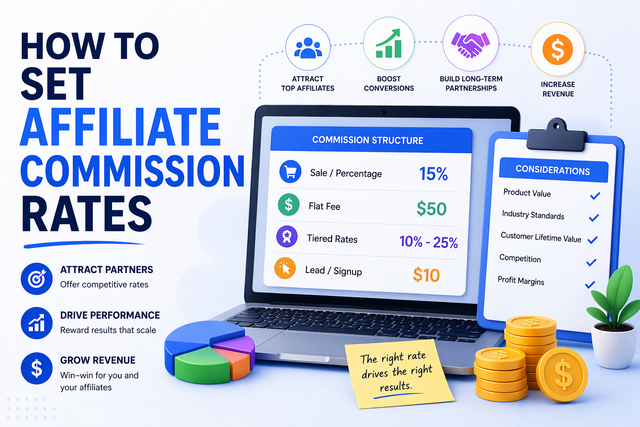
## Introduction
Your affiliate program's commission rate is often the first number a potential affiliate checks. Before they read your landing page, review your products, or consider your brand fit, they look at one thing: what is in it for me?
Getting your commission structure right is not just about being competitive. It is about signaling credibility, attracting the right type of affiliates, and building a program that pays for itself through incremental revenue. Set it too low and serious affiliates scroll past. Set it too high and you erode margins or attract coupon hunters who cannibalize sales you would have made anyway.
This guide walks through how to think about commission structures, what top affiliates actually look for, and how to build a rate that attracts quality partners without wrecking your economics.
## What Affiliates Look At Before Joining Your Program
Before you set a number, understand the evaluation process a serious affiliate goes through. Most experienced affiliates compare programs across four factors.
**Commission rate and type.** Is it a flat fee, a percentage, one-time, or recurring? Recurring models are highly preferred because they compound over time.
**Cookie duration.** A 30-day cookie is table stakes. Anything shorter than 14 days is often a dealbreaker for affiliates running content or email campaigns where the sales cycle stretches past the click.
**Average order value and effective earnings per sale.** A 5% commission on a $500 product ($25 per sale) beats a 30% commission on a $10 product ($3 per sale). Affiliates do this math before applying.
**Program reliability.** They want to know: does this program pay on time? Is there a real team behind it? Is the brand credible enough that their audience will trust the recommendation?
Your commission rate feeds directly into factors one and three. Get those right and the rest of your program becomes easier to sell.
## Types of Commission Structures
There is no single correct commission structure. The right model depends on your product, margins, and the affiliates you want to attract.
### Flat Percentage
The most common model. You pay affiliates a fixed percentage of each sale. SaaS tools typically offer 20-40%, physical products 5-20%, and services anywhere from 10-30%. The upside is simplicity. The downside is that as your pricing grows, costs scale proportionally.
### Flat Fee Per Sale
A fixed dollar amount per conversion regardless of order value. This works well for high-AOV products where a percentage would create unsustainable payouts, and for products with narrow margin bands. Flat fees of $50 to $200 per sale are common in insurance, finance, and B2B software.
### Recurring Commission
Affiliates earn a percentage of the customer's subscription for as long as that customer stays subscribed. This is the most attractive structure for professional affiliates, because a single referral builds into compounding monthly income. SaaS products are the natural fit here. If your churn is low, a 20-30% recurring rate can be extremely profitable for affiliates and still sustainable for you.
### Tiered Commission
Affiliates earn higher rates once they hit volume thresholds. For example: 20% on the first 10 sales per month, 25% from 11 to 30 sales, 30% above that. Tiered structures reward your best performers and create a built-in incentive to promote more aggressively.
### Hybrid
A combination of upfront and recurring. A common structure is a one-time bonus for the first sale plus a lower ongoing percentage. This works well when you want to incentivize fast activation while keeping long-term payouts manageable.
## How to Calculate a Sustainable Commission Rate
The most common mistake program owners make is picking a number by benchmarking competitors without accounting for their own unit economics. Here is a more reliable framework.
**Start with your customer lifetime value (LTV).** If an average customer is worth $300 over 18 months, you have more room to pay for that customer than if they are worth $80. A higher LTV means you can afford a more generous upfront or recurring commission and still come out ahead.
**Factor in your customer acquisition cost (CAC).** If you are already spending $40 to acquire a customer through paid ads, what is the incremental value of an affiliate channel? If affiliates convert at a similar rate with lower overhead, you have room to pay 30-40% of the first sale and still improve your blended CAC.
**Set a ceiling from gross margin.** If your gross margin is 70%, you can afford to pay up to 30-40% in affiliate fees and still operate profitably before accounting for operating costs. If your margin is 20%, a 15% affiliate commission is already aggressive. Work backward from margin, not forward from what sounds impressive.
**Match the rate to the affiliate type you want.** Coupon and cashback sites drive volume at lower rates. Content creators and newsletter operators expect higher rates because their recommendations carry more trust and require more effort to produce. If you want quality affiliates, price your program for quality affiliates.
## Recurring vs One-Time: What Top Affiliates Actually Prefer
If you have a subscription product, recurring commissions are one of the most powerful levers for attracting serious affiliates. Professional affiliate marketers consistently rank recurring commissions as the top program feature they look for in SaaS.
The reason is simple: a content creator who publishes one review can earn $20 per month from that single piece of content for years. That changes the economics of affiliate marketing from a constant content treadmill into a scalable passive income stream. A well-placed review that earns $20/month for 36 months is worth $720. That same review earning a one-time $30 commission is not even close.
If recurring is not economically viable at your current stage, consider a middle ground: offer recurring commissions for the first 6 to 12 months post-signup rather than the full lifetime of the customer. This limits your exposure while still making your program meaningfully more attractive than a flat one-time payout.
## Common Mistakes That Make Affiliates Pass on Your Program
**Rates that are too low with no explanation.** A 5% commission on a $20/month SaaS is $1 per referral. That is not a motivating number. If your margins require a low rate, explain the economics, offer strong performance bonuses, or invest heavily in tools that make promotion effortless.
**Mismatched cookie windows.** A 40% commission with a 3-day cookie is worse than a 25% commission with a 60-day cookie for most content-driven affiliates. They need enough time to move a reader from initial click through to purchase, especially for higher-ticket products with longer consideration cycles.
**No tiered upside.** Flat rates with no room to grow give your best affiliates no reason to prioritize your program over a competitor that rewards scale. Even a modest tier system signals that you value high performers.
**Changing rates without notice.** Cutting commissions retroactively, or with only a few days' notice, is the fastest way to destroy affiliate trust. If your economics require a rate adjustment, grandfather existing affiliates at the old rate and communicate changes with at least 30 days' notice.
**Paying only on the first purchase.** If you sell subscriptions or consumables, single-purchase commission structures miss the point. Affiliates who drive customers with strong retention are adding disproportionate lifetime value. Your commission structure should reflect that.
## Testing and Adjusting Your Structure Over Time
Your first commission rate is a hypothesis. Set it deliberately, but treat it as a starting point rather than a permanent decision.
Track affiliate performance by tier: what does your top 10% of affiliates earn per month? If your best performers are capping out and not growing, your rate structure may not reward scale sufficiently. If you have a high sign-up rate but low activation (affiliates who join but never promote), your rate may be too low relative to the effort required, or your creative assets are too weak to make promotion feel worthwhile.
Run quarterly reviews comparing your affiliate cost-per-acquisition against your other acquisition channels. Raise rates when the channel is outperforming its cost ceiling and you have room to invest more. Reduce them carefully and only when you have clear data showing the current rate is above what the market requires to retain your best affiliates.
Managing tiered commissions, performance tracking, and rate adjustments manually gets unwieldy fast. Tools like [Affonso](https://www.findaffiliates.online/affonso-affiliate-program) are built specifically for this: they handle tiered commissions, affiliate dashboards, and payout tracking without the spreadsheet overhead. If you are running a growing program, purpose-built affiliate management software pays for itself quickly.
## Conclusion
A well-structured commission is not just a cost line. It is a recruitment tool, a retention signal, and a statement about how seriously you take your affiliate partners. The programs that attract the best affiliates are not always the ones with the highest rates. They are the ones that clearly communicate the economics, make it easy to earn, and reward performance over time.
If you are building or refining your affiliate program and want to benchmark what competitive programs actually look like, browse the directory at [FindAffiliates](https://www.findaffiliates.online). Seeing how programs across dozens of niches structure their offers is one of the fastest ways to calibrate your own commission strategy.
---
## Best CRM Affiliate Programs in 2026: Earn Recurring Commissions Every Month
*Published: 2026-04-16*
*URL: https://www.findaffiliates.online/blogs/crm-affiliate-programs-2026*
## Introduction
CRM software is one of the most reliably profitable categories to promote as an affiliate. Businesses of all sizes need a CRM to manage customers and sales pipelines, subscription plans tend to run for years, and the commissions are often recurring, meaning you get paid every month as long as your referral stays subscribed.
That is a very different economics from promoting one-off product sales. Refer a single mid-market team to a CRM platform, and you could earn passive income for 12 months or longer from a single click.
In this guide, you will find the best CRM affiliate programs available in 2026, including commission rates, cookie windows, and what makes each one worth your time. Whether you run a marketing blog, a sales-focused YouTube channel, or a newsletter for business owners, there is a program here that fits.
## Why CRM Programs Are Such Good Affiliate Picks
Before diving into the programs, it helps to understand why CRM affiliate marketing is so attractive compared to other software niches.
### High Average Contract Values
CRM tools are priced for teams. A company with 10 sales reps might pay $300 to $1,000 per month for their CRM. Even at a 20% commission, that generates $60 to $200 every single month from one referral.
### Recurring Payouts
Most of the top programs pay recurring commissions for at least 12 months, and some pay lifetime recurring. Compare that to a one-time 30% payout on a $29 tool and the math becomes obvious.
### Sticky Software
Businesses rarely switch CRMs. Migrating customer data and retraining a sales team is painful, which means low churn. Your referrals stay, and your commissions keep coming.
### Broad Audience
Every business owner, startup founder, sales leader, and marketing director is a potential buyer. CRM is one of the most searched software categories on the internet, which means consistent organic traffic potential for content creators.
## Top CRM Affiliate Programs in 2026
### HubSpot
[HubSpot](https://www.findaffiliates.online/hubspot-affiliate-program) is the dominant name in CRM marketing and one of the most recognizable affiliate programs in software. The company runs a well-organized partner program with strong brand recognition that makes conversion comparatively easy.
**Commission:** 30% recurring for up to 12 months
**Cookie duration:** 180 days
**Best for:** Marketing bloggers, business coaches, startup-focused content
HubSpot's free CRM tier makes it an easy sell, because your audience can start for free and upgrade later, giving your referral link more time to convert. The 180-day cookie window is generous compared to most software affiliate programs.
### Pipedrive
[Pipedrive](https://www.findaffiliates.online/pipedrive-affiliate-program) is the CRM of choice for sales-focused teams. It is simpler than HubSpot by design and consistently ranks among the top CRMs for small and mid-size businesses.
**Commission:** 20% recurring for 12 months (up to 33% for top affiliates)
**Cookie duration:** 90 days
**Best for:** Sales blogs, B2B content, productivity and workflow creators
The tiered commission structure rewards performance. If your content drives consistent signups, your rate increases, making it a program worth building a dedicated content pillar around.
### ActiveCampaign
[ActiveCampaign](https://www.findaffiliates.online/activecampaign-affiliate-program) sits at the intersection of CRM and email automation, which means it appeals to a wider audience than pure CRM tools. Marketers, e-commerce store owners, and coaches all use it.
**Commission:** 20% to 30% recurring (tiered: Silver, Gold, Platinum)
**Cookie duration:** 90 days
**Best for:** Email marketing bloggers, agency owners, e-commerce content creators
ActiveCampaign's breadth of use cases gives you more angles to write about: email sequences for coaches, lead nurturing for e-commerce, CRM pipelines for agencies. Each angle opens a different audience segment.
### Zoho CRM
[Zoho](https://www.findaffiliates.online/zoho-affiliate-program) offers one of the most complete business software suites available. The CRM is often the entry point, and once a business adopts Zoho CRM, they frequently expand to other Zoho products, which keeps them on the platform long-term.
**Commission:** 15% per sale
**Cookie duration:** 90 days
**Best for:** International audiences, SMB-focused content, tech-savvy bloggers
Zoho's global footprint and competitive pricing make it particularly strong in markets outside North America. If your audience is international, Zoho often outperforms HubSpot on conversions because of the price point.
### Monday CRM
[Monday](https://www.findaffiliates.online/monday-affiliate-program) has evolved from a project management tool into a full CRM platform. Its visually intuitive interface makes it popular with teams that find traditional CRMs overly complex.
**Commission:** Competitive rates via Impact (exact rate varies by tier)
**Cookie duration:** 30 days
**Best for:** Creative teams, agencies, content creators targeting non-sales professionals
Monday's broad positioning helps it convert across industries. If your audience is in agencies, marketing, or creative fields, Monday CRM can outperform more sales-specific tools like Pipedrive.
### Close CRM
Close is a CRM built specifically for inside sales teams and remote sales reps. It has a loyal, niche user base and competes on features like built-in calling, SMS, and email sequences.
**Commission:** 20% recurring for 12 months
**Cookie duration:** 90 days
**Best for:** Sales-heavy audiences, cold outreach and SDR-focused content
Close is a strong choice if your content focuses on outbound sales, cold emailing, or scaling a sales team. The audience is highly targeted, which improves conversion rates even on smaller traffic volumes.
## CRM Affiliate Program Comparison
| Program | Commission | Recurring | Cookie | Best Audience |
|---|---|---|---|---|
| HubSpot | 30% | 12 months | 180 days | Marketing, startups |
| Pipedrive | 20-33% | 12 months | 90 days | Sales teams |
| ActiveCampaign | 20-30% | 12 months | 90 days | Email marketers |
| Zoho | 15% | Per sale | 90 days | SMBs, international |
| Monday | Varies | Varies | 30 days | Agencies, creative teams |
| Close | 20% | 12 months | 90 days | Inside sales |
## How to Promote CRM Affiliate Programs Effectively
Picking the right programs is only step one. Commissions actually depend on how well you match the program to your audience and content strategy.
### Write Comparison Content
"HubSpot vs. Pipedrive" or "Best CRM for Small Business" are high-intent search queries. People searching these terms are already evaluating options, which means they are close to a buying decision. Comparison posts and roundups consistently outperform general review content for CRM affiliate conversions.
### Target Business Owners, Not Just Marketers
Most CRM affiliate content goes after marketing professionals. You can stand out by writing for founders, solopreneurs, and operations leaders who are setting up a CRM for the first time. The language is different, the concerns are different (ease of use, setup time, price), and the competition is lower.
### Build a CRM Resource Hub
Rather than writing one review and moving on, build a cluster of related content: setup guides, integration tutorials, use case explainers. Each piece earns search traffic and routes readers toward your affiliate links. Over time, this compounds.
### Use Email Nurture Sequences
CRM purchases are rarely impulse buys. A five-email sequence that educates subscribers on choosing a CRM, positions one or two programs, and addresses common objections tends to convert much better than a single promotion.
## Conclusion
CRM affiliate programs offer some of the best commission structures in the software space. Recurring payouts, long cookie windows, and high customer lifetime values make them worth serious effort. Whether you lean toward HubSpot's brand recognition, Pipedrive's sales focus, or ActiveCampaign's automation power, there is a program that fits the content you already create.
Browse the full list of CRM and business software programs on [FindAffiliates](https://www.findaffiliates.online) to find more opportunities to promote tools your audience actually uses.
---
## Best AI Writing Tool Affiliate Programs in 2026
*Published: 2026-04-15*
*URL: https://www.findaffiliates.online/blogs/ai-writing-tools-affiliate-programs-2026*

## Introduction
AI writing tools have gone from novelty to necessity for bloggers, marketers, copywriters, and content teams. Adoption is still accelerating, which means there is a large and growing audience actively searching for reviews, comparisons, and recommendations on exactly these products.
For affiliates, that is a meaningful opportunity. AI writing tools run on subscription models, carry solid commission rates, and convert well because buyers are already in research mode when they find your content. The category has matured enough that you can create genuinely helpful comparison content without it feeling thin or speculative.
This guide covers the best AI writing tool affiliate programs available in 2026 -- what they pay, who they are best suited for, and what kind of content performs for each one.
---
## What to Look for in an AI Writing Affiliate Program
Not every AI writing tool is worth your promotional effort. A few criteria that separate programs worth building content around from ones to skip:
**Retention.** AI writing tools have higher churn than other SaaS categories. Users often sign up for one project, then cancel. Look for programs with recurring commissions that hedge against this, or tools with strong product-led retention (deep integrations, team features, workflow dependencies).
**Search demand for the brand.** If nobody is searching for the tool by name, comparison content and review posts will be harder to rank and convert. Stick to tools with established brand recognition or strong growth trajectories.
**Commission structure.** Flat-fee bounties are fine for high-ticket tools, but recurring commissions compound better over time for tools with monthly pricing.
**Free trial or freemium.** Tools with a free tier convert better from affiliate traffic because there is no barrier to trying the product. Your referral link works even when the visitor is not ready to pay yet.
---
## Best AI Writing Tool Affiliate Programs in 2026
### Jasper AI
Jasper is one of the most recognized names in AI writing, particularly among professional marketers and content teams. Their affiliate program pays **25% recurring commissions**, and their plans start at $39/month with the Business tier running considerably higher.
Jasper performs well for affiliate content targeting marketing agencies, e-commerce brands, and content teams that produce volume. Review content, comparison posts against competitors, and "Jasper vs." articles consistently rank and convert. The brand recognition means less convincing and more converting.
[View Jasper AI on FindAffiliates](https://www.findaffiliates.online/jasper-ai-affiliate-program)
---
### Writesonic
Writesonic competes directly with Jasper and positions itself as a more affordable alternative with a broader feature set. Their affiliate program pays **30% recurring commissions** with a 30-day cookie window.
What makes Writesonic valuable for affiliates is pricing flexibility -- they have a free tier, pay-as-you-go credits, and monthly plans, which means different price points to match different types of content. Posts comparing Writesonic to pricier alternatives tend to convert well because Writesonic wins on cost for many use cases.
[View Writesonic on FindAffiliates](https://www.findaffiliates.online/writesonic-affiliate-program)
---
### Quillbot
Quillbot is the dominant tool in the paraphrasing and grammar-checking category, with tens of millions of monthly users. Their affiliate program pays **20% recurring commissions** with a 45-day cookie window.
The advantage here is scale. Quillbot has massive organic search volume, a loyal student and writer audience, and a freemium model that converts free users to paid over time. Content targeting students, academics, and non-native English writers converts reliably. The tool is genuinely useful for a broad audience, which makes recommendations feel natural rather than forced.
[View Quillbot on FindAffiliates](https://www.findaffiliates.online/quillbot-affiliate-program)
---
### Koala AI
Koala AI is a rising tool in the AI SEO writing category, built specifically for bloggers and affiliate marketers who need long-form content at scale. Their affiliate program pays **30% recurring commissions**, and the product's core audience -- SEO-focused content creators -- is exactly the type of affiliate who understands the value of a tool like this.
Koala is a strong pick if your own audience includes bloggers, niche site builders, or content operators. The product-audience alignment makes promotion feel authentic rather than off-topic.
[View Koala AI on FindAffiliates](https://www.findaffiliates.online/koala-ai-affiliate-program)
---
### Journalist AI
Journalist AI focuses on automated blog and article writing at scale, targeting agencies and content-heavy businesses rather than individual creators. Their affiliate program pays commissions through their affiliate platform, and the tool's positioning as a productivity multiplier for teams makes it a higher-intent purchase.
The pitch for Journalist AI is efficiency: replacing manual research and drafting with a structured automation layer. Content that speaks to the operational cost of content production converts well for this tool.
[View Journalist AI on FindAffiliates](https://www.findaffiliates.online/journalist-ai-affiliate-program)
---
### Frase
Frase occupies a specific and valuable niche: AI-assisted SEO writing that combines content research, SERP analysis, and drafting in one workflow. Their affiliate program pays **20% recurring commissions** with plans starting at $14.99/month.
Frase is particularly strong for affiliate content targeting SEO professionals, content strategists, and agencies that produce large volumes of search-optimized content. Tutorials, workflow guides, and "how I use Frase" content tend to perform well because the tool is process-oriented.
[View Frase on FindAffiliates](https://www.findaffiliates.online/frase-affiliate-program)
---
### GetGenie
GetGenie is an AI writing assistant built natively for WordPress via a plugin, which gives it a distinct advantage with the massive WordPress creator and blogger audience. Their affiliate program pays **30% recurring commissions**.
The WordPress integration means GetGenie targets a different conversion path than most AI writing tools. Users discover it while looking for WordPress SEO or content plugins rather than through standalone AI tool searches. If your audience is WordPress-focused, GetGenie fits naturally into plugin roundups and content workflow posts.
[View GetGenie on FindAffiliates](https://www.findaffiliates.online/getgenie-affiliate-program)
---
### RightBlogger
RightBlogger is an AI-powered suite designed specifically for bloggers, covering writing, keyword research, and content planning in one dashboard. Their affiliate program pays **30% recurring commissions** via Rewardful, and the product's focused positioning makes it an easy recommendation for audiences of content creators and bloggers.
The brand has a growing community and a founder-led presence online, which means there is real social proof behind the product. Comparison posts against more expensive alternatives tend to convert well.
[View RightBlogger on FindAffiliates](https://www.findaffiliates.online/rightblogger-affiliate-program)
---
### Grammarly
Grammarly is not typically categorized as an "AI writing tool" in the generative sense, but it has expanded significantly into AI suggestions, tone adjustments, and rewriting features -- making it relevant in this category. Their affiliate program pays **$0.20 per free signup and $20 per paid upgrade** with a 90-day cookie window.
The advantage with Grammarly is name recognition. Everyone has heard of it, which means the conversion funnel starts with familiarity rather than awareness-building. Content targeting students, professionals, and anyone who writes in English can include Grammarly naturally with minimal friction.
[View Grammarly on FindAffiliates](https://www.findaffiliates.online/grammarly-affiliate-program)
---
## Quick Comparison
| Tool | Commission | Type | Cookie | Best Audience |
|------|------------|------|--------|---------------|
| Jasper AI | 25% | Recurring | 30 days | Marketers, content teams |
| Writesonic | 30% | Recurring | 30 days | Budget-conscious writers |
| Quillbot | 20% | Recurring | 45 days | Students, academics |
| Koala AI | 30% | Recurring | 30 days | Bloggers, niche sites |
| Journalist AI | Varies | Recurring | -- | Agencies, content ops |
| Frase | 20% | Recurring | 30 days | SEO pros, strategists |
| GetGenie | 30% | Recurring | 30 days | WordPress creators |
| RightBlogger | 30% | Recurring | 30 days | Bloggers, content creators |
| Grammarly | $20/paid upgrade | Bounty | 90 days | General writers |
---
## Content Formats That Convert in This Niche
AI writing tool content has a few reliable formats worth knowing about before you start:
**Tool comparisons.** Searches like "Jasper vs Writesonic" and "Quillbot vs Grammarly" are high-intent because the visitor has already narrowed their consideration set. A well-structured comparison with a clear recommendation typically converts better than a standalone review.
**Workflow tutorials.** "How I use [Tool] to write blog posts faster" or "My AI content workflow" posts attract readers who are already committed to using AI tools and just need to pick one. These are warm audiences.
**Niche-specific use cases.** "Best AI writing tools for real estate agents" or "AI writing tools for email marketers" narrow the competition and increase relevance. Niche content converts better because the reader feels the recommendation was made for them.
**Listicles with a verdict.** Posts like "9 AI writing tools I tested in 2026 -- here's what I kept" work well because they deliver a genuine opinion at the end rather than listing tools without taking a position.
---
## Conclusion
The AI writing tool category has enough depth to support a full content strategy on its own. Whether you are targeting marketers, bloggers, SEO professionals, or general writers, there is a tool in this list that fits your audience.
If you are starting out, Jasper, Writesonic, and Quillbot give you the strongest combination of brand recognition, commission rate, and audience breadth. For more focused audiences, Koala AI, Frase, and RightBlogger offer better product-audience fit.
Browse more programs by category at [FindAffiliates](https://www.findaffiliates.online/) -- including AI tools, SaaS, marketing platforms, and more.
---
## How to Promote Your Affiliate Program
*Published: 2026-03-22*
*URL: https://www.findaffiliates.online/blogs/how-to-promote-your-affiliate-program*

You launched an affiliate program. You set the commission. You waited. And... nothing. Affiliates don't magically find programs. You have to promote your program just like you promote your product. Here's how to get discovered by quality affiliates.
---
## List on Affiliate Directories
Affiliate directories are where affiliates search for programs to join. Listing on directories like FindAffiliates, referly.so, and uppromote.com puts your program in front of affiliates actively looking to promote products in your niche. Most directories are free or low-cost. The ROI on a single quality affiliate makes this a no-brainer.
---
## Optimize Your Affiliate Page for SEO
Affiliates search Google for "your niche + affiliate program." If your affiliate page doesn't rank, they won't find you. Create a dedicated page at yourdomain.com/affiliates. Include your niche, commission rate, and "affiliate program" in the title and H1. Write a clear description of who should join and what they'll earn.
---
## Link From Your Website Footer
Put "Affiliate Program" in your footer next to "Careers" and "Contact." This is the first place potential affiliates look. If it's not there, they assume you don't have a program.
---
## Email Your Customer List
Your best affiliates are already your customers. Send one email to your list inviting them to join your affiliate program. Include your commission rate and a direct signup link. Existing customers convert better and promote more authentically because they actually use your product.
---
## Partner With Complementary Brands
Find companies that sell to the same audience but don't compete directly. If you sell email marketing software, partner with CRM companies. They can recommend your affiliate program to their power users. You can do the same for them.
---
## Reach Out to Content Creators Directly
Search YouTube, blogs, and podcasts in your niche. Find creators who review products like yours. Email them personally with your affiliate offer. Don't copy-paste. Mention their content, explain why your product fits their audience, and include your commission rate upfront.
---
## Run a Launch Campaign
When you launch or improve your affiliate program, treat it like a product launch. Announce it on social media. Email your list. Create a limited-time signup bonus for the first 50 affiliates. Momentum builds momentum.
---
*Last updated: March 2026*
---
## Creating an Affiliate Program Landing Page That Converts
*Published: 2026-03-21*
*URL: https://www.findaffiliates.online/blogs/creating-an-affiliate-program-landing-page-that-converts*
Your affiliate landing page is where affiliates decide to join or move on. Most are terrible. Here's how to make one that actually recruits quality partners.
---
## Lead With Commission Details
Affiliates want to know: How much will I earn? Put commission rates in the first paragraph. Don't bury it. "Earn 30% recurring commission" should be visible above the fold.
---
## Show the Product Value
Affiliates promote products they believe in. Briefly explain what your product does and who it's for. Show them it's something worth recommending.
---
## Include Social Proof
Have existing affiliates? Quote them. Have revenue numbers? Share them. "Our top affiliate earned $50,000 last year" is more compelling than "Join our program."
---
## Make Requirements Clear
Who can join? Do you require a minimum audience size? Specific niches? State this upfront. It saves everyone time and sets expectations.
---
## Provide a Simple FAQ
Answer the obvious questions:
- When do payouts happen?
- What's the minimum payout threshold?
- What's the cookie duration?
- How do I get paid (PayPal, bank transfer, etc.)?
---
## Show the Dashboard
If you have an affiliate portal, include a screenshot. Affiliates want to know they can track their performance. A good dashboard signals professionalism.
---
## Add a Clear CTA
"Join Now" or "Apply to Join" should be impossible to miss. One button, no confusion. Don't make them hunt for the sign-up link.
---
## Mobile-Friendly Matters
Affiliates check programs on phones. If your landing page breaks on mobile, you lose them. Test it.
---
## Link From Your Footer
Every page on your site should have "Affiliate Program" in the footer. Affiliates scout brands this way. If they can't find it, they'll assume you don't have one.
---
*Last updated: March 2026*
---
## Common Affiliate Program Mistakes to Avoid
*Published: 2026-03-20*
*URL: https://www.findaffiliates.online/blogs/common-affiliate-program-mistakes-to-avoid*
Companies make the same mistakes with affiliate programs. Here's what goes wrong and how to fix it.
---
## Mistake 1: Treating Affiliates Like Employees
Affiliates are partners, not staff. They choose what to promote, when to promote, and how to promote. You can provide guidance, but demanding specific tactics backfires.
The best approach: Give resources, answer questions, pay on time. Let affiliates do their job.
---
## Mistake 2: Low Cookie Duration
A 7-day cookie means affiliates lose credit if someone buys on day 8. That's unfair. Most purchases don't happen in one session.
The fix: 30-day minimum. 60 or 90 days is better. Lifetime cookies on subscriptions are ideal.
---
## Mistake 3: Paying Late
Affiliates talk. If you pay late, the whole industry knows. Pay on time, every time. If there's a delay, communicate proactively.
---
## Mistake 4: Reversing Commissions
Some companies reverse commissions for "suspicious" activity. Overuse this and affiliates will leave. Reserve reversals for actual fraud. If a sale happened, pay the commission.
---
## Mistake 5: No Affiliate Manager
Launching a program and ignoring it doesn't work. Assign someone to review applications, answer questions, and recruit actively. Affiliate programs need human attention.
---
## Mistake 6: Complicated Sign-Up
If your application asks for 20 fields and requires approval from three departments, affiliates will quit halfway. Keep it simple. Name, email, website, payment method. Done.
---
## Mistake 7: Ignoring Fraud Prevention
While over-reversing is bad, ignoring fraud is worse. Watch for:
- Self-referrals (affiliates signing up as their own customers)
- Cookie stuffing (forcing cookies without clicks)
- Bot traffic with no conversions
Set thresholds and monitor suspicious patterns.
---
## Mistake 8: No Attribution for Upsells
If an affiliate refers someone who buys the basic plan, then upgrades later, does the affiliate get credit? They should. Recurring or lifetime attribution keeps affiliates motivated.
---
*Last updated: March 2026*
---
## Attracting Quality Affiliates to Your Program
*Published: 2026-03-19*
*URL: https://www.findaffiliates.online/blogs/attracting-quality-affiliates-to-your-program*

Most companies launch an affiliate program and wait. Quality affiliates don't just appear. You have to recruit them. Here's how to attract affiliates who actually drive sales.
---
## Pay Competitively
Affiliates compare programs. If your competitor pays 30% and you pay 15%, you'll get the scraps. Check what similar programs offer and match or exceed it.
Recurring commissions beat one-time bounties for affiliates. A 30% recurring commission on a $50/month product beats $100 one-time after 7 months. Affiliates do this math.
---
## Make Your Program Easy to Find
Put "Affiliate Program" in your website footer. Create a dedicated landing page. Link from your main navigation if possible. If affiliates can't find you, they can't promote you.
---
## Provide Real Marketing Assets
Don't just give affiliates a link. Give them:
- Banners in multiple sizes
- Email swipe copy
- Social media post templates
- Product screenshots
- Logos with transparent backgrounds
- Case studies and testimonials
The easier you make it to promote, the more affiliates will promote.
---
## Approve Quickly
Don't make affiliates wait weeks for approval. Review applications within 48 hours. Good affiliates apply to multiple programs. The first to approve gets the promotion.
---
## Communicate Proactively
Send affiliates a welcome email. Tell them about new features, promotions, or content they can use. A monthly affiliate newsletter keeps your program top of mind.
---
## Offer Tiered Commissions
Reward your best performers. If someone drives $5,000 in sales, bump their commission. This incentivizes affiliates to prioritize your program over others.
---
## Provide an Affiliate Dashboard
Affiliates need to track clicks, conversions, and earnings. A good dashboard builds confidence. If they can't see their performance, they'll assume the worst.
---
*Last updated: March 2026*
---
## Building Trust With Your Affiliate Audience
*Published: 2026-03-18*
*URL: https://www.findaffiliates.online/blogs/building-trust-with-your-audience*

Anyone can slap affiliate links on a page. The money comes from trust. People buy from sources they believe. Here's how to build credibility that converts.
---
## Actually Test What You Recommend
The fastest way to lose trust is recommending products you've never used. Actually sign up. Actually try the features. Actually find the flaws.
Your reviews should include real screenshots, specific examples, and honest limitations. Readers can tell the difference between a real review and rewritten marketing copy.
---
## Admit Product Weaknesses
No product is perfect. If you say something is flawless, you sound like a shill. Point out real downsides. "This VPN is fast but expensive." "This tool is powerful but has a learning curve."
Paradoxically, admitting flaws makes your recommendations more credible. People trust balanced reviews over glowing ones.
---
## Show Your Face
Anonymous sites work, but personal brands convert better. Put your name on your content. Write in your voice. Let people know there's a real human behind the recommendations.
---
## Respond to Comments and Emails
When someone asks a question, answer it. When someone disagrees, engage respectfully. Building trust happens in the details. A single helpful response can create a reader for life.
---
## Disclose Clearly
Legal requirements aside, clear disclosures build trust. "I earn a commission if you buy through my links" is honest. Readers appreciate transparency. Hidden affiliate links feel scammy.
---
## Don't Chase Every Commission
Turn down programs that don't fit your audience. Recommending irrelevant products erodes trust. Your audience would rather see 3 relevant recommendations than 20 random ones.
---
## Create Value Beyond Affiliate Links
Write content that helps people even if they don't click your links. Tutorials, guides, comparisons, and honest advice. The commissions come as a side effect of being genuinely useful.
---
*Last updated: March 2026*
---
## Affiliate SEO That Actually Works
*Published: 2026-03-17*
*URL: https://www.findaffiliates.online/blogs/affiliate-seo-that-actually-works*
Most affiliate SEO advice is garbage. "Write great content" isn't a strategy. Here's what actually moves the needle for affiliate sites.
---
## Target Buying Intent, Not Informational Intent
Informational searches: "what is a VPN"
Buying searches: "best VPN for streaming Netflix" or "NordVPN vs Surfshark"
Informational traffic doesn't convert. Buying traffic does. Target keywords that indicate someone is ready to purchase.
---
## The Comparison Post Formula
Comparison posts convert best because they help people decide. Structure them like this:
1. Quick verdict at the top (most readers skim)
2. Side-by-side comparison table
3. Detailed breakdown of each option
4. Clear winner with reasoning
5. Your affiliate links throughout
---
## Build Topical Authority, Not Random Posts
Don't write one post about VPNs, one about web hosting, one about email marketing. Google rewards topical authority. Build a cluster:
- Best VPNs for [use case]
- [Brand A] review
- [Brand B] review
- [Brand A] vs [Brand B]
- How to [use VPN for specific purpose]
Interlink everything. Make your site the resource on that topic.
---
## Update Old Content Regularly
Google favors fresh content. Set a reminder to update your top posts every 3-6 months. Add new products, update prices, refresh screenshots. A 30-minute update can restore rankings.
---
## Internal Links Are Underrated
Every post should link to 3-5 other posts on your site. This passes authority and keeps people on your site longer. Use descriptive anchor text, not "click here."
---
## Don't Ignore Technical SEO
Fast loading, mobile-friendly, no broken links. Use a caching plugin. Compress images. Fix 404s. Google's Core Web Vitals matter for rankings.
---
## The Patience Problem
Affiliate SEO takes 6-12 months to see real results. Most people quit at month 3. If you can write consistently for a year, you'll outrank the quitters.
---
*Last updated: March 2026*
---
## How to Choose the Right Affiliate Niche
*Published: 2026-03-16*
*URL: https://www.findaffiliates.online/blogs/how-to-choose-the-right-affiliate-niche*

Picking a niche is the most important decision an affiliate makes. Choose wrong and you'll fight for scraps. Choose right and the commissions compound. Here's how to find a niche that actually pays.
---
## Follow the Money, Not the Passion
Passion is overrated. You can learn to care about anything that pays well. Look for niches where companies spend money on affiliate programs. That means the economics work.
Check affiliate networks like ShareASale, CJ, or Impact. Sort by EPC (earnings per click). High EPC means affiliates are making money. That's your signal.
---
## Three Questions to Validate Any Niche
Before committing, answer these:
1. Is there recurring spend? Subscriptions beat one-time purchases. A VPN customer pays monthly. A t-shirt buyer pays once.
2. Is the audience searchable? Can you write content people actively search for? "Best CRM for small business" gets searches. "Best quantum computing software" does not.
3. Can you add value? If the affiliate program requires approval, good. That means they reject bad affiliates. If anyone can join, you'll compete with spam.
---
## The Sweet Spot: Specific But Not Niche
Too broad: "Finance" - you'll never rank.
Too narrow: "Credit cards for left-handed dentists" - no search volume.
Sweet spot: "Credit cards for small business owners" or "Budgeting apps for freelancers."
Specific enough to target, broad enough to matter.
---
## Red Flags to Avoid
- Low commissions on cheap products. 5% of a $20 item is $1. You need massive traffic.
- Shady industries. Supplements, casino, payday loans. They pay well because they exploit people. Short-term gain, long-term regret.
- Programs with bad reputations. Search "[program name] affiliate scam" before joining. If affiliates are complaining, stay away.
---
## Start With One, Expand Later
Don't build five niche sites. Build one. Get it to $1,000/month. Then consider expanding. Most affiliates fail because they spread too thin before mastering one niche.
---
*Last updated: March 2026*
---
## Top Business Affiliate Programs 2026
*Published: 2026-03-15*
*URL: https://www.findaffiliates.online/blogs/top-business-affiliate-programs-2026*
The business tools market is exploding in 2026, with companies spending over $1 trillion annually on software and services. For affiliates, this niche offers exceptional earning potential with commissions ranging from $7 to $1,000 per sale. This guide covers the top business affiliate programs worth promoting.
---
## [Brightpath BD](https://www.findaffiliates.online/brightpath-bd-affiliate-program)
Commission: Up to $1,000
Niche: Business Development
Brightpath BD is a business development and growth platform helping companies scale their operations. Their affiliate program offers one of the highest payouts in the business category, making it ideal for B2B-focused affiliates and consultants.
---
## [Crisis Proof Business Blueprint](https://www.findaffiliates.online/crisis-proof-business-blueprint-affiliate-program)
Commission: 40%
Niche: Business Training
This comprehensive training program teaches entrepreneurs how to build resilient businesses that thrive during economic downturns. The 40% commission rate and high-ticket pricing create significant earning potential for business coaches and financial education creators.
---
## [Cold Outreach OS Toolkit](https://www.findaffiliates.online/cold-outreach-os-toolkit-affiliate-program)
Commission: 50%
Niche: Outreach & Sales
A complete system for cold email outreach and sales automation. This toolkit appeals to sales teams, agencies, and entrepreneurs looking to scale their outreach efforts. The 50% commission makes it attractive for marketing affiliates.
---
## [Canva](https://www.findaffiliates.online/canva-affiliate-program)
Commission: 25%
Niche: Design & Marketing
Canva is the leading design platform for non-designers, with over 150 million users. The free-to-paid conversion funnel is excellent, and their brand recognition makes this an easy sell for content creators, social media managers, and marketers.
---
## [Zoom](https://www.findaffiliates.online/zoom-affiliate-program)
Commission: $25
Niche: Communication
The video conferencing giant remains a staple for remote teams and businesses worldwide. With hybrid work here to stay, Zoom's paid plans continue to see strong adoption among small and medium businesses.
---
## [Shopify](https://www.findaffiliates.online/shopify-affiliate-program)
Commission: $150
Niche: E-commerce
The leading e-commerce platform powers millions of online stores. Their $150 bounty per signup is competitive, and the platform's dominance makes it an easy recommendation for anyone looking to start an online business.
---
## [First Time CEO Masterclass](https://www.findaffiliates.online/first-time-ceo-masterclass-affiliate-program)
Commission: 25%+
Niche: Leadership Training
This program targets new CEOs and business leaders transitioning into executive roles. The 25% commission with potential bonuses appeals to leadership coaches and business development content creators.
---
## Tips for Promoting Business Affiliate Programs
1. Target B2B decision-makers - Focus on business owners, managers, and team leads who control purchasing decisions
2. Create comparison content - Compare tools like Shopify vs competitors, Canva alternatives, or best video conferencing solutions
3. Highlight ROI - Business buyers care about returns, so emphasize cost savings and efficiency gains
4. Leverage LinkedIn - The professional network is ideal for reaching business tool buyers
5. Offer free resources - Templates, toolkits, or guides that complement the affiliate products increase conversions
---
## Getting Started
Most of these programs offer instant or quick approval, meaning you can start promoting within days. Consider your audience's specific needs when choosing which programs to promote. Design-focused creators should prioritize Canva, while sales and marketing audiences will respond well to Cold Outreach OS and Brightpath BD.
*Last updated: March 2026*
---
## Marketing Tools Affiliate Programs 2026
*Published: 2026-03-14*
*URL: https://www.findaffiliates.online/blogs/marketing-tools-affiliate-programs-2026*

Marketing tools represent one of the most diverse and profitable affiliate niches. From email automation to thumbnail creation, businesses spend billions annually on marketing software. This guide covers 10 marketing affiliate programs with commissions from 20% to 55%, plus bounties up to $100 per sale.
---
## [FindAffiliates](https://www.findaffiliates.online/findaffiliates-affiliate-program)
Commission: 55%
Niche: Advertising
FindAffiliates runs its own affiliate program, paying 55% commission for referring new program submitters. As the platform grows, this rate stands out in the industry. Ideal for affiliates already in the affiliate marketing space.
---
## [SocialRails](https://www.findaffiliates.online/socialrails-affiliate-program)
Commission: 50%
Niche: Social Media Management
SocialRails offers social media management tools for scheduling, analytics, and engagement. The 50% commission is among the highest for social media tools. Great for affiliates targeting social media managers and small businesses.
---
## [Kit](https://www.findaffiliates.online/kit-affiliate-program)
Commission: 50%
Niche: Email Automation
Kit (formerly ConvertKit) is an email automation platform designed for creators. The 50% recurring commission makes this a top choice for passive income. Strong brand recognition among bloggers, YouTubers, and podcasters.
---
## [beehiiv](https://www.findaffiliates.online/beehiiv-affiliate-program)
Commission: 50%
Niche: Newsletter Platform
beehiiv is a newsletter platform built for growth, with built-in referral programs and monetization tools. The 50% commission and creator-focused features make this a natural fit for newsletter and content creator audiences.
---
## [Aweber](https://www.findaffiliates.online/aweber-affiliate-program)
Commission: Up to 50%
Niche: Email Marketing
AWeber is one of the oldest and most trusted email marketing platforms. The commission structure goes up to 50% for high-volume affiliates. Their long track record and reliability make conversions easier with business audiences.
---
## [Clarmix](https://www.findaffiliates.online/clarmix-affiliate-program)
Commission: 40%
Niche: Marketing
Clarmix offers marketing automation and lead generation tools. The 40% commission applies to all subscription tiers. Appeals to agencies and marketing teams seeking workflow automation.
---
## [ThumbnailTest](https://www.findaffiliates.online/thumbnailtest-affiliate-program)
Commission: 40%
Niche: Thumbnail Optimization
ThumbnailTest helps YouTube creators test and optimize video thumbnails for higher click-through rates. The 40% commission targets a specific creator niche. Perfect for YouTube-focused affiliates and video marketing audiences.
---
## [AdCreative.ai](https://www.findaffiliates.online/adcreative-ai-affiliate-program)
Commission: 40%
Niche: AI Ad Creation
AdCreative.ai uses AI to generate high-converting ad creatives. The 40% commission and AI angle make this a timely opportunity. Appeals to e-commerce stores, agencies, and performance marketers.
---
## [GetResponse](https://www.findaffiliates.online/getresponse-affiliate-program)
Commission: 33% or $100
Niche: Email Marketing
GetResponse offers email marketing, automation, and landing page tools. Affiliates can choose between 33% recurring or $100 bounty per sale. Flexibility lets you optimize based on your audience type.
---
## [Moosend](https://www.findaffiliates.online/moosend-affiliate-program)
Commission: 40%
Niche: Email Automation
Moosend provides email marketing and automation at competitive prices. The 40% recurring commission and lower price point make this accessible to small business audiences. Good for affiliates targeting startups and SMBs.
---
## Tips for Promoting Marketing Tool Affiliate Programs
1. Segment your audience. Email marketers convert differently than social media managers. Match specific tools to specific audiences for higher conversion rates.
2. Create how-to content. Marketing tools buyers want to see real use cases. Tutorials like "How to Set Up Your First Email Sequence" or "Best YouTube Thumbnail Tools" convert research traffic.
3. Compare alternatives. Marketing tools buyers compare options. Articles like "Kit vs Mailchimp" or "Best Email Marketing Tools for Small Business" attract buyers ready to purchase.
4. Highlight integrations. Marketing tools that integrate with popular platforms (Shopify, WordPress, Zapier) are easier to sell. Mention integration benefits in your content.
5. Focus on recurring revenue. Email marketing and automation tools typically offer recurring commissions. A few successful referrals can compound into significant passive income.
*Last updated: March 2026*
---
## Best E-learning Affiliate Programs 2026
*Published: 2026-03-13*
*URL: https://www.findaffiliates.online/blogs/best-e-learning-affiliate-programs-2026*

The e-learning industry is booming, projected to reach $400 billion by 2026. With more people seeking online education than ever before, e-learning affiliate programs offer excellent earning potential. This guide covers 10 e-learning affiliate programs with commissions ranging from 15% to 50%, plus fixed bounties up to $50 per sale.
---
## [Boat Buying Blueprint](https://www.findaffiliates.online/boat-buying-blueprint-affiliate-program)
Commission: 50%
Niche: E-learning
Boat Buying Blueprint teaches people how to buy boats without getting ripped off. The 50% commission is among the highest in the e-learning space. This niche program appeals to boating enthusiasts and has less competition than broader education programs.
---
## [Ling](https://www.findaffiliates.online/ling-affiliate-program)
Commission: 50%
Niche: Language Learning
Ling is a language learning app offering courses in 60+ languages. The 50% commission rate applies to premium subscriptions. Language learning is a proven high-converting niche with strong mobile appeal.
---
## [Nuenki](https://www.findaffiliates.online/nuenki-affiliate-program)
Commission: 50%
Niche: Language Learning
Nuenki is a language learning app focused on efficiency and spaced repetition. The 50% commission makes it competitive with other language programs. Best for affiliates targeting language learners and education-focused audiences.
---
## [Teachable](https://www.findaffiliates.online/teachable-affiliate-program)
Commission: 30%
Niche: Online Course Platform
Teachable is a platform for creating and selling online courses. The 30% recurring commission means you earn every month a creator stays subscribed. With thousands of course creators using Teachable, this converts well with entrepreneur and creator audiences.
---
## [RiseUpp](https://www.findaffiliates.online/riseuppp-affiliate-program)
Commission: 40%
Niche: Learning Hub
RiseUpp is a learning hub offering courses across multiple categories. The 40% commission is strong for a platform-style product. Appeals to lifelong learners and those seeking professional development.
---
## [Puzzlik](https://www.findaffiliates.online/puzzlik-affiliate-program)
Commission: 40%
Niche: Chess Learning
Puzzlik offers chess learning tools and puzzles. The 40% commission targets a passionate niche audience. Chess has seen massive growth, especially among younger demographics, making this a timely opportunity.
---
## [Coursera](https://www.findaffiliates.online/coursera-affiliate-program)
Commission: 20%
Niche: Online Learning
Coursera partners with top universities to offer courses, certificates, and degrees. The 20% commission applies to all courses, and brand recognition drives conversions. Best for affiliates targeting career-focused audiences and professionals seeking credentials.
---
## [Udemy](https://www.findaffiliates.online/udemy-affiliate-program)
Commission: Up to 15%
Niche: Online Learning
Udemy is the world's largest online course marketplace with over 200,000 courses. Commission starts at 15% and increases with volume. The massive course library and frequent sales promotions make this an easy first purchase for new online learners.
---
## [Skillshare](https://www.findaffiliates.online/skillshare-affiliate-program)
Commission: $20
Niche: Online Learning
Skillshare focuses on creative skills like design, illustration, and photography. The $20 fixed bounty per new subscriber works well for volume-focused affiliates. Strong appeal among creatives and makers.
---
## [30DaySinger](https://www.findaffiliates.online/30daysinger-affiliate-program)
Commission: $30
Niche: Singing Lessons
30DaySinger offers online singing lessons with professional vocal coaches. The $30 bounty per sale targets a passionate hobbyist audience. Great for affiliates in the music, performance, or entertainment space.
---
## Tips for Promoting E-learning Affiliate Programs
1. Match the program to your audience. Creative audiences convert better with Skillshare, while career-focused audiences prefer Coursera or Udemy. Choose programs that align with your readers' goals.
2. Create curriculum-style content. Articles like "Best Online Courses for [Skill]" or "How to Learn [Subject] Online" attract buyers in research mode and convert well.
3. Highlight certificates and credentials. For career-focused audiences, emphasize programs that offer certificates (Coursera) or professional development value.
4. Use seasonal timing. E-learning peaks in January (New Year goals) and August/September (back to school). Plan content around these periods for maximum conversions.
5. Focus on recurring revenue. Platforms like Teachable and subscription-based learning apps pay recurring commissions, building passive income over time.
*Last updated: March 2026*
---
## Top SEO Tools Affiliate Programs 2026
*Published: 2026-03-12*
*URL: https://www.findaffiliates.online/blogs/top-seo-tools-affiliate-programs-2026*
Looking to monetize your marketing or tech-focused audience? SEO tools are one of the most profitable affiliate niches in 2026. With businesses spending billions on search engine optimization, affiliate commissions in this space can be substantial. This guide covers 10 SEO affiliate programs with commissions ranging from 25% to 50%, plus bounties up to $350.
---
## [RightBlogger](https://www.findaffiliates.online/rightblogger-affiliate-program)
Commission: 50%
Niche: SEO
RightBlogger offers AI-powered blogging tools that help content creators write SEO-optimized posts faster. Their affiliate program pays a generous 50% commission on all subscription sales. The platform includes keyword research tools, content generators, and SEO analyzers that appeal to bloggers and content marketers. High conversion rates due to their free trial offering.
---
## [SEMrush](https://www.findaffiliates.online/semrush-affiliate-program)
Commission: $200
Niche: SEO
SEMrush is one of the most recognized names in SEO, offering keyword research, competitive analysis, and site audit tools. Their affiliate program pays a flat $200 bounty per sale, making it one of the highest-paying fixed commissions in the SEO niche. The brand recognition alone drives conversions. Best for affiliates with B2B or digital marketing audiences.
---
## [Moz](https://www.findaffiliates.online/moz-affiliate-program)
Commission: Up to $350
Niche: SEO
Moz pioneered the SEO tools industry and remains a trusted name for keyword research, link building, and site audits. Their affiliate program offers up to $350 per sale, with tiered commissions based on volume. Their domain authority metric is industry-standard, making this an easy sell to SEO professionals and agencies.
---
## [Frase](https://www.findaffiliates.online/frase-affiliate-program)
Commission: 30%
Niche: Content SEO
Frase combines AI content creation with SEO optimization, helping writers produce search-optimized content in minutes. The 30% recurring commission makes this ideal for affiliates seeking passive income. Their AI answer engine and content brief features appeal to content teams and agencies.
---
## [Mangools](https://www.findaffiliates.online/mangools-affiliate-program)
Commission: 30%
Niche: SEO
Mangools offers a user-friendly SEO toolkit including KWFinder for keyword research, SERPChecker for rank tracking, and LinkMiner for backlink analysis. Their 30% commission rate applies to all subscription plans. Great for affiliates targeting beginners and small businesses who find enterprise tools overwhelming.
---
## [vidIQ](https://www.findaffiliates.online/vidiq-affiliate-program)
Commission: 25%
Niche: YouTube SEO
vidIQ specializes in YouTube SEO, helping creators optimize videos for discovery and growth. With YouTube being the second largest search engine, this niche has massive potential. The 25% commission and strong brand among YouTubers make this ideal for creators in the video space.
---
## [GetGenie](https://www.findaffiliates.online/getgenie-affiliate-program)
Commission: 30%
Niche: SEO Content
GetGenie is an AI-powered content and SEO tool that integrates directly with WordPress. It generates optimized content while analyzing competitors and keywords in real-time. The 30% commission and WordPress integration make it easy to promote to bloggers and website owners.
---
## [RankChase](https://www.findaffiliates.online/rankchase-affiliate-program)
Commission: 50%
Niche: SEO Optimization
RankChase offers automated SEO optimization tools that help websites improve their search rankings. Their 50% commission rate is among the highest in the industry. The platform focuses on technical SEO fixes and automated optimization, appealing to agencies and business owners.
---
## [Snitcher](https://www.findaffiliates.online/snitcher-affiliate-program)
Commission: 25-30%
Niche: SEO
Snitcher provides visitor identification and B2B lead generation, combining website analytics with SEO insights. The 25-30% commission structure rewards performance. Best for affiliates targeting B2B marketers and sales teams who need both SEO and lead intelligence.
---
## [Blogbuster](https://www.findaffiliates.online/blogbuster-affiliate-program)
Commission: 35%
Niche: SEO Blog
Blogbuster focuses specifically on blog SEO, offering tools for content optimization, internal linking, and keyword integration. The 35% commission is solid for a niche tool. Perfect for affiliates with blogging or content marketing audiences.
---
## Tips for Promoting SEO Affiliate Programs
1. Target the right audience. SEO tools appeal to digital marketers, bloggers, agencies, and business owners. Focus on audiences already interested in growing organic traffic.
2. Create comparison content. SEO buyers love comparison articles like "SEMrush vs Moz" or "Best Keyword Research Tools for 2026." These convert well and rank for buyer-intent keywords.
3. Use the tools yourself. Authentic reviews perform better. Most SEO affiliate programs offer free trials or demo accounts to affiliates.
4. Highlight recurring commissions. Programs like Frase, Mangools, and RightBlogger pay recurring commissions, meaning you earn every month the customer stays subscribed.
5. Focus on enterprise tools for bigger payouts. While consumer SEO tools pay 25-30%, enterprise solutions like SEMrush and Moz pay flat bounties up to $350, which can outperform percentage-based commissions on high-ticket sales.
*Last updated: March 2026*
---
## Why Your Affiliate Program Has No Signups And How to Fix It
*Published: 2026-03-11*
*URL: https://www.findaffiliates.online/blogs/why-your-affiliate-program-has-no-signups-and-how-to-fix-it*
You launched an affiliate program. You set the commission. You waited. And nothing happened. No signups. No affiliates. No revenue from your partner channel.
The problem isn't your product. It's usually one of these five issues, and they're all fixable.
---
## 1. Your Affiliate Page Doesn't Exist (or Can't Be Found)
This sounds obvious, but it's the most common issue. Companies bury their affiliate signup link in:
- A footer link that says "Partners" instead of "Affiliates"
- A login portal that requires registration just to see commission rates
- A PDF terms document with no actual signup form
**The fix:** Create a dedicated landing page at yourcompany.com/affiliates with:
- Commission structure clearly visible
- A signup form that takes under 60 seconds
- No login required to see the offer
If affiliates can't find your program in 30 seconds, they'll move on to the next one.
---
## 2. Your Commission Is Too Low (or Too Complicated)
A 5% commission on a $20 product won't attract serious affiliates. Neither will a commission structure that requires a calculator to understand.
Common issues:
- Percentages without context (is 15% good for your industry?)
- Caps that kick in after the first sale
- Confusing tiers based on volume nobody reaches
**The fix:** Research what your competitors offer. If you can't beat their commission, beat their clarity:
- Simple flat percentage (e.g., 25% of every sale)
- Clear cookie duration (30 days minimum, 60-90 for higher-ticket)
- No caps, no tiers, no fine print
---
## 3. You're Not Listed Where Affiliates Search
Affiliates don't magically find your program. They search directories, ask in communities, and browse curated lists.
If you're not listed on [FindAffiliates](https://www.findaffiliates.online), industry-specific affiliate directories, or your own social media channels, then you're invisible to the affiliates who are actively looking for programs like yours.
**The fix:** List your program on affiliate directories. It takes 5 minutes and costs nothing. Make sure your program name is clear, commission is visible, and signup link works without friction.
---
## 4. Your Signup Process Has Too Much Friction
Some affiliate programs require:
- Manual approval that takes days
- Tax forms before you can get a referral link
- A minimum audience size that excludes smaller creators
- A phone interview
Each step loses affiliates. The ones who push through are often the ones you don't actually want, spamming their low-quality links across the internet.
**The fix:** Remove barriers:
- Instant signup (or approval within 24 hours)
- Referral link available immediately
- No minimum audience requirement
- Clear terms instead of lengthy forms
---
## 5. You're Not Promoting Your Own Program
This one hurts: you launched an affiliate program but never told anyone.
No tweet. No email to your customers. No mention in your newsletter. No link in your blog posts.
Affiliates can't promote what they don't know exists.
**The fix:** Announce your program:
- Email your customer list (they already know your product)
- Post on social media with your commission rate
- Add the link to your email signature
- Mention it in your content
---
## Quick Diagnostics
If your affiliate program has zero signups, run through this checklist:
1. Hidden signup page - Fix: 1 hour - Priority: Critical
2. Low or confusing commission - Fix: 1 day - Priority: High
3. Not listed on directories - Fix: 5 minutes - Priority: High
4. Friction-heavy signup - Fix: 1-3 days - Priority: Medium
5. No promotion - Fix: 1 hour - Priority: Medium
---
## Start Getting Signups
Most affiliate programs fail because they're built and then ignored. Fixing these issues isn't complicated:
1. Make your signup page easy to find
2. Offer competitive, simple commissions
3. List yourself where affiliates search
4. Remove unnecessary barriers
5. Tell people your program exists
If you're running an affiliate program and want more visibility, [list it on FindAffiliates](https://www.findaffiliates.online/submit).
*Last updated: March 2026*
---
## 5 Mistakes Affiliate Programs Make That Drive Affiliates Away
*Published: 2026-03-10*
*URL: https://www.findaffiliates.online/blogs/5-mistakes-affiliate-programs-make-that-drive-affiliates-away*

You built an affiliate program. You set the commission. You launched. But the affiliates aren't coming, or they're leaving faster than they sign up.
The problem isn't your product. It's your program structure. Affiliates talk, and they avoid programs that waste their time. This guide covers the 5 mistakes that make affiliate programs unattractive to serious marketers.
---
## 1. Hiding Your Signup Page Behind Login Walls
Nothing kills affiliate interest faster than a "Partner Portal" that requires registration just to see commission rates.
Affiliates evaluate dozens of programs before choosing where to invest their traffic. If they can't see your offer in 30 seconds, they move on.
**What to do instead:** Create a dedicated landing page that shows:
- Commission structure (percentage or fixed bounty)
- Cookie duration
- Payment schedule
- Minimum payout threshold
No login required. No "apply to join" friction.
---
## 2. Offering "Recurring Revenue" That Isn't Really Recurring
Many SaaS programs advertise "lifetime recurring commissions" but bury the fine print:
- Only paid on the first subscription tier
- Caps at 12 months
- Voids if the customer upgrades
- Requires minimum active referrals to qualify
Affiliates read the terms. When they catch you misrepresenting the offer, they don't just leave, they warn others.
**What to do instead:** Be explicit. If it's 12 months, say "12 months of recurring revenue" not "lifetime recurring." If there's a cap, state it upfront.
---
## 3. 30-Day Cookies (or Worse, 7-Day)
A 30-day cookie made sense in 2015. Today, B2B buying cycles are 3-6 months. Enterprise deals take even longer.
When your cookie expires before the prospect even schedules a demo, affiliates sending high-value traffic get zero credit. They notice.
**What to do instead:**
- SaaS: 60-90 day minimum
- Enterprise: 120 days or first-touch attribution
- High-ticket: Consider lifetime or extended attribution windows
---
## 4. Treating Affiliates Like a Cost Center
Some programs cap commissions, reduce rates without notice, or delay payments. The logic: "We're paying too much to affiliates."
This misses the point. Affiliates are your lowest-CPA sales channel. They only cost money when they produce revenue. Cutting their rates cuts your sales.
**What to do instead:**
- Pay on time, every time
- Lock in commission rates for at least 12 months
- Reward top performers with higher tiers
- Never retroactively reduce commissions
---
## 5. Not Being Listed on Affiliate Directories
Affiliates search directories to find programs. If you're not there, you're invisible.
Top affiliates don't Google "your-brand affiliate program", they browse curated lists on sites like FindAffiliates, filtering by niche, commission type, and cookie duration. No listing means no discovery.
**The mistake:** Relying solely on your website footer. You're waiting for affiliates to find you instead of meeting them where they search.
**What to do instead:** List your program on [FindAffiliates](https://www.findaffiliates.online). It's free, takes 5 minutes, and puts you in front of affiliates actively looking for programs in your niche. Include clear commission info, niche category, and a working signup link.
---
## Quick Fixes That Matter
If you're making any of these mistakes, here's the good news: they're fixable.
| Mistake | Fix Time | Impact |
|---------|----------|--------|
| Hidden signup page | 1 day | High |
| Misleading recurring copy | 1 hour | Critical |
| Short cookie window | 1 week | Medium |
| Late/missing payments | Immediate | Critical |
| Not listed on directories | 5 minutes | High |
*Last updated: March 2026*
---
## Top Hosting Affiliate Programs 2026: Earn Up to $500 Per Sale
*Published: 2026-03-09*
*URL: https://www.findaffiliates.online/blogs/hosting-affiliate-programs-2026*
Web hosting is the foundation of every website, making hosting affiliate programs some of the most reliable and profitable in the industry. With payouts ranging from $50 to over $500 per sale, promoting hosting services can generate substantial income for affiliates. Here are the best hosting affiliate programs to consider in 2026.
---
## [Bluehost](https://www.findaffiliates.online/bluehost-affiliate-program)
Commission: Up to $125
Niche: Hosting
Bluehost is one of the most popular web hosting providers, officially recommended by WordPress.org. Their affiliate program offers generous commissions and is perfect for promoting to bloggers and small business owners. With reliable uptime and affordable pricing, Bluehost converts well across various audiences.
---
## [HostGator](https://www.findaffiliates.online/hostgator-affiliate-program)
Commission: $125
Niche: Hosting
HostGator has been in the hosting industry for over two decades, offering shared, VPS, and dedicated hosting solutions. Their flat $125 commission per sale makes it easy to calculate earnings. HostGator is ideal for beginners and small businesses looking for affordable hosting options.
---
## [DigitalOcean](https://www.findaffiliates.online/digitalocean-affiliate-program)
Commission: 10%
Niche: Hosting
DigitalOcean specializes in cloud hosting for developers and tech-savvy users. Their 10% recurring commission structure means you earn ongoing income from referred customers. With a developer-focused audience, DigitalOcean is perfect for promoting technical content and tutorials.
---
## [GoDaddy](https://www.findaffiliates.online/godaddy-affiliate-program)
Commission: Up to 15%
Niche: Hosting
GoDaddy is the world's largest domain registrar and a major hosting provider. Their affiliate program covers domains, hosting, and additional services. With strong brand recognition and a wide range of products, GoDaddy appeals to beginners launching their first websites.
---
## [Namecheap](https://www.findaffiliates.online/namecheap-affiliate-program)
Commission: 20% to 50%
Niche: Hosting
Namecheap is best known for affordable domain registration but also offers competitive hosting services. Their tiered commission structure rewards higher performance with rates up to 50%. Namecheap attracts budget-conscious users without sacrificing quality.
---
## [A2 Hosting](https://www.findaffiliates.online/a2-hosting-affiliate-program)
Commission: Up to $140
Niche: Hosting
A2 Hosting emphasizes speed and performance with their Turbo Server option. With commissions up to $140 per sale, they offer one of the highest payouts in shared hosting. A2 Hosting is ideal for performance-focused audiences and developers.
---
## [Kinsta](https://www.findaffiliates.online/kinsta-affiliate-program)
Commission: $50-$500 + 10%
Niche: Hosting
Kinsta offers premium managed WordPress hosting powered by Google Cloud Platform. Their unique commission structure includes both upfront payments ($50-$500) and 10% lifetime recurring commissions. This makes Kinsta perfect for high-value referrals.
---
## Tips for Promoting Hosting Affiliate Programs
Target beginners: New website owners need hosting guidance - create tutorials and comparison content.
Emphasize reliability: Uptime and support matter more than price for serious website owners.
Create setup guides: Step-by-step WordPress installation tutorials convert well with hosting offers.
Compare features: Side-by-side comparisons help readers choose the right host for their needs.
Highlight migration options: Many users want to switch hosts - mention free migration services.
Focus on niches: Different hosts appeal to different audiences - developers love DigitalOcean, bloggers prefer Bluehost.
*Last updated: March 2026*
---
## Top VPN Affiliate Programs 2026: Earn Up to 100% Commission
*Published: 2026-03-08*
*URL: https://www.findaffiliates.online/blogs/vpn-affiliate-programs-2026*
# Top VPN Affiliate Programs 2026: Earn Up to 100% Commission
VPN affiliate programs offer some of the highest commissions in the affiliate marketing space. With privacy concerns growing globally, promoting VPN services can generate substantial recurring income. Here are the top VPN affiliate programs worth promoting in 2026.
---
## [Surfshark](https://www.findaffiliates.online/surfshark-affiliate-program)
Commission: 40%
Niche: VPN
Surfshark is a fast and secure VPN service for privacy protection. They offer 40% commission on all subscription sales, making it one of the most generous VPN programs available. With unlimited device connections and strong brand recognition, Surfshark converts well with privacy-focused audiences.
---
## [NordVPN](https://www.findaffiliates.online/nordvpn-affiliate-program)
Commission: 30-100%
Niche: VPN
NordVPN offers one of the highest commission rates in the VPN industry. As one of the most recognized VPN brands globally, NordVPN has strong conversion rates. They provide dedicated affiliate managers, marketing assets, and multiple partnership programs including influencer and TikTok partnerships.
---
## [ExpressVPN](https://www.findaffiliates.online/expressvpn-affiliate-program)
Commission: 100%
Niche: VPN
ExpressVPN is the world's leading premium VPN provider with servers in 105 countries. They offer the highest commissions in the VPN industry with flexible tiered structures. Affiliates get dedicated account managers, custom landing pages, and fast payouts through Impact.
---
## [CyberGhost](https://www.findaffiliates.online/cyberghost-affiliate-program)
Commission: 100%
Niche: VPN
CyberGhost VPN offers up to 100% commission with fastest payouts in the industry. Founded in 2011, CyberGhost has over 38 million users and provides affiliates with HasOffers tracking and dedicated affiliate managers. Perfect for reaching European privacy-conscious audiences.
---
## [Proton VPN](https://www.findaffiliates.online/proton-vpn-affiliate-program)
Commission: 100%
Niche: VPN
Proton VPN offers competitive commission rates. As part of the Proton privacy ecosystem (Proton Mail, Proton Drive), this is ideal for affiliates promoting to privacy-first audiences. Proton is a Swiss-based company known for transparency and open-source software.
---
## [Private Internet Access](https://www.findaffiliates.online/private-internet-access-affiliate-program)
Commission: 33%
Niche: VPN
Private Internet Access (PIA) offers 33% commission with over 10 years as a leading VPN provider. PIA has best-in-class conversion rates and provides affiliates with pre-made banners, videos, and landing pages. They offer 24/7 live support and real-time commission tracking.
---
## Tips for Promoting VPN Affiliate Programs
**Target privacy-conscious audiences**: Tech blogs, digital security content, and remote work audiences convert well for VPN offers.
**Highlight security features**: Emphasize no-logs policies, encryption standards, and server locations to build trust with potential customers.
**Create comparison content**: VPN comparisons and reviews are high-intent pages that drive conversions.
**Leverage seasonal promotions**: VPNs run major sales during Black Friday, Cyber Monday, and privacy awareness events.
**Focus on recurring revenue**: Many VPN programs offer recurring commissions on renewals, building passive income over time.
*Last updated: March 2026*
---
## Best Social Media Affiliate Programs 2026: Tools That Pay 30%+
*Published: 2026-03-07*
*URL: https://www.findaffiliates.online/blogs/best-social-media-affiliate-programs-2026*

Social media tools are the unsung heroes of affiliate marketing. Why? Because everyone uses them. Content creators, small businesses, marketers, your neighbor selling handmade candles - they all need scheduling, analytics, and management tools. This universal need makes social media affiliate programs some of the highest-converting offers in the game.
If you're a content creator, social media manager, or blogger looking to monetize your audience, this guide covers 5 top-tier social media affiliate programs paying 15-30% commissions.
---
## [Later](https://www.findaffiliates.online/later-affiliate-program)
Commission: 30% recurring
Niche: Social Media Scheduling
Later is a visual content planning platform built for Instagram, TikTok, Pinterest, Twitter, and Facebook. It lets users schedule posts, plan their feed aesthetic, and analyze performance - all from a drag-and-drop calendar.
Why it converts: Later targets the exact audience that becomes affiliates - content creators and social media managers. The free plan hooks users, and the visual planning features create genuine "aha" moments that drive upgrades. At 30% recurring, you earn month after month from each referral.
Best for: Instagram-focused creators, influencers, and social media consultants.
---
## [Hootsuite](https://www.findaffiliates.online/hootsuite-affiliate-program)
Commission: 20% recurring
Niche: Social Media Management
Hootsuite is the OG of social media management. It supports over 35 platforms, offers team collaboration features, and provides robust analytics for enterprises and agencies. It's the go-to choice for businesses managing multiple brands or high-volume posting schedules.
Why it converts: Brand recognition does half the work. Hootsuite is a household name in social media, so referrals already trust it. The enterprise feature set means higher-ticket subscriptions - and 20% recurring on those adds up fast.
Best for: B2B marketers, agency owners, and business consultants.
---
## [Sprout Social](https://www.findaffiliates.online/sprout-social-affiliate-program)
Commission: $50 per sale
Niche: Social Media Analytics
Sprout Social is a premium analytics and engagement platform used by major brands. It combines social listening, publishing, and detailed reporting in one dashboard. Think enterprise-grade insights with a cleaner interface than most competitors.
Why it converts: The $50 flat bounty is perfect for affiliates who prefer guaranteed payouts over percentage-based uncertainty. Sprout's audience is businesses with budgets - they're not price-sensitive, which means less friction at checkout.
Best for: B2B content creators and marketing educators.
---
## [Buffer](https://www.findaffiliates.online/buffer-affiliate-program)
Commission: 15% recurring
Niche: Social Media Scheduling
Buffer is the user-friendly alternative to complex management tools. It focuses on simplicity - schedule posts, track basic analytics, and collaborate with your team. No bloated features, no steep learning curve.
Why it converts: Buffer's brand is built on trust and transparency. They've cultivated a loyal community through their blog and educational content. When you recommend Buffer, you're recommending a company people already respect. That trust translates to conversions.
Best for: Beginner-friendly content, solopreneurs, and productivity-focused audiences.
---
## [Tagshop](https://www.findaffiliates.online/tagshop-affiliate-program)
Commission: 20% per sale
Niche: Social Commerce
Tagshop turns user-generated content into shoppable galleries. Brands can collect Instagram and TikTok posts, tag products, and embed these galleries on their e-commerce sites. It's the bridge between social proof and sales.
Why it converts: Social commerce is booming. Brands are desperate to turn their UGC into revenue, and Tagshop solves that exact problem. The 20% commission on a tool that directly drives sales is an easy pitch.
Best for: E-commerce educators, Shopify experts, and DTC brand consultants.
---
## How to Promote Social Media Tools Effectively
**1. Use the tools yourself.** Nothing sells like genuine experience. Share screenshots of your scheduling workflow, show your analytics dashboard, demonstrate how the tool saved you time. Authentic use cases beat generic reviews every time.
**2. Target the "I'm overwhelmed" moment.** Social media managers and creators constantly feel behind. Position these tools as the solution to chaos. Lead with pain points: "Tired of manual posting?" "Struggling to track engagement across platforms?"
**3. Create comparison content.** "Later vs Buffer for Instagram scheduling" or "Hootsuite vs Sprout Social for agencies" - these search queries have high purchase intent. Compare features, pricing, and ideal use cases.
**4. Offer bonuses.** If you have an audience, sweeten the deal. A free social media audit, a content calendar template, or a 30-minute strategy call for anyone who signs up through your link.
**5. Focus on recurring revenue.** Later, Hootsuite, and Buffer all pay recurring commissions. One referral compounds into months of passive income. Emphasize this in your content - it's not just a one-time payout.
---
## Final Thoughts
Social media affiliate programs convert because the need is universal. Everyone with an online presence needs scheduling, analytics, or management tools. The key is matching the right tool to your audience.
- **Creators and influencers** - Later or Buffer
- **Agencies and B2B** - Hootsuite or Sprout Social
- **E-commerce brands** - Tagshop
All five programs listed here are verified and active on FindAffiliates. Sign up, start promoting, and turn your social media content into a revenue stream.
*Last updated: March 2026*
---
## 5 Email Marketing Affiliate Programs With Recurring Commissions (2026)
*Published: 2026-03-06*
*URL: https://www.findaffiliates.online/blogs/email-marketing-affiliate-programs-recurring-commissions-2026*
Email marketing affiliate programs are the closest thing to passive income in the affiliate game. One referral, multiple paydays. Every month that customer stays subscribed, you get paid.
The math is simple: recurring commissions compound. The challenge is picking programs worth promoting.
Here are five email marketing affiliate programs that actually convert.
---
## [Beehiiv](https://www.findaffiliates.online/beehiiv-affiliate-program) - 50% Commission (First Year)
Beehiiv was built by the Morning Brew team - people who grew a newsletter to millions before building the platform. That credibility matters when selling to creators who've heard every promise before.
**Why it converts:** Newsletter creators obsess over growth. They pay for tools that deliver, and 50% commission is among the highest in the space.
**Commission:** 50% recurring for the first year. On a $49/month plan, that's $24.50 per month.
**Best for:** Newsletter creators, content marketers, anyone building an audience.
---
## [Kit (ConvertKit)](https://www.findaffiliates.online/kit-affiliate-program) - 50% Commission (First Year)
Kit executed one of the most successful rebrands in SaaS history. Same email platform, new positioning for today's creator economy.
**Why it converts:** Creator-focused branding works. Kit's name recognition helps with audiences who want something modern.
**Commission:** 50% recurring first year. A customer on the $49 Creator plan pays you $24.50 monthly.
**Best for:** Bloggers, course creators, podcasters.
---
## [GetResponse](https://www.findaffiliates.online/getresponse-affiliate-program) - 40-60% Commission (12 Months)
GetResponse offers tiered commissions: 40% base, climbing to 60% based on performance. The platform bundles email, automation, webinars, and landing pages.
**Why it converts:** All-in-one platforms stick. Once a business integrates everything into one system, switching costs are massive.
**Commission:** 40-60% for 12 months, tiered by performance.
**Best for:** Agencies, freelancers, anyone recommending marketing stacks.
---
## [Moosend](https://www.findaffiliates.online/moosend-affiliate-program) - Up to 40% Commission (Lifetime)
Moosend positions itself as professional-grade tools at accessible pricing.
**Why it converts:** Lifetime recurring is rare. Most programs cap at 12 months. Moosend keeps paying as long as the customer stays subscribed.
**Commission:** Up to 40% recurring, lifetime. A $50/month customer pays you $20/month indefinitely.
**Best for:** Small business audiences, budget-conscious buyers.
---
## [AWeber](https://www.findaffiliates.online/aweber-affiliate-program) - 30% Commission (Recurring)
The grandparent of email marketing tools. AWeber launched in 1998.
**Why it converts:** Trust matters. "Been around since 1998" is a selling point for risk-averse buyers.
**Commission:** 30% recurring. On AWeber's $19.99/month starter plan, that's $6/month per referral.
**Best for:** Conservative buyers, established businesses, traditional industries.
---
## The Math of Recurring Commissions
| Program | Monthly Price | Commission | Your Monthly Earnings |
|---------|---------------|------------|----------------------|
| Beehiiv | $49 | 50% (1 yr) | $24.50 |
| Kit | $49 | 50% (1 yr) | $24.50 |
| GetResponse | $99 | 40% | $39.60 |
| Moosend | $50 | 40% (lifetime) | $20 |
| AWeber | $20 | 30% | $6 |
Ten Beehiiv referrals = $245/month in year one. Ten Moosend referrals = $200/month forever.
---
## How to Promote Email Marketing Affiliate Programs
1. **Lead with the problem** - "Stop paying for features you don't use" converts better than listing features
2. **Create comparison content** - "Beehiiv vs Kit vs GetResponse" captures people in decision mode
3. **Show real results** - "How I grew my list 340% using [Tool]" beats generic recommendations
4. **Email about email** - Your email list is the perfect audience for email tool recommendations
5. **Time your promotions** - **January**, September, and tax season see higher conversion rates
---
## Email marketing tools are stickier than most SaaS.
Once someone migrates their list and sets up automations, they rarely switch.
That stickiness is why email affiliate programs work. You're not just earning commission. You're building an asset that pays you monthly.
Start with one program. Master it. Then expand.
*Last updated: March 2026*
---
## High-Converting SaaS Affiliate Programs 2026: 9 Programs Worth Promoting
*Published: 2026-03-05*
*URL: https://www.findaffiliates.online/blogs/high-converting-saas-affiliate-programs-2026*
Recurring revenue is the holy grail of affiliate marketing. One referral, multiple paydays - that's the SaaS affiliate model in a nutshell. But not all SaaS programs are created equal.
This guide covers 9 SaaS affiliate programs that actually convert. We're talking commissions from 25% to 55%, products with real traction, and affiliate systems that won't make you want to throw your laptop.
---
## [Pixpa](https://www.findaffiliates.online/pixpa-affiliate-program)
Commission: 55% per sale
Niche: Website Builder
Pixpa gives creators a no-code way to build portfolio sites that don't look like templates. Photographers, designers, and artists use it because the end result actually looks professional.
**Why it converts:** 55% commission is nearly unheard of in SaaS. The target audience (creators) already knows they need a portfolio. They're not being sold on the concept - they're being sold on which tool to use.
**Best for:** Photography blogs, design communities, creative freelancer audiences.
---
## [Beehiiv](https://www.findaffiliates.online/beehiiv-affiliate-program)
Commission: 50% per sale
Niche: Newsletter Platform
Beehiiv was built by the Morning Brew team - people who actually grew a newsletter to millions of subscribers. The platform handles everything from publication to monetization.
**Why it converts:** Newsletter creators are obsessive about their craft. They'll happily pay for tools that help them grow, and 50% commission makes this one of the most attractive programs in the creator economy.
**Best for:** Newsletter creators, content marketing blogs, email marketing audiences.
---
## [Otio](https://www.findaffiliates.online/otio-affiliate-program)
Commission: 50% per sale
Niche: AI Research Tool
Otio handles the tedious part of research - summarizing documents, extracting key points, and helping you write about what you've found. Researchers and students use it to cut hours from their weekly workflow.
**Why it converts:** The AI writing space is crowded, but Otio focuses specifically on research workflows. That specificity makes it easier to target the right audience.
**Best for:** Academic blogs, productivity content, researcher communities.
---
## [Shipfast](https://www.findaffiliates.online/shipfast-affiliate-program)
Commission: 30% - 50% per sale
Niche: SaaS Boilerplate
Shipfast is the NextJS boilerplate that launched a thousand indie hackers. It gives developers everything they need to ship a SaaS product in days instead of months.
**Why it converts:** Developers hate repetitive setup work. Shipfast eliminates it. The audience has money and isn't afraid to spend it on tools that save time.
**Best for:** Developer blogs, indie hacker communities, startup content.
---
## [Shipped](https://www.findaffiliates.online/shipped-affiliate-program)
Commission: 40% per sale
Niche: SaaS Boilerplate
Shipped takes a similar approach but targets busy founders who want to launch fast. Next.js boilerplate with all the infrastructure pre-built.
**Why it converts:** 40% flat commission is strong. The messaging appeals to founders who are tired of 18-month development cycles.
**Best for:** Founder communities, startup blogs, entrepreneurial content.
---
## [Leonardo AI](https://www.findaffiliates.online/leonardo-ai-affiliate-program)
Commission: 25% per sale
Niche: AI Image Generation
Leonardo AI creates production-quality visuals for marketing, gaming, and creative projects. It focuses on style consistency and professional output.
**Why it converts:** Visual content is exploding. Every marketer needs images. Leonardo positions itself as the professional grade option.
**Best for:** Design blogs, marketing content, gaming communities.
---
## [HeyGen](https://www.findaffiliates.online/heygen-ai-affiliate-program)
Commission: 25% per sale
Niche: AI Video Generation
HeyGen turns text into studio-quality videos with AI avatars. Sales teams, educators, and marketers use it to produce video at scale.
**Why it converts:** Video is expensive. HeyGen cuts that cost dramatically while maintaining quality.
**Best for:** Marketing blogs, sales content, educator communities.
---
## [Mangools](https://www.findaffiliates.online/mangools-affiliate-program)
Commission: 30% per sale
Niche: SEO Tools
Mangools is the SEO suite that doesn't require a PhD to use. Keyword research, backlink analysis, rank tracking - all wrapped in an interface normal humans can understand.
**Why it converts:** SEO tools are evergreen. Every business with a website needs them. 30% commission on recurring subscriptions adds up fast.
**Best for:** SEO blogs, marketing content, small business audiences.
---
## [Fathom Analytics](https://www.findaffiliates.online/fathom-analytics-affiliate-program)
Commission: 25% per sale
Niche: Privacy Analytics
Fathom provides web analytics without the privacy nightmare. No cookies, no GDPR headaches, no Google-sized data harvesting.
**Why it converts:** Privacy regulations are tightening. Companies are looking for Google Analytics alternatives that won't get them sued.
**Best for:** Privacy-focused content, web development blogs, compliance audiences.
---
## How to Promote These Programs
1. Match program to audience - Don't pitch Mangools to photographers or Pixpa to SEOs
2. Lead with the problem, not the commission - "Stop losing research time" beats "Earn 50% promoting Otio"
3. Use the tools yourself - Nothing sells like genuine experience
4. Create comparison content - "Shipfast vs Shipped" captures people in decision mode
5. Highlight recurring revenue - Most programs pay on subscriptions, so one referral generates income for months
*Last updated: March 2026*
---
## 10 AI Image Generation Affiliate Programs That Pay Well in 2026
*Published: 2026-03-04*
*URL: https://www.findaffiliates.online/blogs/10-ai-image-generation-affiliate-programs-that-pay-well-in-2026*

AI image generation has exploded. Tools that create photos, art, and designs from text prompts are now essential for marketers, content creators, and businesses. The affiliate programs behind these tools offer solid commissions - some paying up to 50% per sale.
This guide covers 10 AI image generation affiliate programs worth promoting in 2026. Each program has been verified and offers real earning potential.
---
## [Leonardo AI](https://leonardo.ai/)
Commission: 25% per sale
Niche: AI Image Generation
Leonardo AI creates production-quality visual assets with impressive consistency. Popular with game developers, concept artists, and marketers who need high-quality images fast. The platform offers style control, texture generation, and batch processing - features that make it convert well with creative professionals. Best for affiliates targeting designers and content creators.
---
## [PhotoAI](https://photoai.com/)
Commission: 20% per sale
Niche: AI Photography
PhotoAI generates realistic photos of people in any setting without cameras or photoshoots. Users upload selfies and get professional-quality images for social media, dating apps, or business headshots. Strong conversion with influencers and professionals who want photos without hiring photographers. Best for lifestyle and personal branding audiences.
---
## [HeadshotPro](https://headshotpro.com/)
Commission: 30% per sale
Niche: AI Headshots
HeadshotPro turns casual selfies into professional corporate headshots. Remote teams, freelancers, and job seekers use it for LinkedIn profiles and company directories. The value proposition is clear - professional photos without studio costs. Converts well with B2B audiences and career-focused content. Best for business and professional development niches.
---
## [DomoAI](https://domoai.com/)
Commission: 25-35% per sale
Niche: AI Video Generation
DomoAI transforms text, images, and videos into anime, realistic, or stylized content. Popular with content creators who want video variations without manual editing. The tool supports multiple output styles and formats, making it versatile for different creative needs. Best for affiliates in the animation and video content space.
---
## [OurBabyAI](https://ourbabyai.com/)
Commission: 30% per sale
Niche: Fun Image Generation
OurBabyAI generates baby images from photos of potential parents. A novelty product that resonates with couples, expecting parents, and curious users. The emotional appeal drives engagement and shares on social media. Best for lifestyle, relationship, and family-focused content creators.
---
## [Magicfit](https://magicfitai.com/)
Commission: 50% per sale
Niche: AI Image/Video for E-commerce
MagicFit is an AI ad creative studio built for e-commerce brands. It generates product images and videos with AI models, eliminating photoshoot costs. DTC founders and agencies use it to create variations fast. The 50% commission makes it one of the highest-paying AI creative tools. Best for e-commerce and dropshipping audiences.
---
## [Uwear AI](https://uwear.ai/)
Commission: 25% per sale
Niche: AI Fashion Visualization
Uwear AI generates fashion images from flat-lay product photos. Clothing brands and e-commerce businesses use it to show apparel on diverse virtual models. Saves photoshoot costs and speeds up product launches. Best for fashion, apparel, and e-commerce affiliates.
---
## [DesignsAI](https://designs.ai/)
Commission: 25% per sale
Niche: AI Graphic Design
DesignsAI creates logos, videos, banners, and mockups using AI. Marketers and content creators use it for quick branding assets without design skills. The all-in-one approach appeals to small businesses and solopreneurs. Best for marketing and small business audiences.
---
## [Writecream](https://writecream.com/)
Commission: 35% per sale
Niche: AI Content Creation
Writecream generates marketing and sales content with AI, including AI-generated images for ads and social posts. The combination of text and image generation makes it versatile for content marketers. Strong tool for affiliates promoting content creation workflows. Best for marketing and copywriting audiences.
---
## [FindAffiliates](https://www.findaffiliates.online/)
Commission: 55% per sale
Niche: Affiliate Marketing
FindAffiliates connects affiliate marketers with high-performing programs. The platform itself offers 55% commission - one of the highest in the affiliate marketing space. Beyond the AI image programs listed above, FindAffiliates has hundreds more affiliate programs across SEO, SaaS, marketing tools, and e-commerce. If your audience includes affiliate marketers looking for programs to promote, this converts well. Best for make-money-online and affiliate marketing audiences.
---
## Why AI Image Affiliate Programs Convert
AI image tools solve real problems. They eliminate photoshoot costs, speed up content creation, and democratize design. Users see immediate value - upload a photo, get professional results in minutes.
For affiliates, these programs offer:
- Clear value propositions that are easy to explain
- High demand as AI adoption grows
- Recurring commission potential with subscription models
- Visual products that demo well in content
The key is matching the right tool to your audience. B2B audiences convert with headshot and professional image tools. E-commerce audiences want product visualization. Content creators need design and video generation.
---
*Last updated: March 2026*
---
## 15 High-Ticket Affiliate Programs That Pay $100+ Per Sale (2026 Guide)
*Published: 2026-03-03*
*URL: https://www.findaffiliates.online/blogs/high-ticket-affiliate-programs-2026*
Ten sales at $10 commission or one sale at $100 commission - same payout, fraction of the effort.
High-ticket affiliate programs let you earn more with less traffic. Instead of chasing volume, you focus on quality. One conversion can cover your monthly hosting bill. Two can fund your ad spend.
But here's the catch: high-ticket doesn't mean hard-to-sell. Many high-commission programs are for products people already want - hosting, SEO tools, business software. The commission is higher because the product value is higher.
This guide covers 15 programs paying $100 or more per sale, all available on FindAffiliates.
---
## [WP Engine](https://www.findaffiliates.online/wp-engine-affiliate-program)
**Commission:** $200 per sale
**Niche:** Managed WordPress Hosting
WP Engine is premium managed WordPress hosting trusted by agencies and developers. Their affiliate program pays a flat $200 per qualified signup - one of the highest fixed commissions in the hosting space.
WP Engine's reputation for speed, security, and support sells itself. If your audience already pays for quality hosting, they'll upgrade. Perfect for WordPress developers, agency owners, and technical bloggers.
---
## [FreshBooks](https://www.findaffiliates.online/freshbooks-affiliate-program)
**Commission:** $200 per sale
**Niche:** Cloud Accounting
FreshBooks is accounting software built for freelancers and small businesses. Track time, send invoices, and manage expenses in one place.
Freelancers hate accounting. FreshBooks makes it tolerable. Strong brand recognition among solopreneurs makes this an easy sell for freelancer content, side hustle guides, and small business startup blogs.
---
## [SEMrush](https://www.findaffiliates.online/semrush-affiliate-program)
**Commission:** $200 per sale
**Niche:** SEO Tools
SEMrush is an all-in-one SEO platform for keyword research, competitor analysis, and site audits. Their affiliate program pays $200 per referred subscription.
SEMrush is already trusted by SEO professionals. You're recommending an industry standard, not selling an unknown tool. Ideal for SEO bloggers, marketing consultants, and anyone teaching keyword research or competitive analysis.
---
## [LiquidWeb](https://www.findaffiliates.online/liquidweb-affiliate-program)
**Commission:** 200% of first month (minimum $200)
**Niche:** Premium Hosting
LiquidWeb provides high-performance managed hosting for businesses and developers. Their commission structure pays 200% of the first month's hosting fee - meaning high-ticket plans can generate $500+ commissions.
Guaranteed uptime, dedicated support, and enterprise-grade infrastructure appeal to businesses that can't afford downtime. Best for B2B content, agency owners, and enterprise-focused marketers.
---
## [Moz](https://www.findaffiliates.online/moz-affiliate-program)
**Commission:** Up to $350 per sale
**Niche:** SEO
Moz offers SEO tools including keyword research, link building, and site audits. Their affiliate program pays some of the highest commissions in the marketing space - up to $350 depending on the plan referred.
Moz is the OG of SEO tools. Brand recognition alone drives conversions. Perfect for SEO bloggers, marketing consultants, and anyone teaching audience research or link building.
---
## [Kinsta](https://www.findaffiliates.online/kinsta-affiliate-program)
**Commission:** $50-$500 per sale + 10% recurring
**Niche:** Managed WordPress Hosting
Kinsta is premium managed WordPress hosting built on Google Cloud. Their affiliate program rewards you for referring higher-tier plans - up to $500 for enterprise sales, plus recurring commissions on renewals.
Kinsta's dashboard is beautiful. Their support is legendary. Speed-obsessed WordPress users upgrade willingly. Best for WordPress developers, agency owners, and technical bloggers.
---
## [A2 Hosting](https://www.findaffiliates.online/a2-hosting-affiliate-program)
**Commission:** Up to $140 per sale
**Niche:** Speed-Focused Hosting
A2 Hosting positions itself as the speed leader. Their "Turbo" servers promise 20x faster page loads - a compelling angle for performance-focused content.
The speed angle differentiates from generic hosting pitches. Great for technical audiences who care about Core Web Vitals, speed optimization content, and developer audiences.
---
## [Shopify](https://www.findaffiliates.online/shopify-affiliate-program)
**Commission:** $150 per sale
**Niche:** E-commerce Platform
Shopify is the leading e-commerce platform for online stores. Their affiliate program pays $150 for each referred merchant who opens a store.
Shopify powers millions of stores. The brand is synonymous with "online store." First-time entrepreneurs trust it. Ideal for e-commerce content, dropshipping guides, and entrepreneur blogs.
---
## [Bluehost](https://www.findaffiliates.online/bluehost-affiliate-program)
**Commission:** Up to $125 per sale
**Niche:** Web Hosting
Bluehost powers over 2 million websites. Their affiliate program is one of the most popular in the hosting space for a reason: it converts.
Recommended by WordPress.org. One-click WordPress install. Pricing that doesn't scare beginners. Best for bloggers teaching "how to start a blog" content, WordPress tutorials, and side hustle guides.
---
## [HostGator](https://www.findaffiliates.online/hostgator-affiliate-program)
**Commission:** $125 per sale
**Niche:** Web Hosting
HostGator targets the same beginner audience as Bluehost but with slightly different positioning - more focused on affordability and 24/7 support.
Low entry price point (hosting starts under $3/month). Strong brand recognition. 45-day tracking cookie. Ideal for budget-focused content, small business startup guides, and student audiences.
---
## [Elegant Themes](https://www.findaffiliates.online/elegant-themes-affiliate-program)
**Commission:** 50% per sale
**Niche:** WordPress Themes
Elegant Themes offers Divi, the most popular WordPress theme with a visual drag-and-drop builder. Their 50% commission on annual plans means $100+ per sale is common.
Divi's visual builder appeals to non-coders. Lifetime access option removes subscription friction. Best for WordPress design tutorials, no-code web design content, and small business websites.
---
## [Webflow](https://www.findaffiliates.online/webflow-affiliate-program)
**Commission:** 50% per sale
**Niche:** No-Code Web Design
Webflow enables designers to create responsive, professional websites visually without code. Their 50% commission on annual plans can exceed $150 for higher tiers.
Designers love the control. Developers love the clean code export. Agencies love the CMS. Perfect for design-focused creators, agency content, and visual development tutorials.
---
## [NordVPN](https://www.findaffiliates.online/nordvpn-affiliate-program)
**Commission:** 30-100% per sale
**Niche:** VPN Security
NordVPN delivers secure, private internet access with global servers and advanced encryption. Their commission structure ranges from 30% to 100% depending on volume and plan type.
VPN demand is growing. NordVPN's reputation for speed and security makes it an easy recommendation. Best for privacy content, remote work guides, and streaming tutorials.
---
## [Fiverr](https://www.findaffiliates.online/fiverr-affiliate-program)
**Commission:** 25-100% per sale
**Niche:** Freelance Marketplace
Fiverr's affiliate program is unique - up to 100% commission on first-time buyer fees (varies by category). CPA and hybrid models also available.
Fiverr has a freelancer for everything. Your audience can find services they need while you earn. Ideal for business content, entrepreneurship guides, and anyone teaching outsourcing.
---
## [Framer](https://www.findaffiliates.online/framer-affiliate-program)
**Commission:** 50% per sale
**Niche:** Website Builder
Framer is a visual website builder that lets designers create and publish stunning websites without code. Their 50% commission on subscriptions means substantial payouts for annual referrals.
Framer's design-first approach appeals to creatives who want visual control without developer dependency. Best for design bloggers, portfolio tutorials, and creative entrepreneur content.
---
## What Makes a High-Ticket Program Attractive to Affiliates
If you're a company reading this, wondering how to attract affiliates to your program, here's what top performers look for:
**Commission worth the effort.** Affiliates do mental math. Is promoting your product worth their time? A $5 commission on a $200 product feels insulting. A $100 commission gets attention. Rule of thumb: 20-30% is competitive. 40%+ stands out.
**Cookie duration.** 30 days is standard. 60-90 days is generous. 7 days sends affiliates running. Longer cookies give affiliates credit even if the buyer researches for weeks.
**Product quality.** Affiliates protect their audience. They won't recommend garbage for a quick buck. Your product needs real value, real support, and a real refund policy.
**Affiliate resources.** Banners, email swipes, landing pages, comparison sheets. The less work affiliates do, the more likely they'll promote you.
**Payment reliability.** Pay on time. Every time. Late payments destroy affiliate trust faster than anything else.
---
## Tips for Promoting High-Ticket Programs
**Target the right audience.** High-ticket buyers aren't budget shoppers. They research and compare. Build content that answers their questions: "Is X worth it?", "X vs Y comparison", "X review 2026".
**Focus on value, not price.** Don't sell on price - high-ticket products aren't cheap. Sell on outcome. What does the buyer get? What problem disappears? A $500/month tool that saves 10 hours weekly is worth it.
**Use content that builds trust.** High-ticket sales rarely happen on first visit. Long-form reviews, video walkthroughs, comparison tables, and honest pros/cons all build credibility. Skip the hype. Address objections.
**Capture email first.** High-ticket sales often require multiple touchpoints. Capture emails with lead magnets - checklists, free guides, templates. Nurture before selling.
**Track and optimize.** Not all programs perform equally. Track your clicks, conversions, and earnings per click. Double down on what works, cut what doesn't.
---
## Ready to Start Earning?
High-ticket affiliate programs let you earn more with less traffic. Pick 2-3 programs that match your audience. Create content that answers buyer questions. Track your results. Scale what works.
Browse all high-ticket affiliate programs at [FindAffiliates](https://findaffiliates.online).
---
*Last updated: March 2026*
---
## Whop Affiliate Program: Boost Your Sales with Whop's Built-In Affiliate Network
*Published: 2025-04-05*
*URL: https://www.findaffiliates.online/blogs/whop-affiliate-program-boost-sales-2025*

## Introduction
Looking to scale your digital product sales? The [Whop affiliate program](https://www.findaffiliates.online/whop-affiliate-program) is a game-changer for creators and sellers. In this comprehensive guide, you'll learn what Whop is (and why it's trending), how the Whop affiliate system works, and how to leverage this ecosystem to promote your offers and earn more revenue.
## What Is Whop, and Why Is It Trending?
Whop is a fast-growing digital marketplace for creators to sell communities, courses, software, and other digital products. Think of it as an all-in-one platform where entrepreneurs can monetize their expertise or audience. Whop's business model centers on taking a small fee from transactions (around 3–4.5% per sale plus a small fixed fee, or a higher cut for featured promotion [according to Starter Story](https://www.starterstory.com/whop-breakdown#:~:text=How%20Whop%20Founders%20Scaled%20a,digital%20entrepreneurs%20with%20transparent%20pricing)), which allows creators to list and sell their products with minimal upfront cost. This transparent pricing has attracted over 1 million entrepreneurs to start earning online with Whop [as reported by AffPaying](https://www.affpaying.com/whopaffiliateprogram#:~:text=Whop%20is%20a%20digital%20marketplace,you%20and%20discover%20the%20many). Every product is manually approved to ensure quality, giving buyers confidence in the marketplace.
Why is Whop trending now? In short, explosive growth and creator success. Whop has reportedly helped make 100+ creators into millionaires and drives over $1 billion in annual sales for its creators [according to LinkedIn posts](https://www.linkedin.com/posts/cameron-zoub-29368851_another-year-in-the-books-and-we-still-just-activity-7270933453959757824-mLOB#:~:text=Earlier%20this%20week%2C%20we%20launched,and%20a%20lot%20of%20crazy). These eye-popping numbers, alongside high-profile investors and a buzzing creator community, have put Whop on the map. The platform is frequently mentioned in entrepreneurial circles – one co-founder even noted that people are "seeing it everywhere" as Whop's popularity surges. By focusing on the creator economy and integrating features like storefronts, community access, and affiliate marketing, Whop has positioned itself as a trendy hub for digital entrepreneurs.
## How the Whop Affiliate Program Works for Sellers
One of Whop's most powerful features is its built-in affiliate program, which is automatically available to every seller on the platform. In fact, every product on the Whop marketplace can have an affiliate code for others to share and earn commissions. This means as soon as you start selling on Whop, you essentially have an [affiliate program](https://www.findaffiliates.online/) ready to go – without needing to set up any third-party software. Here's how it works:
### Automatic Affiliate Setup
By default, your product's page includes a "Become an Affiliate" option. Any Whop user (or even a non-customer browsing the marketplace) can request to be your affiliate and get a unique referral link [as explained in Whop's help documentation](https://help.whop.com/en/articles/10416330-how-to-become-an-affiliate-from-a-store-page#:~:text=Earn%20money%20by%20becoming%20an,a%20current%20user%20or%20not). You can also invite specific affiliates via email or username and set custom terms if desired.
### Commission Structure
As the seller, you define the commission rate for your affiliates. Whop allows flexible reward types – you can set a percentage of the sale to give as commission, and even choose between one-time payments or recurring commissions for subscription products. For example, you might offer 30% of each sale to affiliates, or 15% recurring for as long as the referred customer remains subscribed. This built-in flexibility lets you design an attractive program to motivate promoters.
### Tracking and Management
Whop provides a dashboard for you to manage affiliates and for affiliates to track their own performance. As a seller, you can see all your affiliates, the traffic and sales they drive, and adjust their rewards or permissions easily. You can have private (invite-only) affiliates with special rates, or open it up globally so any user can grab a link and promote (often called "global" affiliates in Whop's system). On the affiliate side, each affiliate gets a personal dashboard to monitor clicks, referrals, and earnings in real time.
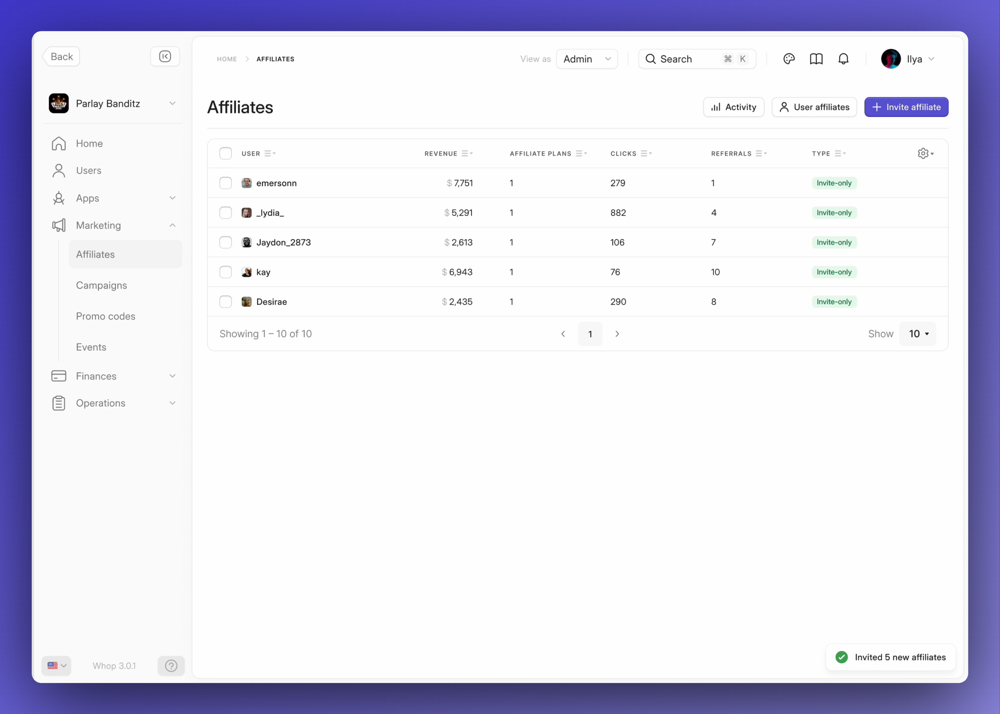
Whop's affiliate dashboard for sellers provides an easy interface to manage affiliates, track referrals, and adjust rewards. In this example, a seller can see their list of affiliate partners, the revenue each has driven, number of referrals, and commission type. The built-in tools make it simple to expand or refine your affiliate program without leaving the Whop platform.
### Automatic Payouts
One major headache for traditional affiliate programs is paying out your affiliates. Whop handles this for you seamlessly. Whenever an affiliate earns a commission by referring a sale of your product, that commission goes into their Whop balance automatically. Affiliates can then withdraw their earnings through Whop's payment system (e.g. to their bank or PayPal). For you as the seller, there's no need to manually calculate or send payouts – it's all taken care of. This builds trust with affiliates (they know they'll get paid on time) and saves you administrative work.
### Affiliate Discovery
Whop also makes it easier to find affiliates. The platform has a Discover page for affiliates, where users can browse products with affiliate programs and join them with one click. By listing your product on Whop, you're instantly tapping into a network of potential promoters who are actively looking for offers to promote. In other words, Whop doubles as an affiliate network — connecting willing promoters (affiliates) with products like yours, all under one roof.
In summary, the [Whop affiliate program](https://www.findaffiliates.online/whop-affiliate-program) is essentially plug-and-play for sellers. It's automatically enabled for your products (you can tweak settings as needed), and provides the infrastructure — tracking links, dashboards, and payouts — so you can focus on recruiting affiliates and creating great products. Next, let's look at why joining this affiliate ecosystem is so beneficial.
## Benefits of Joining Whop's Affiliate Ecosystem
Why should you, as a creator or seller on Whop, care about the affiliate program? Here are some key benefits of embracing Whop's affiliate ecosystem:
### 🚀 Instant Expansion of Your Sales Force
Every customer or follower can become a promoter. With the affiliate system in place, your satisfied users and fans can turn into Whop affiliates who earn a commission for referring others. This effectively gives you a crowd-sourced sales team without hiring anyone. It's an incredible way to expand your reach through word-of-mouth marketing.
### 💸 Higher Sales with Low Effort
Affiliates bring in new customers you might not reach on your own. By offering a commission incentive, you motivate affiliates to share your product in their circles, blogs, YouTube channels, or social media. Many Whop products offer generous commissions (some as high as 50% of the sale) since digital goods often have high margins. These high commissions attract skilled affiliate marketers [according to Whop's blog](https://whop.com/blog/make-money-no-audience/#:~:text=Fastest%20Way%20to%20Make%20Money,products%2C%20from%20courses%20to%20communities), which can lead to a significant uptick in sales. You only pay a commission when a sale is made, so it's a performance-based marketing model – essentially free advertising, paying only for results.
### ⚙️ Built-In Tools & Easy Management
Whop's platform provides all the tools needed to run an affiliate program without technical overhead. No need to integrate third-party tracking or worry about coupon codes – everything from link generation to tracking and payment is handled in your Whop dashboard. You can monitor affiliate-driven sales in real time and see which partners perform best. Adjusting commission rates or adding new affiliates is straightforward. This ease-of-use means even creators new to affiliate marketing can manage a program effectively.
### 🤝 Trust and Transparency
Because Whop automates tracking and payouts, affiliates are more likely to trust promoting your product. They have a transparent view of their clicks and earnings, and they know Whop will pay out reliably. This trust factor can attract more affiliates to join your program. Plus, Whop's verification of products (remember, each listing is reviewed for quality) gives affiliates confidence that they're promoting something legitimate and valuable, which encourages them to share it enthusiastically.
### 🌐 Marketplace Network Effect
By being part of Whop, your product benefits from the platform's network. Affiliates on Whop often browse for new products to promote – if your offering is attractive (good product, solid commission), you can gain affiliates organically through the marketplace discovery. Additionally, Whop's overall user base growth means more potential customers and affiliates over time. It's a virtuous cycle: more affiliates drive more customers to Whop, and more customers can become affiliates for you. This network effect is hard to replicate if you host your course or community on a standalone site.
### 📈 Recurring Income Potential
If you sell a subscription-based product (like a membership or SaaS tool) on Whop, you can set recurring commissions for affiliates. This means affiliates earn ongoing income for every billing period their referral stays subscribed, which heavily incentivizes them to bring loyal, high-quality customers. For you, it means those affiliates will be motivated to keep those referrals engaged (perhaps even providing support or community, since they benefit from retention too). It creates a win-win where everyone is aligned to retain customers. Whop natively supports recurring affiliate rewards, which is a huge benefit for membership-style businesses.
### 🔒 Security and Fraud Protection
Since Whop's team manually approves each seller and product, and with built-in systems handling links and payments, there's reduced risk of fraud compared to running an affiliate program on your own. You won't have to worry about tracking manipulation or rogue affiliates – Whop's ecosystem has checks in place. As a result, you can confidently scale your affiliate efforts without nasty surprises.
By joining Whop's affiliate ecosystem, you tap into a powerful growth lever for your business. Sellers who actively leverage affiliates can see compounding growth, as each new customer acquired through an affiliate can potentially become an affiliate too. It's a self-perpetuating growth engine.
## How to Promote Your Whop Offers Using the Affiliate Program
Now that you understand the potential, let's get practical. How can you, as a Whop creator or seller, maximize this affiliate program to promote your offers? Here are some actionable steps and tips:
### Optimize Your Affiliate Offer Settings
Start by configuring your affiliate program in your Whop dashboard. Decide on a competitive commission rate that will attract affiliates while still being profitable for you. Many creators offer anywhere from 20% to 50% commission depending on the product's margins. If your product has a subscription component, consider enabling recurring commissions to entice affiliates with ongoing income. Set whether your program is open to all (global) or invite-only. (Tip: In most cases, allowing anyone to become an affiliate will maximize reach, but you can always vet and remove affiliates later if needed.) Make sure the "Become an Affiliate" callout is visible on your product page (Whop handles this by default).
### Leverage Your Existing Audience and Customers
Your first affiliates should ideally be people who already know and love your product. Announce your affiliate program to your community, email list, Discord server, or Twitter followers. Let them know they can earn by referring others and share how to grab their unique link (e.g. "Just scroll to the bottom of our Whop store page and click Become an Affiliate"). By recruiting loyal users as affiliates, you ensure your promoters truly understand the product and can authentically recommend it. This can jumpstart your program with a base of active affiliates. Some sellers even create a small incentive for first affiliates, such as bonus content or higher commission for the first few sales, to encourage sign-ups.
### List on Affiliate Directories and Communities
Expand beyond your current audience by making your affiliate offer known on larger platforms. For example, you can feature your program on [FindAffiliates](https://www.findaffiliates.online/) – a platform dedicated to connecting affiliate marketers with affiliate programs. This can expose your [Whop affiliate program](https://www.findaffiliates.online/whop-affiliate-program) to thousands of potential marketers searching for new offers. Similarly, post about your program in affiliate marketing forums or social media groups (where allowed). The goal is to get your offer in front of affiliate influencers who can drive significant traffic. Be sure to highlight what makes your program attractive (high commission %, recurring revenue, quality product, etc.) in these listings.
### Provide Marketing Assets and Support
Make it as easy as possible for affiliates to promote your product. Within Whop, consider creating an "Affiliate Resources" section (you could add a Google Drive link or a folder in your community) containing things like banner images, product screenshots, a short description or ad copy, and even a coupon code if you use one. While affiliates on Whop can promote without any extra tools, giving them ready-made content can boost their motivation and effectiveness. Also, communicate with your affiliates – welcome them, offer tips on what marketing angles work best for your product, and be available to answer questions. A little support can turn a one-time referrer into a long-term super affiliate.
### Collaborate with Influencers and Creators
Whop itself grew through influencer partnerships, and you can too [as detailed by Starter Story](https://www.starterstory.com/whop-breakdown#:~:text=,Partnerships). Identify influencers or content creators in your niche who have an audience that would benefit from your product. Reach out and invite them to join your affiliate program, offering them a special commission rate or bonus if needed. Influencer affiliates can be extremely potent – a single YouTube review or Twitter thread with your affiliate link could drive a flood of sales. Whop's ease of joining means the barrier for them is low (they likely just need to click your affiliate link and sign into Whop). This strategy not only boosts sales but also adds credibility to your product through social proof.
### Promote the Affiliate Opportunity on Your Storefront
Don't be shy about advertising that you have an affiliate program on your Whop page. Whop already places a "Become an Affiliate" section on your store page, but you can reinforce it elsewhere – for instance, mention in your product description or welcome email to new buyers that they can earn by sharing. When users know upfront that there's a referral program, they might be more inclined to join after purchasing. It plants the seed for virality: every customer is a potential advocate. (Just ensure the process to become an affiliate is clearly explained or linked, to avoid confusion.)
### Monitor, Optimize, and Celebrate Success
Use the analytics Whop provides to see which affiliates are performing well and which marketing channels bring sales. You might notice, for example, that affiliates who are YouTubers bring higher-LTV customers than those who are bloggers. Use this data to optimize your approach – perhaps focus on recruiting more YouTubers, or provide your blog affiliates with SEO-friendly content to help them rank. If certain affiliates are excelling, reach out to thank them and maybe increase their commission tier (a little personal recognition goes a long way). Likewise, if someone isn't driving results, you could offer them help or tips. Regularly withdrawing your earnings and those sweet affiliate-driven profits can be motivating for you as well – it's proof the system is working!
By following these steps, you'll actively promote not just your Whop product but the affiliate opportunity around it. The result is a growing base of partners who are financially incentivized to spread the word about your offerings.
## Why Whop's Affiliate Program Stands Out
It's worth noting how Whop's approach differs from a traditional affiliate setup. In a typical scenario, setting up an affiliate program might involve purchasing affiliate software or joining an external network, setting up tracking links, negotiating payouts, etc. That process can be time-consuming and often expensive. Whop wraps all of that into its platform natively. If you're already using Whop to sell your product, turning on the affiliate program is virtually effortless, and it's cost-free aside from the commissions you pay on actual sales (and the standard Whop platform fee on those sales).
Moreover, Whop's affiliate ecosystem blurs the line between customer and affiliate. By rewarding "referring a friend" in a formalized way, it encourages a community-driven growth. This social aspect – combined with the marketplace's ability to surface trending products and top affiliates – creates a dynamic environment where good products can really take off. Some sellers on Whop have credited affiliates for helping them achieve breakout success, turning side hustles into full-time six-figure businesses.
If you're a creator serious about growth, leveraging the [Whop affiliate program](https://www.findaffiliates.online/whop-affiliate-program) is a no-brainer. It taps into the core principle of affiliate marketing: shared success. When your affiliates earn, you earn more. Whop has simply removed the usual friction and upfront costs, so you can kickstart this strategy from day one.
## Conclusion & Next Steps
In conclusion, Whop isn't just a platform to host your digital products – it's an entire ecosystem designed to help you sell more, and the built-in affiliate program is a centerpiece of that system. By understanding what Whop offers and actively engaging with its affiliate features, you give your product the best chance to trend in the marketplace and reach new customers far beyond your own audience. Whether you're selling an online course, a Discord community membership, or a SaaS tool, the Whop affiliate program empowers you to create a win-win scenario: others promote your product and earn income, while you enjoy higher sales and faster growth.
If you're ready to take your affiliate strategy to the next level, be sure to explore [FindAffiliates's tools and resources](https://www.findaffiliates.online/) for additional guidance. From discovering other [affiliate opportunities](https://www.findaffiliates.online/) to optimizing your program's visibility, FindAffiliates can help you maximize your success in the affiliate marketing space. Embrace the Whop affiliate ecosystem today, and watch your creator business scale like never before.
Also, if you're interested in learning more about the latest affiliate marketing trends and strategies, check out our article on [7 Affiliate Marketing Trends Dominating 2025](/blogs/7-affiliate-marketing-trends-dominating-2025) and our guide on [Affiliate Program Best Practices for Businesses](/blogs/affiliate-program-best-practices-for-businesses-2025-guide).
## Whop Frequently Asked Questions (Whop FAQ)
### Q: How do I become a Whop affiliate?
A: If you want to earn commissions by promoting products on Whop, the process is simple. First, create a free Whop account (if you don't have one already). Then, browse the Whop marketplace (the "Discover" section) for products you're interested in promoting. On any product's page, scroll down to the "Become an affiliate" section and click the button to add that product to your affiliate dashboard. You'll instantly receive a unique referral link for that product. Share this link with your audience (in DMs, social media, your blog, etc.). Whenever someone purchases through your link, you'll earn the commission set by the seller – it could be a percentage of the sale or a flat amount, depending on the program. You can repeat this process for multiple products; there's no limit to how many offers you promote. Tip: Focus on products you genuinely believe in, so your promotions are more authentic and effective.
### Q: What commission rates does the Whop affiliate program offer?
A: The commission rate varies by product and is determined by the product's seller. There isn't one single rate across all of Whop – each creator sets their own affiliate reward. However, many Whop affiliate programs are quite generous to attract marketers. It's common to see commissions around 20-30% of the sale price for one-time payments. Some products, especially digital courses or memberships, offer 50% commissions on sales (or even higher in special cases). If the product is subscription-based, the seller might offer a smaller percentage recurring commission (e.g. 15% every month the referred user stays subscribed) or a one-time bounty. You can view the commission offered before you join an affiliate program – Whop will typically display the percentage or reward in the "Become an affiliate" section. Always choose programs that align with your audience and where the commission is worth your effort. The good news is Whop's niche in digital products means high commission rates are the norm compared to many traditional affiliate programs.
### Q: How are Whop affiliate earnings paid out?
A: Whop handles payouts automatically through its platform. When you refer someone and they make a purchase, your commission is credited to your Whop account balance in real time (or as soon as the transaction is confirmed). You can view your accumulated earnings in your affiliate dashboard at any time. Whop's payment system allows you to withdraw your balance to your linked payment method (such as a bank account or PayPal) once you meet any minimum payout threshold. According to Whop's documentation, affiliate earnings go straight to your balance without the seller needing to manually intervene. This means you don't have to chase down individual creators for payment – Whop guarantees you get paid. Payouts are usually processed on a regular schedule or on request, and you might have to meet a small minimum (for example, $50) before withdrawing, depending on Whop's current terms. Be sure to check Whop's latest payout policy for affiliates (found in their Help Center or Terms) for specifics on timing and methods. Overall, you can trust that if you earn it, Whop will pay it – reliably and on time.
### Q: Is it free to join the Whop affiliate program?
A: Yes – becoming an affiliate on Whop is completely free. There's no cost to sign up for a Whop account or to join any product's affiliate program. In fact, Whop encourages users to become affiliates as a way to earn extra income, so they don't charge you anything upfront. The only "cost" involved is your time/effort in promoting and the fact that you'll only earn commissions when you successfully refer sales (as with any affiliate marketing). For sellers, it's also free to have an affiliate program on Whop; the platform's normal transaction fees apply on product sales, but there's no additional charge for enabling affiliate features. This makes Whop a very low-risk, high-reward environment for affiliate marketing on both sides. If you're a newcomer, you can jump in without any investment and start trying out affiliate promotion for various products. And if you're a seller, there's no reason not to activate your affiliate program – it's built-in and won't cost you anything unless it generates you a paying customer (at which point sharing a commission is well worth it).
---
## Winning Affiliate Strategies for Content Creators in 2025
*Published: 2025-03-26*
*URL: https://www.findaffiliates.online/blogs/winning-affiliate-strategies-for-content-creators-2025*

## Winning Affiliate Strategies for Content Creators in 2025
If you're an affiliate marketer, blogger, YouTuber, or any content creator looking to maximize affiliate income, a strategic, audience-first approach is key. Here are proven strategies (backed by data) to boost your success:
## 1. Choose Quality Affiliate Programs and Products
Not all affiliate programs are created equal. Focus on high-converting, reputable programs in your niche. When evaluating an affiliate offer, consider:
**Relevance to Your Audience:** The product or service should solve a problem or fulfill a desire your audience has. Promoting unrelated or random items will erode trust. For example, a tech YouTuber will do better promoting software or gadgets than fashion accessories. Align with your niche for higher conversion rates.
**Earnings Potential:** Look at commission rates and average order values. A program offering 5% commission on $1,000 products ($50 per sale) might beat one offering 20% on $50 products ($10 per sale). Also check if they offer recurring commissions (common in SaaS subscriptions) or high-ticket upsells. According to industry stats, typical commission rates range from 5% up to 30% for retail products on average, but software/SaaS and financial services often pay 20–70% commission. Don't be afraid to prioritize programs that fairly reward your efforts.
**Conversion and Reputation:** A high commission is worthless if the merchant's site doesn't convert or, worse, fails to pay reliably. Research what other affiliates say about the program. Look for data like conversion rate (some affiliate networks show EPC – earnings per click). Ideally, find programs with solid conversion rates (at least 1-2%) – the industry average conversion via affiliates is often around 0.5%–1%, but well-optimized programs can convert much higher. Pro tip: Sign up and go through the customer journey yourself; is the checkout smooth, is the product high quality? Your audience will blame you if you send them to a poor experience.
**Cookie Duration & Attribution:** Ensure the cookie length (tracking window) is reasonable for your audience's buying cycle. 30 days is a common standard, but some programs offer 60 or 90 days (or even lifetime cookies for registered referrals). Longer cookies mean a better chance to get credit if users take time to decide. Also, clarify if they use last-click attribution or if other channels might overwrite your referral.
Use resources like affiliate program directories (for example, [FindAffiliates](https://www.findaffiliates.online/)) to discover and compare programs across niches. Many successful affiliates also spy on competitors – use SEO tools to see what programs similar content creators promote. If a high-authority blog in your niche consistently links a certain product, chances are it converts well for them.
## 2. Create High-Value, Trustworthy Content
Content is the engine of affiliate marketing. In 2025, both readers and search engines demand quality. Here's how to stand out:
**Be the Expert & Be Honest:** Position yourself as a trusted advisor in your niche. That means in-depth reviews, tutorials, comparisons, and case studies – not thin 300-word posts. Use data and personal experience to back up your recommendations. If something has drawbacks, mention them. Transparency builds credibility; in fact, 85% of consumers find user-generated content (like personal reviews) more influential than polished brand photos. An honest review that ultimately recommends a product (after weighing pros and cons) can convert extremely well because readers feel informed, not sold to.
**Leverage SEO – Target Intent-Driven Keywords:** Given the importance of search, make sure you optimize for keywords that indicate buyer intent. Think "best [product]", "[Product A] vs [Product B]", "[Product] review", or long-tails like "how to do X" that naturally allow you to recommend a solution. According to research, searches for "affiliate marketing" itself grew 300%+ since 2015, but more pertinent to you are product-specific queries in your domain. Use keyword research tools to find high-volume, low-competition topics (the holy grail!). Then craft comprehensive, well-structured content that satisfies those queries better than anyone else. This not only pleases Google but also keeps readers engaged (dwell time), which further boosts rankings.
**Use Visuals and Comparisons:** Enrich your content with images, charts, or even short videos. Demonstrate the product if possible. For example, if you're an affiliate for a fitness app, include screenshots of the app's dashboard, or a short GIF of you using it. Visual comparisons (tables, infographics) between options help readers decide and can increase conversion. If you have permission, embed user testimonials or social proof from the brand to bolster trust.
**Implement Content Funneling via Internal Linking:** A savvy SEO trick is internal linking between your content pieces to guide readers from informational posts to money pages. This is also known as content funneling. For instance, you might have a general blog post about "5 Ways to Stay Healthy This Winter" (which lightly mentions vitamins), and within it link to your in-depth review of the specific vitamin supplement you're an affiliate for. The internal link nudges interested readers toward a page where they're more likely to convert, and it also distributes SEO authority to help that review rank. Ensure your internal links are relevant and use descriptive anchor text (e.g., "best VPN services for privacy" linking to your VPN review page). This not only helps SEO but improves user experience by directing readers to related info.
**Update and Refresh Content:** The top content sites refresh their articles frequently – adding recent stats (e.g., "updated for 2025"), new product versions, etc. This can boost your search rankings and keep content accurate. Set a schedule to revisit your high-traffic pages every few months. Also, prune or revamp old posts that aren't performing; better to have a dozen great, up-to-date articles than 100 outdated ones.
## 3. Diversify Traffic Sources (SEO, Social, Email, PPC)
We noted that successful affiliates diversify their traffic – don't rely solely on Google (algorithm updates can be painful). Expand your reach with:
**Social Media and Communities:** Establish a presence where your audience hangs out. This could be a YouTube channel demonstrating products, an Instagram page with niche tips (using Link in Bio for affiliate links), or a TikTok account if your niche skews young. 67% of affiliates use social media to engage prospects, and with good reason – platforms like Instagram or Pinterest can drive buying inspiration. Just be sure to follow platform rules for posting affiliate links (some allow in posts/stories, others only bio or swipe-up links, etc.). Additionally, participate in forums or groups (Reddit, Facebook Groups, Discord communities) relevant to your niche. By genuinely helping people and occasionally suggesting your affiliate product when appropriate, you can generate sales. Pro tip: Some affiliates create free mini-courses or challenges on Facebook or email to attract sign-ups, then recommend products inside those – a clever way to warm up an audience.
**Email Marketing:** Building an email list is one of the best hedges against platform algorithm changes. Offer a free resource (ebook, checklist) to your site visitors in exchange for their email, then send periodic newsletters with valuable content and affiliate recommendations. Email has a personal touch and can drive repeat traffic to your site. Just avoid spamming offers; nurture the list with 80-90% pure value and 10-20% promotional content. Many top affiliates swear by the mantra "the money is in the list."
**Paid Advertising (Use Caution):** Some affiliates profitably use PPC ads (Google Ads, Facebook Ads) to drive traffic to their affiliate content or directly to offers (where allowed). This requires skill and budget, as you need to ensure ad costs < commission earnings. New affiliates should be cautious here – start with content and free traffic before scaling into paid ads, because it's easy to burn money. If you do try ads, consider remarketing campaigns to people who visited your site but didn't buy; an affiliate cookie might still be active if they come back and purchase.
**YouTube and Podcasts:** If you're comfortable on camera or audio, these channels are booming. Product review videos on YouTube can rank on Google and YouTube search, effectively doubling your search exposure. Include your affiliate links in the description (with disclosure). Podcasts allow you to discuss products in depth; you can share affiliate links on your site or show notes for listeners. Keep in mind, personal recommendation in voice/video can be very compelling – listeners can hear your enthusiasm and trust.
The main point is to not keep all your eggs in one basket. Top affiliates might get 50% of traffic from search, 30% from email, 20% from social, for example. Diversification not only grows your reach but insulates you from sudden changes in any one channel. For more insights on emerging channels and platforms, check out our guide on [7 Affiliate Marketing Trends Dominating 2025](/blogs/7-affiliate-marketing-trends-dominating-2025).
## 4. Engage and Build Trust with Your Audience
Beyond tactics, the heart of affiliate success is audience trust. Here's how to cultivate it:
**Authenticity & Disclosure:** Always disclose your affiliate links. Phrases like "This post contains affiliate links. If you purchase through these links, I may earn a commission at no extra cost to you." are now common – and required in many jurisdictions. Readers appreciate honesty. Far from driving them away, a clear disclosure can actually increase trust, making them more likely to use your link to support you. Authenticity also means only promoting things you truly stand behind. Your audience will sense if you're just chasing commissions on a subpar product. Remember, long-term success > short-term gains. One bad promo can lose a fan forever, whereas consistent helpful recommendations build a loyal following that gladly buys via your links.
**Interact and Help:** Engage with your followers or readers. Reply to blog comments, answer questions on your YouTube videos, respond on social media. By providing free help and advice, you become a go-to resource. This goodwill translates into higher conversion when you do suggest a paid solution. Also, listen to your audience's feedback – they might tell you what products they want reviewed or problems they need solved, which can spark ideas for new content (and affiliate opportunities).
**Leverage Social Proof:** People are more likely to try something if they see others have had a good experience. Where possible, integrate testimonials, user reviews, or your own results with the product. For instance, "After using this software for 3 months, my team's productivity increased by 30%" or "Over 5,000 five-star reviews on Amazon speak for themselves." Social proof can tip an on-the-fence reader into taking action.
**Keep an Eye on Trends and Update Recommendations:** As an affiliate, you should stay updated on your niche. If a new competitor product is making waves, acknowledge it and perhaps do a comparison. Don't stubbornly stick to promoting an outdated or inferior solution – you'll lose credibility. Instead, be the one who always has the latest, best info. Your audience will learn that if something new and great comes out, they'll hear it from you first.
Finally, understand that making significant income with affiliate marketing takes time and consistency. The average affiliate marketer reportedly earns around $8,000 per month, but that average comes from a wide spectrum – many earn less, some top performers earn much more. Roughly 80% of affiliates are in the low-to-mid range (up to $80k/year), while the top few percent achieve six or seven figures. What separates the best is often persistence and continual learning. By applying these strategies and adapting as you gain experience, you'll be well on your way to joining the ranks of high-earning affiliate marketers.
## Conclusion
Affiliate marketers and content creators can thrive in 2025 by selecting quality affiliate programs, creating trust-driven content, diversifying traffic sources, and engaging authentically with their audiences. Consistency and adaptation are key to scaling your affiliate income.
For more comprehensive insights on affiliate marketing, check out our detailed [Affiliate Marketing Statistics & Growth Trends for 2025](/blogs/affiliate-marketing-statistics-2025), which provides valuable context on industry benchmarks and expectations. If you're a business or marketer running an affiliate program, you might want to learn valuable insights on the [best practices for businesses launching or managing affiliate programs](/blogs/affiliate-program-best-practices-for-businesses-2025-guide).
---
## Affiliate Program Best Practices for Businesses (2025 Guide)
*Published: 2025-03-23*
*URL: https://www.findaffiliates.online/blogs/affiliate-program-best-practices-for-businesses-2025-guide*
.png)
## Affiliate Program Best Practices for Businesses (2025 Guide)
For companies, an affiliate program can be a cost-effective revenue driver – but only if managed well. Simply "build it and they will come" doesn't work when competitors are also vying for top partners. Below are key strategies for launching, scaling, and optimizing an affiliate program in the current landscape:
## 1. Design an Attractive, Competitive Affiliate Offer
To recruit quality affiliates, make your program compelling:
**Commission Rate & Structure:** Set commissions that are enticing yet sustainable. Research your industry standards: for example, beauty and apparel brands often offer 10–15% commissions, while SaaS products might offer 30% or more, especially for recurring subscriptions. If your margins allow, consider being above average to stand out – affiliates will notice. You can also structure tiered commissions (higher rates for higher sales volume) or offer performance bonuses. For instance, "10% base commission, but 15% if you sell over $5,000 in a month" can motivate affiliates to push harder. Just ensure the goals are attainable. A case in point: one company offers up to $550 per sale for top affiliates in its program, which certainly grabs attention in that niche.
**Cookie Duration:** Offer a cookie window that matches the purchase cycle of your product. If you sell big-ticket items that customers research for weeks, a 7-day cookie is not enough. 30 days is standard, but if you can do 60 or 90 days, advertise that fact – it's a selling point for affiliate recruiters. Also, if you have multi-touchpoint attribution (like last click vs first click), be clear about how affiliates will be credited.
**Creative and Tools:** Provide your affiliates with high-converting creative assets – banner ads, product images, pre-written product descriptions, etc. Affiliates (especially novices) appreciate ready-to-use materials that they can plug into their site or social. More seasoned affiliates might create their own, but they'll still value having official images or demos. If possible, give affiliates access to exclusive promo codes for their audience, as these can boost conversion and also track offline or video promotions.
**Competitive Intelligence:** If affiliates are already promoting similar products, why should they switch or add yours? Perhaps your product converts better or you have a unique selling proposition (USP). Emphasize your USP in your outreach. It might be higher payout, or a more generous trial, or a niche feature that others lack. You could even create a comparison sheet for affiliates highlighting how your program/product stacks up against others – essentially arming them with talking points to promote you.
## 2. Proactive Affiliate Recruitment
Great affiliates won't magically find you. Put on your marketing hat to recruit them:
**Leverage Affiliate Networks and Directories:** As noted in our [affiliate marketing statistics](/blogs/affiliate-marketing-statistics-2025), 83% of brands use networks or affiliate SaaS platforms to find affiliates. Listing your program on popular networks (CJ, ShareASale, Impact, etc.) instantly puts you in front of thousands of potential publishers searching for offers. Yes, networks often charge a fee or commission override, but they provide infrastructure and visibility – a worthwhile trade-off for many. Additionally, submit your program to affiliate directories and communities (such as [FindAffiliates](https://www.findaffiliates.online/), PartnerStack, etc.). These are often frequented by content creators looking for new partnerships.
**Incentivize Your Customers and Fans:** Often your best affiliates can be your own customers or followers of your brand. They already love your product. Encourage them to join your program – for example, send an email to satisfied customers inviting them to earn by referring friends (blurring affiliate and referral program lines). Tap into content creators who already mention your brand organically; if a blogger wrote a positive review, reach out and offer an affiliate partnership with a special perk (like higher commission initially or free product for them to review).
**Direct Outreach – Find the Perfect Fit:** Identify influencers, bloggers, or site owners in your niche whose audience aligns with your target market. Then reach out directly with a personalized pitch. Show that you value their content ("I loved your article on sustainable fashion...") and explain how your product could benefit their audience. Highlight the commission and maybe offer a free trial or sample so they can evaluate it. This hands-on approach can win over high-quality partners who appreciate the personal touch versus a generic mass invite. It is time-consuming, but even a handful of top affiliates can drive the bulk of your sales. For more insights on what successful content creators look for in affiliate programs, check out our guide on [Winning Affiliate Strategies for Content Creators in 2025](/blogs/winning-affiliate-strategies-for-content-creators-2025).
**Use Events and Communities:** Many niches have conferences, webinars, or online groups. Affiliate marketers often network at industry events – attending or sponsoring such events (e.g., Affiliate Summit, FinCon for finance bloggers, etc.) can put your brand on their radar. According to a Rakuten report, 79% of brands find new affiliates at events hosted by networks, and 56% host their own recruitment events. If budget permits, host a virtual meetup or workshop about your program or a topic of mutual interest (not just a sales pitch, but something that provides value to affiliates and subtly promotes your program).
**"Join Us" Prominence:** Don't forget the simple stuff – make sure your own website prominently features an invitation to join your affiliate program. 71% of brands get affiliates via a "Join our affiliate" link on their site. Include it in your footer, maybe create content about your program's success, and make the sign-up process easy to find. People who are already exploring your brand site could be prime affiliate material (e.g., fans or bloggers doing research).
## 3. Support and Nurture Your Affiliates
Recruiting affiliates is just step one. To keep them active and producing sales, you need to manage relationships and support them:
**Onboarding and Resources:** When a new affiliate joins, provide a warm welcome and clear next steps. Offer an affiliate guide or FAQ that explains how to generate links, commission payment schedule, best practices for promotion, and who to contact for help. The smoother the onboarding, the quicker they can start promoting. Some companies even assign affiliate managers to high-potential signups to coach them early on.
**Communication and Community:** Maintain regular communication – but not just generic newsletters pushing them to sell more. Segment your affiliates by activity or niche if possible, and send tailored tips. For example, share what's converting well ("Product X is trending this season, here are new banners for it"), or content ideas ("Hey fitness affiliates, New Year resolution season is coming – perfect time to promote our diet plan, here's a blog outline"). Create a sense of community: perhaps a private Facebook or Slack group for your affiliates to share feedback and ask questions. Remember, affiliates who feel valued and connected are likely to be more loyal and motivated.
**Tracking and Analytics:** Use a robust affiliate tracking platform and share data with your affiliates to help them improve. For instance, let them see their conversion rates, top-selling items, etc. If you notice certain affiliates have low conversions but high traffic, reach out with suggestions (maybe their traffic is mobile and your site wasn't mobile-optimized – fix that, or suggest they target different keywords). Conversely, analyze what your top 10% affiliates are doing and share those insights (anonymously) with the rest: "Our top partners see success when they promote via video – maybe try a product demo on YouTube."
**Prompt Payments and Fair Policies:** Pay commissions on time, every time. If there are payment thresholds or delays (e.g., holding commission until refund periods pass), make that clear upfront. Affiliates treat their work like a business, and cash flow matters. Consistent, reliable payments will earn you a good reputation. Also, enforce fair policies – if you ever have to reverse commissions (due to fraud or returns), communicate it clearly. A reputation for "shaving" commissions or poor support can kill your program's appeal in affiliate communities.
**Provide Exclusive Opportunities:** Keep affiliates engaged by offering occasional exclusive deals or contests. For example, run an affiliate contest in Q4: "Whoever generates the most sales this holiday season wins a $1,000 bonus" – this can spur a friendly competition. Or give affiliates an exclusive discount code to share during a special sale (affiliates love having unique perks for their audience, it makes them look good and drives more conversions). Ensure these incentives align with your margins and are structured to encourage incremental sales, not things they would have sold anyway.
**Listen to Feedback:** Your affiliates are on the front lines with customers. They might tell you that a landing page is confusing or that buyers are asking for a feature your product lacks. Treat affiliate feedback as free user research. Thank them for insights and act on reasonable suggestions. If you implement a popular request (say, adding PayPal as a payment option on your site), let your affiliates know – it shows you value their input, and it might help them convert more sales.
## 4. Optimize Your Program for Higher ROI
Running a program isn't "set and forget." Continuously optimize to ensure it's profitable and growing:
**Identify and Cultivate Top Performers:** It's common in affiliate programs that the top 10% of affiliates drive the majority of sales. Identify these VIPs and nurture them. This could mean giving them a higher commission tier (if justified by the volume they bring), or simply thanking them with a personal note or gift. Conversely, look at the bottom tier – if some affiliates are completely inactive after a long time, you might politely prune them from the program or at least exclude them from special incentives, focusing your energy on those who engage.
**Expand in High-Performing Areas:** Analyze which niches, content types, or channels are bringing you sales through affiliates. If you find, for example, that tech review sites are killing it for you, double down: recruit more tech bloggers, create more tech-focused promo materials, increase commissions on tech products, etc. Similarly, if coupon/deal sites bring volume but maybe lower margins (due to discounts), decide if that's okay or if you want to shift focus. Not all affiliates provide equal value – some bring new customers who stick, others might attract deal-hunters who churn. Look at metrics like new vs. repeat customers, customer lifetime value from each affiliate channel, etc., if you have the ability to track that.
**Protect Your Brand and Affiliate Integrity:** Make sure your affiliates adhere to your terms – for instance, you may forbid certain tactics like bidding on your trademark in Google Ads, or spamming links in forums. Enforce these rules to keep the playing field fair. Additionally, monitor for affiliate fraud (like fake leads or self-referrals) which unfortunately can happen in any large program. Modern affiliate software often has fraud detection, and keeping an eye on suspicious patterns (like one affiliate suddenly "referencing" a ton of self-made accounts) will save you money. As noted in industry reports, digital marketing fraud is a growing concern (projected to reach $172 billion globally by 2028 across channels) – stay vigilant on quality control.
**Keep Innovating Offers:** Refresh your affiliate offers periodically. Introduce new products or upsells they can promote. If your business has seasonal trends, create seasonal affiliate campaigns (with themed banners or content ideas for affiliates). Consider launching a two-tier affiliate scheme if appropriate – where existing affiliates can refer other affiliates to your program for a small bonus. This can incentivize word-of-mouth recruitment (though manage it carefully to avoid pyramid-scheme vibes; it should be modest, like 5% of sub-affiliate sales, and focus on quality referrals).
**Measure ROI and Adjust:** Continuously measure the ROI of your affiliate channel. Compare it to other marketing channels – if affiliates are bringing customers at a lower CPA (cost per acquisition) than your Facebook ads, for example, that's a sign to potentially invest more in affiliate (like increasing commissions or doing more recruitment). On the flip side, if margins are shrinking, you might optimize by adjusting commission for certain product lines or implementing performance-based tiers. Many brands find that affiliate marketing contributes 15-30% of total sales at an excellent ROI, making it one of the highest ROI channels. Use data to justify growing your affiliate budget or strategy. Ultimately, a well-run program is win-win: affiliates earn good money, and you acquire customers profitably.
By implementing these best practices, businesses can build robust affiliate programs that attract enthusiastic partners and drive significant revenue growth. Affiliate marketing truly exemplifies a performance partnership – you and your affiliates succeed together when the strategy is executed right.
## Conclusion
A well-managed affiliate program drives substantial business growth. Businesses that proactively recruit affiliates, offer competitive commissions, support partners actively, and continuously optimize their programs will see profitable, long-term results. As highlighted in our [affiliate marketing trends for 2025](/blogs/7-affiliate-marketing-trends-dominating-2025), building stronger affiliate-brand relationships is becoming increasingly important, with top programs treating affiliates more like valued marketing partners than anonymous third parties.
For more insights into the current affiliate marketing landscape, be sure to explore our comprehensive [affiliate marketing statistics and growth trends](/blogs/affiliate-marketing-statistics-2025), which provide valuable context on industry benchmarks and expectations for 2025.
Whether you're just starting an affiliate program or looking to revamp an existing one, implementing these best practices will position your business for success in the competitive affiliate space. And if you're a content creator interested in the affiliate side of the equation, check out our guide on [Winning Affiliate Strategies for Content Creators in 2025](/blogs/winning-affiliate-strategies-for-content-creators-2025) to understand what successful affiliates look for in programs and how they maximize their earnings.
---
## 7 Affiliate Marketing Trends Dominating 2025 (AI, Micro-Influencers & More)
*Published: 2025-03-20*
*URL: https://www.findaffiliates.online/blogs/7-affiliate-marketing-trends-dominating-2025*

## How to Leverage Affiliate Marketing Opportunities in 2025
Staying ahead of the curve is crucial in the fast-evolving affiliate space. Here are some notable trends in 2025 that affiliate marketers, influencers, and affiliate program managers should have on their radar:
## 1. The Rise of Micro-Influencers as Affiliates
In 2025, more brands are partnering with micro and nano-influencers (creators with smaller but highly engaged followings) through [high-converting affiliate programs](https://www.findaffiliates.online/). Rather than pay large upfront fees to big influencers, companies see value in offering commissions to a network of micro-influencers who authentically promote products to niche audiences.
This trend opens doors for content creators: even with a few thousand followers, you can earn as an affiliate if your audience trusts you. The data backs this shift – consumers respond strongly to relatable voices, and influencers have "inspired 88% of consumers to purchase" at some point.
**Implication**: Brands should actively recruit passionate micro-creators into their affiliate programs, and creators should leverage their trust equity by incorporating honest affiliate recommendations.
## 2. AI-Powered Content and Optimization
As mentioned, AI is transforming affiliate marketing. Content creators now have access to AI writing assistants that can draft blog outlines, chatbots that engage users, and predictive analytics to tailor offers. A striking 79% of affiliate marketers use AI tools for content creation, illustrating how commonplace this has become.
On the merchant side, AI is used to identify high-performing affiliates, detect fraud, or even dynamically adjust commissions.
**Implication**: Don't fear AI – leverage it. Use AI to work smarter (research, SEO optimization, A/B testing ideas), but pair it with your unique human voice and expertise to ensure content remains original and relatable. Also, be aware that Google's algorithms prioritize helpful, people-first content even as AI content grows – so avoid low-quality AI spam. The winning formula is AI efficiency + human authenticity.
## 3. Tighter Affiliate-Brand Relationships
Successful programs in 2025 treat affiliates less like anonymous third parties and more like valued marketing partners. Brands are investing in affiliate manager roles and community-building, essentially acting as "affiliate success coaches."
We see affiliates invited to exclusive brand groups, given early access to products, or given personalized promo codes. This comes as affiliate management shifts toward a partnership marketing mindset, where forging deeper relationships can significantly lift performance. Case in point: Oak Furniture's 85% sales jump was driven by "forging new strategic partnerships" in untapped sectors.
**Implication**: Affiliates should network with advertisers and even fellow affiliates (top earners often attend industry conferences – those making over $10k/month are more likely to do so). Merchants should proactively engage with their affiliate community – consider hosting webinars, providing one-on-one support to top partners, and recognizing high performers. A bit of personalization can motivate affiliates to go the extra mile in promoting your brand. For a complete guide on building successful affiliate partnerships, check out our [Affiliate Program Best Practices for Businesses](/blogs/affiliate-program-best-practices-for-businesses-2025-guide).
## 4. Diversification of Platforms & Channels
Gone are the days when affiliate marketers could rely solely on a blog and Google search rankings. In 2025, multi-channel promotion is key. Short-form video platforms (TikTok, Reels), podcasts, and even emerging channels like newsletters or community forums are being monetized with affiliate links.
For example, an increasing number of TikTok creators use affiliate links in Link-in-Bio or integrated "affiliate shops" – Instagram and TikTok both launched affiliate commerce features recently. Meanwhile, content creators often mix revenue streams: affiliate links, YouTube ad revenue, Patreon, etc., to reduce dependence on one source.
**Implication**: As an affiliate, explore new traffic sources where you can influence purchasing – a viral TikTok or a niche Discord group might convert as well as an SEO article if done authentically. As a business, ensure your affiliate tracking and attribution can handle various channels (e.g., provide trackable links for social posts, consider coupon codes for influencers to share in videos). For a complete guide on diversifying your traffic sources and maximizing your affiliate income across platforms, see our detailed [Winning Affiliate Strategies for Content Creators in 2025](/blogs/winning-affiliate-strategies-for-content-creators-2025).
## 5. Mobile and Voice Search Optimization
With over 50% of affiliate traffic coming from mobile devices, affiliates and brands are optimizing for mobile user experience. This includes faster page loads, mobile-friendly layouts, and using mobile-centric content (like vertical video and social stories).
Additionally, voice search is on the rise – people asking Alexa or Siri for recommendations – which means long-tail, conversational keywords are increasingly important in content.
**Implication**: Check your site on mobile: is it easy to navigate and read your product reviews? If you're a merchant, is your signup or purchase process smooth on a phone? Improve site speed and consider techniques like AMP for blogs. And incorporate natural language keywords (questions, phrases) in your content to capture voice queries, which often have commercial intent (e.g., "what's the best protein powder for runners").
## 6. Focus on First-Party Data & Cookie Changes
The digital ad world is buzzing about privacy and the phasing out of third-party cookies. For affiliate marketing, which typically uses first-party cookies or unique links, the impact is less direct – but attribution and tracking are getting more attention.
Many programs are extending cookie durations or implementing server-side tracking to ensure sales are credited properly even as browser tracking tightens. Brands are also encouraging customers to opt in to email or loyalty programs via affiliates, converting affiliate traffic into first-party data for remarketing.
**Implication**: Affiliates should prioritize programs with reasonable cookie windows (30 days or more) and perhaps negotiate "last-click" vs "first-click" attribution terms if applicable. Merchants should keep their tracking tech up-to-date and be transparent about how they credit affiliates for sales (to build trust – affiliates won't promote you if they feel tracking is unfair or broken).
## 7. Compliance and Authenticity
With great revenue comes great responsibility – regulators are keeping an eye on affiliate promotions. FTC guidelines in the U.S. require clear disclosure of affiliate links (e.g., telling readers "I may earn a commission…"), and platforms like Instagram have built-in features to mark affiliate or sponsored content.
In 2025, authenticity is the name of the game. Audiences are savvy and can sniff out overly salesy or insincere plugs. The best affiliates integrate products in a helpful, honest way.
**Implication**: Always disclose your affiliate relationships clearly – it's legally required and builds trust with your audience. For brands, encourage transparency and provide affiliates with approved disclosure language. Also, favor affiliates who produce quality, truthful content; a single misleading promo can damage brand reputation. Ultimately, authenticity drives conversions: a truthful review that highlights pros and cons will convince more buyers (and yield repeat traffic) than a generic fluff piece.
## Conclusion
By understanding these trends, you can adapt your approach to remain competitive yet genuine. To fully leverage these insights, you'll need practical strategies appropriate for your position in the affiliate ecosystem. For a deeper understanding of the affiliate landscape, be sure to check our comprehensive [affiliate marketing statistics and growth trends](/blogs/affiliate-marketing-statistics-2025) to put these trends in context.
By adapting to emerging trends like AI, micro-influencers, and multi-channel marketing, affiliates and brands can position themselves for continued success. For both beginners and experienced marketers, finding the [best affiliate programs for your niche](https://www.findaffiliates.online/) is crucial to staying proactive and ensuring relevance in this dynamic marketplace.
---
## Affiliate Marketing Statistics & Growth Trends for 2025
*Published: 2025-03-18*
*URL: https://www.findaffiliates.online/blogs/affiliate-marketing-statistics-2025*
## Affiliate Marketing in 2025: Data-Driven Trends and Statistics

## Introduction
Affiliate marketing has evolved from a niche tactic into a $17+ billion global industry that's embraced by over 80% of brands and 84% of publishers. In 2025, this growth shows no sign of slowing – in fact, affiliate marketing is projected to reach $37+ billion by 2025 and climb toward $48 billion by 2027. Such expansion is driven by its proven effectiveness: affiliate programs drive 16% of all online orders in the U.S. and deliver an average return on ad spend (ROAS) of 12:1 for businesses.
For affiliate marketers and content creators, these trends mean more opportunities to monetize content and earn commissions. For businesses launching or managing affiliate programs, it means greater potential to acquire customers and increase sales through partnerships. But taking full advantage requires staying informed and adapting to the latest strategies.
In this article, we'll delve into data-driven insights and industry benchmarks that matter in 2025. You'll discover how to recruit and motivate high-quality affiliates, which emerging trends (like AI and micro-influencers) are shaping the landscape, and how to optimize your affiliate program for maximum ROI – all presented in a credible, SEO-optimized format.
Whether you're a blogger looking to boost passive income or a brand manager aiming to scale your affiliate program, use this guide as your playbook for affiliate marketing success in 2025.
Let's start by examining the current state of affiliate marketing with key statistics, then explore actionable strategies for both affiliates and program managers.
## The State of Affiliate Marketing in 2025: Key Stats & Trends
Affiliate marketing is now a cornerstone of digital commerce, with an estimated 80% of brands running an affiliate program. If that sounds high, consider that affiliate partnerships drive between 5% and 25% of total online sales for major brands, making it a vital revenue channel. In fact, a recent survey found 40% of U.S. retailers name affiliate programs as their top customer acquisition method. With such impact, it's no surprise that over 83% of marketers use affiliate marketing to increase brand awareness and 65% of retailers credit affiliates for boosting revenues by 20% or more as mentioned in [rewardful.com](https://www.rewardful.com/articles/affiliate-marketing-statistics#:~:text=%2A%20ROI%3A%2065,increase%20in%20mobile%20affiliate%20spending).
Some eye-opening statistics paint the picture of affiliate marketing's influence and growth:
### Market Growth
Global affiliate marketing spend reached $15.7 billion in 2023 and is forecasted to hit $21+ billion in 2024, en route to nearly $37 billion by 2030. In the U.S. alone, annual affiliate spend surpassed $9.5 billion in 2023 and is climbing with double-digit growth each year. This sustained ~10% annual growth rate since 2015 underscores that affiliate marketing is a long-term growth play, not a passing fad.
### Adoption & Reach
81% of advertisers and 84% of publishers (bloggers, media sites, etc.) engage in affiliate marketing today. Roughly 80% of brands have some form of affiliate program, spanning every niche from fashion and beauty to tech and finance. Notably, 31% of web publishers now rely on affiliate marketing as their main income source – a testament to how integral it has become for content monetization.
### Affiliate-Driven Sales
As mentioned, affiliate referrals account for 16% of all e-commerce orders in the U.S. For some companies, affiliate partnerships contribute an even larger share of revenue – about 23.9% of businesses say 11-20% of their marketing-driven revenue comes from affiliate sales, with some reporting even higher percentages. In essence, affiliate marketing can drive roughly 1 out of every 6 online sales, a substantial piece of the pie.
### Return on Investment
Affiliate marketing offers one of the best ROIs among digital channels. Rakuten's data shows an average of $12 in revenue for every $1 spent on affiliate marketing – that's a 1200% ROI. Other sources such as [affiliatewp.com](https://affiliatewp.com/affiliate-marketing-statistics/#:~:text=,major%20brands%E2%80%99%20total%20internet%20sales) report a similar 14x return (1400%). This high ROI stems from the performance-based model: you generally pay commissions on actual sales or leads, making it a cost-efficient, low-risk spend. No wonder 17% of brands now devote 80%+ of their marketing budget to affiliates.
### Consumer Influence
Affiliate marketing's effectiveness ties closely to consumer trust in recommendations. 88% of consumers have been inspired to purchase by an influencer's recommendation, and 9 out of 10 shoppers rely on online reviews when making decisions according to [optinmonster.com](https://optinmonster.com/affiliate-marketing-statistics/#:~:text=9,Buying%20Decisions%20Based%20on%20Reviews). Great affiliates often double as influencers or subject-matter experts whose content (reviews, tutorials, social posts) carries weight with audiences. This trust factor is gold for conversion rates – it's like word-of-mouth at internet scale.
### Content Creators & Influencers Join In
The rise of the creator economy has further fueled affiliate marketing. More than half (58%) of U.S. content creators now earn income from affiliate links, making it the second most popular revenue stream for creators after sponsored content. In fact, in the first half of 2023, 58% of all new publishers joining a major affiliate network (Awin) were influencers integrating affiliate deals into their monetization mix. The lines between "affiliate marketer" and "influencer" have blurred – many influencers use affiliate links to monetize their recommendations, and many affiliates build influential personal brands. Both paths lead to the same result: trusted voices driving sales and earning commissions.
### Top Affiliate Verticals
Affiliates operate in virtually every industry, but some niches dominate in terms of program prevalence and profit potential. Fashion is the single largest affiliate vertical, accounting for ~25% of affiliate programs. Other lucrative niches include health & wellness (a $6 trillion market), technology & gadgets, personal finance, and hobbies/leisure, all of which offer high consumer demand and plenty of products to promote. Notably, affiliate marketers in certain niches can earn exceptional incomes – e.g., the finance niche sees average affiliate earnings around $9,300/month, and tech around $7,400/month. By contrast, niches like arts & crafts or pet supplies tend to have lower earnings (under $1,100/month on average). This doesn't mean you can't succeed in smaller niches (in fact, less competition can be an advantage), but it highlights where a lot of affiliate money flows in 2025.
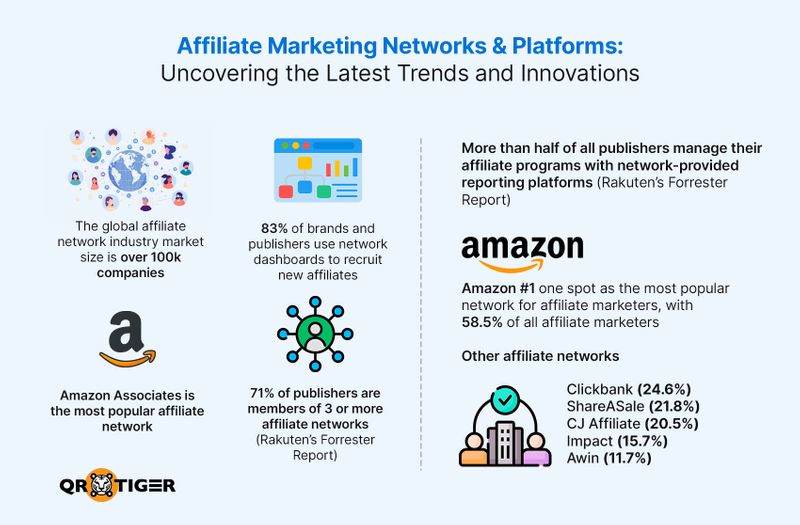
### Affiliate Platforms & Networks
Most brands don't run affiliate programs entirely alone – 83% of businesses use affiliate networks or SaaS platforms to manage recruitment and tracking (Rakuten/Forrester). These networks (like Amazon Associates, ShareASale, CJ, Impact, etc.) provide a ready pool of affiliates and tools. Amazon's affiliate program is by far the largest, with ~900,000 active affiliates and an estimated 58.5% of affiliate marketers participating. Other major networks each command smaller slices (e.g., ClickBank ~25%, ShareASale ~22%, CJ ~20%, Impact ~16%, Awin ~12%). Publishers also tend to multi-home: 71% of affiliate publishers belong to three or more networks, giving them access to a wide range of offers. For businesses, listing your program on popular networks or directories (like [FindAffiliates](https://www.findaffiliates.online/), an affiliate program directory) can substantially widen your reach to prospective partners.
### Traffic & Marketing Channels
SEO (Search Engine Optimization) remains the #1 traffic source for affiliates, with around 70–78% of affiliate marketers relying on organic search to drive visitors to their content. Ranking high on Google for product reviews or "best X" comparisons is incredibly valuable for affiliate conversions. Social media is the second-biggest channel – about 65-67% of affiliates use social platforms like Facebook, Instagram, or YouTube to engage audiences. Blogging (content marketing) closely follows, used by ~65% as well. Email marketing and paid advertising (PPC) are also in the mix but less common across the board. Mobile traffic is huge too: roughly 50% of affiliate-referred traffic now comes from mobile devices, so both affiliate content and merchant landing pages must be mobile-friendly for success.
### Technology & Automation
One of the biggest shifts in 2025 is the mainstream adoption of AI tools among affiliate marketers. Over 79% of affiliates report using AI-driven content creation tools – from AI writers that draft product descriptions to AI image generators for blog graphics – to increase productivity. Additionally, affiliates and program managers alike are using advanced tracking software, attribution tools, and analytics dashboards to optimize performance. The arms race for efficiency has even led to dedicated AI-powered affiliate platforms that help match influencers to products. Embracing these technologies (while still adding human creativity and insight) can give you a competitive edge.
## Conclusion
In summary, affiliate marketing in 2025 is bigger and more competitive than ever, yet full of opportunity. Both the data and real-world outcomes affirm its value. For example, when one online retailer overhauled its affiliate strategy with better partnerships and tracking, it saw an +85% surge in affiliate-driven orders, dramatically boosting sales. Brands are doubling down on affiliate partnerships, and creators are flocking to this income stream. To capitalize, you need to align with [the latest trends in affiliate marketing](/blogs/7-affiliate-marketing-trends-dominating-2025) and implement best practices whether you're promoting products or managing a program.
Affiliate marketing is booming in 2025, driven by exceptional ROI and expanding digital influence. By staying informed of industry trends, marketers and businesses can effectively leverage [affiliate programs](https://www.findaffiliates.online/) for sustainable growth. If you're running a business and looking to launch or optimize your affiliate program, be sure to check out our detailed guide on [Affiliate Program Best Practices for Businesses](/blogs/affiliate-program-best-practices-for-businesses-2025-guide). Content creators and affiliate marketers should explore our comprehensive [Winning Affiliate Strategies for Content Creators](/blogs/winning-affiliate-strategies-for-content-creators-2025) to learn proven tactics for maximizing your affiliate income in 2025.
---
## The Latest Affiliate Programs With Huge Earning Potential
*Published: 2024-03-11*
*URL: https://www.findaffiliates.online/blogs/latest-affiliate-programs-huge-earning-potential*
Are you looking to capitalize on the growing trend of affiliate marketing? This article delves into the latest affiliate programs that boast significant earning potential.

Choosing the right affiliate programs is essential for success in the ever-evolving world of affiliate marketing. This article provides an overview of ten affiliate programs that have high potential in 2024. Whether you're an experienced marketer or a beginner, this overview can help you identify programs that align with your interests and target audience. By understanding the offerings and strengths of each program, you can make informed decisions to maximize your earnings through affiliate marketing.
So let's begin listing the programs.
## [MuteDeck](https://mutedeck.com/?via=findaffiliates)
**Commission:** 15% per sale
**Description:** Make your virtual meetings easier with MuteDeck. You can manage multiple call apps without any hassle. You'll always be in control of your meetings, regardless of the platform.
## [Find Affiliates](https://findaffiliates.online)
**Commission:** 50% per sale
**Description:** Are you looking for an easy way to find affiliate programs to monetize your work and increase your earnings? "Find Affiliates" is the perfect platform for you. It offers a variety of affiliate programs to choose from, including the latest AI tools, SaaS, and creative products that your users will love. Say goodbye to boring options and enjoy browsing and comparing the best affiliate programs available.
## [SocialSense](https://www.socialsense.ai/)
**Commission:** 30% per sale
**Description:** SocialSense is not just another LinkedIn Content Creation Platform; it's way more than that! they've created a platform that allows you to generate content that's engaging and sounds like it's coming from you. They talked to over 100 professionals and influencers to make sure we build something that can help you create human-like content. Their platform has a number of key features that make this possible.
## [Niceboard](https://niceboard.co/?via=findaffiliates)
**Commission:** 50% per sale
**Description:** Niceboard is the plug-and-play job board platform that helps creators and communities start and run job boards effortlessly, no code required! Looking to start a job board and monetize your audience? Launch your own white label job board in under 10 minutes with Niceboard, and create a new automated revenue stream by connecting employers to talent.
## [Daito](https://www.daito.io/)
**Commission:** $80 per sale
**Description:** Daito is a 2FA authenticator that works through the web. It's perfect for startups, SMBs, and teams that prioritize security. With Daito, you can share access securely without needing a phone. It's fully web-based, which means you can use it from any browser without requiring an app. You're in control of access levels: you can choose to limit users to read-only access to 2FA tokens, or grant them access to the 2FA secret key. This feature is particularly useful for limiting access of freelancers and agencies.
---
## The Highest Paying Affiliate Programs Of 2024
*Published: 2024-03-11*
*URL: https://www.findaffiliates.online/blogs/highest-paying-affiliate-programs-2024*
Looking for lucrative affiliate programs to monetize your content? Look no further! Below is a curated list of top affiliate programs offering quick commissions and high conversion rates per sale.

So are you finding affiliate programs for your content, in this article, I will give you a list of the best affiliate programs out there, which you should check for quick commissions and high conversion rates per sale.
Let's start the list of the programs.
## [Find Affiliates](https://findaffiliates.online)
**Commission:** 50% per sale
**Description:** This platform is called "Find Affiliates" and is the quickest way to find affiliate programs for your work. It is considered the best option for this purpose. Here, you can browse and compare a variety of affiliate programs to efficiently monetize your work and increase your potential earnings. The latest AI tools, SaaS, and creative products that are popular among your users are available, so forget about boring stuff.
## [FileRev](https://filerev.com/?via=findaffiliates)
**Commission:** 30% per sale
**Description:** Filerev provides a free, comprehensive scan of your Google Drive files. This scan offers a fast, secure, and user-friendly way to organize your files directly in the cloud. It provides insightful details on how your storage is being used, identifies clutter in your account, and lets you organize and clean up your files in Google Drive.
## [Tella](https://tella.tv/?via=findaffiliates)
**Commission:** 30% per sale
**Description:** Tella is the screen recorder that enables you to create amazing demos, tutorials, and presentations in minutes without compromising on speed or creativity. Record your screen and/or camera in 2-clicks, Add multiple clips in the same video, Automatically save videos online.
## [Guapire](https://guapire.com/affiliates)
**Commission:** 30% per sale
**Description:** This NextJS boilerplate has all you need to build your SaaS, AI tool, or any other web app and make your first $ online fast. Supercharge your app instantly, launch faster, make $
## [WeConnect.chat](https://weconnect.chat/)
**Commission:** 20% per sale
**Description:** WeConnect.chat emerges as a cutting-edge conversational AI platform designed to turbocharge your business processes. With an advanced ChatGPT-Powered AI chatbot at its core, this platform redefines the way businesses handle lead generation, customer support, and employee onboarding.
## Contact
- Website: https://www.findaffiliates.online